When Should You Use Robotic Soldering?
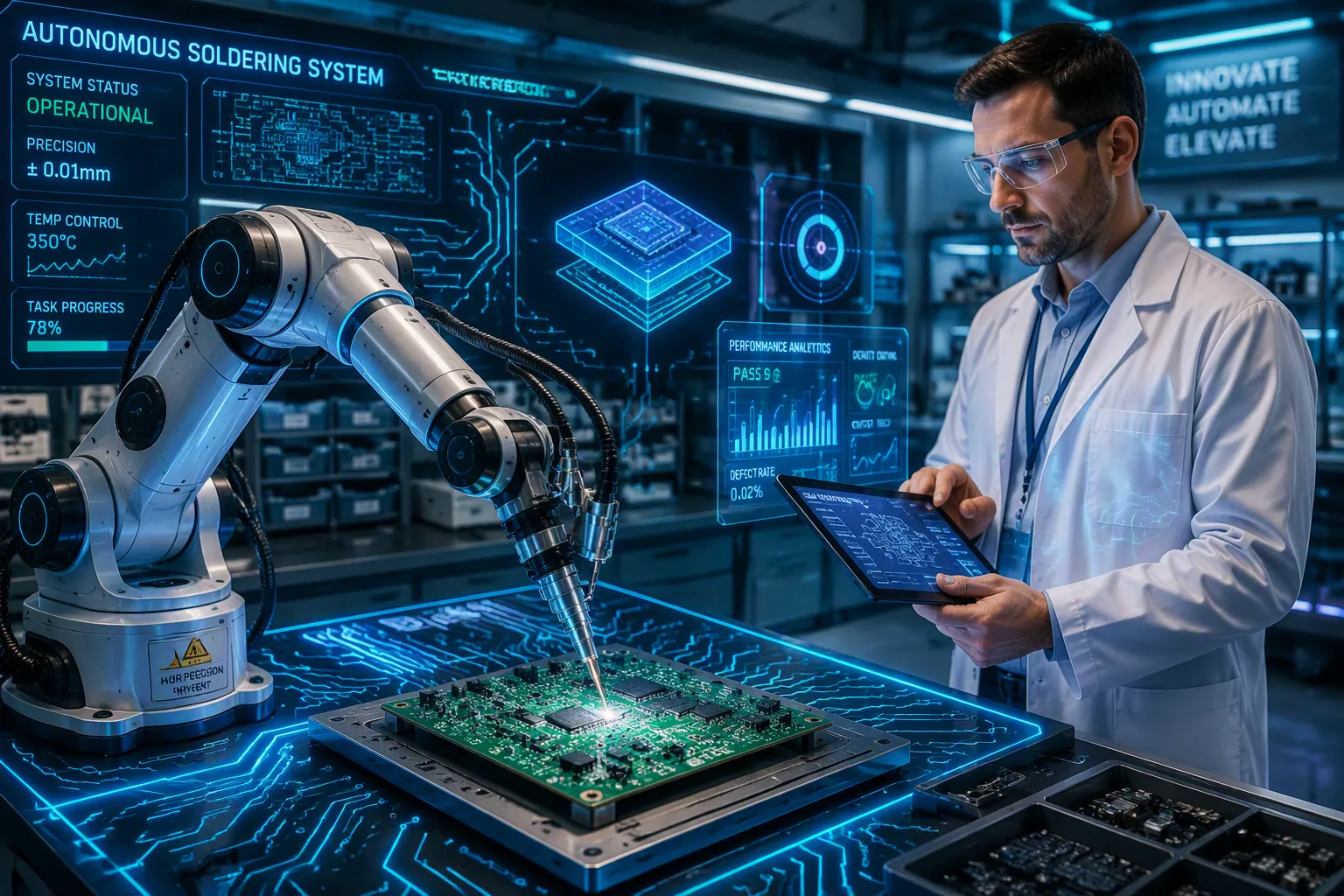
Robotic soldering does not fit every production line. You must weigh several factors before choosing automation. Market data shows the global robotic soldering market reaching USD 580 million in 2026, growing to USD 1,100 million by 2033. That 7% compound annual growth rate signals strong industry adoption. Yet the real question remains: when should you invest? High volume, precision demands, complex joints, and cost structures all influence your decision. Manual soldering still outperforms automation for certain tasks. This article breaks down each factor into a practical framework. You will learn exactly which production scenarios justify robotic systems and which ones do not.
Key Takeaways
Robotic soldering doubles production speed and removes operator fatigue.
It achieves precise placement for fine-pitch components down to 0.3 mm.
The robot reaches hard-to-access spaces and solders multiple sides in one setup.
Robotic soldering cuts defects from 5,000 to 200 per million parts.
The system pays back its cost in about 12 months for high-volume lines.
Manual soldering still works best for low volumes, prototypes, and repairs.
Your decision depends on volume, precision needs, and cost analysis.
Robotic Soldering for High-Volume Production
When your production line runs thousands of joints daily, manual soldering creates a bottleneck. Human hands fatigue. Speed varies between operators. Quality fluctuates across shifts. Robotic soldering removes these variables entirely. You gain predictable output that scales with demand.
When throughput demands exceed manual capacity
Manual soldering has a physical ceiling. An operator sustains focus for limited hours. Each joint requires steady hands and precise timing. Production targets beyond that ceiling demand automation. Consumer electronics manufacturers face this reality daily. They assemble circuit boards with hundreds of components. Automotive plants face the same pressure. They produce control units and sensors in massive quantities. These industries rely on robotic soldering to meet delivery schedules.
The numbers show a clear advantage. A case study comparing manual and robotic methods recorded 17 seconds per joint for manual work. The robotic system completed the same joint in 9 seconds. That translates to roughly 50% faster cycle times. Your production capacity nearly doubles without adding staff. The robot works continuously. It does not take breaks. It does not slow down near the end of a shift. This consistency matters when customers demand tight delivery windows.
Consistent cycle times and reduced operator fatigue
Manual soldering quality depends on the person holding the iron. Fatigue sets in after hours of repetitive work. Hands tremble. Attention wanders. Joint quality suffers. A soldering robot eliminates this human factor entirely. Every joint receives the same heat application. Every solder point gets identical dwell time. The process repeats exactly the same way, every cycle.
This consistency directly impacts your yield rates. Fewer defective joints mean less rework. Less rework means lower costs. Your quality control team spends less time inspecting marginal connections. The robot also protects your workforce. Operators move to less physically demanding roles. They monitor machines instead of performing repetitive motions. This reduces workplace injuries and keeps experienced staff engaged.
Scaling production with robotic soldering
Robotic systems scale with your business. You start with one soldering robot on a single line. You measure the results. You add more units as orders grow. Each robot delivers the same performance as the first. You do not need to recruit and train additional soldering specialists. The system maintains its precision regardless of production volume.
Different industries benefit in specific ways. The table below summarizes these advantages.
Industry | Key Benefit for High-Volume Production |
|---|---|
Automotive | Reliable solder joints for safety-critical electronics (control units, sensors, power electronics) |
Electronics Manufacturing (EMS) | Efficient high-volume production with consistent quality and optimized cycle times |
Medical Technology | High-precision, fully controlled processes for sensitive and regulated applications |
Industrial Electronics | Robust assemblies for demanding environments and long-term reliability |
Each sector demands a highly efficient approach to assembly. Robotic soldering delivers that efficiency. The robot handles the repetitive work. Your team focuses on process improvement and problem-solving. This division of labor creates a stronger production operation. You build capacity without compromising quality. You meet growing demand without expanding your workforce proportionally. That is the real value of automation in modern electronics manufacturing.
Precision and Repeatability with Robotic Soldering
Some assemblies demand a level of accuracy that human hands cannot deliver consistently. Medical devices and aerospace systems fall into this category. A single defective joint can compromise an implantable device or an avionics control module. Robotic soldering delivers the precision these industries require.
Achieving tight tolerances and fine pitch components
Modern electronics pack more functionality into smaller spaces. Components sit closer together. Pads shrink. Pitch distances narrow. Manual soldering struggles with these geometries. A human operator cannot maintain steady positioning at extremely fine pitches. A robotic system can.
Consider the numbers. A robotic soldering system reliably handles a minimum pitch of 0.3 mm. It achieves placement accuracy of ±30 μm. That accuracy enables stable soldering at that fine pitch. The stencil dimensional accuracy reaches ±0.01 mm. Placement repeatability holds at ±15 μm. These figures exceed what manual methods can achieve consistently.
Medical device manufacturers depend on this capability. They assemble pressure sensors, medical pumps, and implantable electronics. These products must meet stringent FDA requirements. Manual soldering cannot reach the precision levels those regulations demand. Aerospace and defense contractors face similar pressure. They build mission-critical electronic systems, avionics, and communication devices. Each joint must meet exceptional precision and consistency standards. The traceability of robotic systems also matters. You can track every product through each production stage, supporting verification and quality control.
Eliminating human error in repetitive tasks
Human error creeps into manual soldering in predictable ways. An operator's hand drifts after hours of work. Attention wanders during monotonous tasks. The iron tip angle changes slightly between joints. Each variation introduces risk. A soldering robot removes these variables.
The robot applies the same heat, the same pressure, and the same dwell time to every joint. It does not tire. It does not lose focus. It does not rush near the end of a shift. This consistency directly improves your yield rates. Fewer defective joints mean less rework and lower scrap costs. Your quality team spends less time inspecting marginal connections.
The system also automates maintenance tasks that would otherwise introduce variability. A brush cleaner removes carbides and tin oxides from the tip automatically. This ensures optimal thermal conductivity for every joint. A tip position corrector adjusts for slippage caused by thermal expansion or burnout. You do not need manual recalibration. A fiducial correction system uses vision to compensate for board or component placement variations. These features work together to eliminate the common sources of human-induced defects.
Controlled and repeatable process
Long production runs test any soldering method. Manual processes drift over time. Operators change. Techniques vary. A robotic system maintains its performance indefinitely. The specifications demonstrate this capability.
Feature | Specification |
|---|---|
Repeatability | ±0.01 mm (XY & Z axes) / ±0.008° (R axis) |
Memory Capacity | Up to 999 programs and 32,000 points |
Temperature Range | Adjustable from 200°C to 450°C |
Heater Output | High-power 250 W heater |
Max Speed | Up to 500 mm/s (XY axes) / 900°/s (R axis) |
The repeatability of ±0.01 mm means the robot returns to the exact same position every cycle. The memory capacity lets you store hundreds of programs. You switch between products without reprogramming. The temperature range covers most soldering applications. The high-power heater maintains stable temperatures even during continuous operation.
A twin-table gantry configuration further enhances this process. Two separate work areas operate independently or simultaneously. You load new materials on one table while the robot solders on the other. This eliminates downtime between cycles. The soldering process runs without interruption. You maintain consistent throughput and repeatability over extended runs. The robot delivers the same quality on joint number one and joint number ten thousand.
Robotic Soldering for Complex Joints
Some joints simply defeat manual methods. You cannot reach them with a standard iron. You cannot hold the angle steady. You cannot apply consistent heat in a confined space. Robotic soldering solves these problems with specialized hardware designed for difficult geometries.
Accessing confined spaces with robotic arms
Standard soldering irons require straight-line access. Complex assemblies block that access. A 6-axis robot changes the game. It moves in multiple directions and changes its head angle freely. You can reach irregularly shaped workspaces and hard-to-reach angles. The UNIX-VFR series exemplifies this capability. It performs point soldering in spaces your hand cannot enter.
SCARA robots offer a different advantage. The UNIX-HFR series moves in high-speed circular motion at 7,128 mm/sec. It delivers high repeatability for planar soldering. You choose between these robot types based on your geometry. The table below compares them.
Robot Type | Key Capability | Best Suited For |
|---|---|---|
6-Axis (e.g., UNIX-VFR) | Multi-directional movement; can change head angle freely | Irregularly shaped works and hard-to-reach angles (point soldering) |
SCARA (e.g., UNIX-HFR) | High-speed circular motion (7,128 mm/sec) with high repeatability | High-speed, precise planar soldering and linear soldering in mass production |
Custom robots extend this flexibility further. Manufacturers tailor them to specific client requirements. They often include vision systems or multi-axis arms. Hot bar soldering robots combine heat and pressure with accurate motion control. They handle complex paths, larger components, and irregular parts in electronics, automotive, and aerospace fields.
Soldering multiple sides or angles in one setup
Traditional soldering requires you to reposition the workpiece for each side. That repositioning wastes time and introduces alignment errors. The Fancort UNIX-DF series eliminates this problem. It carries two additional axes beyond the standard X, Y, and Z axes. These extra axes facilitate penetration angles or rotate the PCB. You access multiple sides of a component in a single setup. You never manually reposition the workpiece. Complex PCB and component soldering becomes straightforward.
Ideal for through-hole, wires, and connectors
Through-hole joints, wire connections, and connectors present unique challenges. High conductor counts complicate the process. Unique solder alloys demand precise temperature control. Robotic soldering handles these variables consistently. A soldering robot applies the same amount of solder and the correct heat every cycle. You eliminate hand-assembly inconsistencies completely.
The cost benefits matter too. Automation reduces material waste compared to hand soldering. You also solve a labor market problem. Skilled hand solder operators have become exceedingly difficult to hire over the past 3–5 years. Robotic soldering offers a more reliable workforce solution.
Advanced wire feeders improve joint quality further. They use built-in roulette cutting blades to perforate the soldered wire. This exposes the flux core before the wire reaches the hot iron tip.
Advanced wire feeders with built-in roulette cutting blades perforate the soldered wire to expose the flux core. This prevents solder balls formed when molten flux bursts free of the wire as it touches the hot iron tip. By piercing the wire prior to reaching the tip, the flux outgases before the solder melts, preventing solder splatter that could damage electrical components. This also provides consistent flux coverage, allowing the solder to melt on a clean, active surface.
Pre-tinning the iron tip before each cycle maintains thermal transfer. The robot performs this step automatically. High-mass joints present another challenge. The MPS700 inline robotic soldering iron addresses this directly. Traditional selective mini-wave soldering requires prolonged exposure to molten solder. That exposure causes copper dissolution. The copper layers thin dangerously. The robotic iron preheats the joint via the tip and only adds solder wire. This eliminates copper dissolution entirely. You get a reliable solder joint where wave soldering fails.
Key Considerations When Selecting a Robotic Soldering System
Selecting a robotic system requires careful evaluation of several factors. You must consider temperature control, programming requirements, and how different methods compare for your specific applications.
Temperature control and flux management
Precise temperature control determines joint quality. The system features a 250W heating element with a temperature sensor for precise temperature control and efficient heat transfer to the joint.
Flux management plays an equally important role. A dedicated flux dispensing system precisely applies flux onto the PCB before the soldering process begins. This chemical cleaning agent removes oxidation and prepares metal surfaces for a stronger solder bond. The soldering robot maintains this process automatically, eliminating the inconsistency of manual application.
Tip maintenance also affects your results. Programmable tip cleaning removes carbides and tin oxides automatically. This ensures optimal thermal conductivity for every joint without operator intervention.
Programming and setup complexity
Your staff must understand robotics and automation to implement these systems effectively. This knowledge gap presents a real challenge. You may need to invest in training or hire new talent.
However, the newest high-end robots reduce this burden significantly. They use code-free frameworks that simplify programming. Camera-assisted programming allows operators to set up joints visually. You define points on screen rather than writing complex code.
Board size also affects setup complexity. The system must accommodate your current and future board dimensions. Dual-drawer designs handle large boards or enable continuous operation with smaller ones. You load materials on one drawer while the robot works on the other. This keeps your automated system running at full capacity.
Safety features matter too. Drawer loading, ESD-safe enclosures, and integrated fume extraction protect your operators. You should evaluate these features before making your final selection.
Comparing automated soldering methods for your application
Different automated soldering methods suit different applications. The iron-tip approach and the other approach represent two common options.
The iron-tip method uses a metal tip to supply heat. It requires a pre-tinning step for proper reflow. This involves preheating to pre-tin the tip, then feeding the main wire. The other approach works differently. A laser provides the heat directly to the joint area. No pre-tinning is needed because the laser preheats the joint area directly. The difference between robotic soldering and laser soldering lies mainly in heat source and pre-treatment requirements.
Laser methods excel for heat-sensitive components because they apply heat only to the target area. The iron-tip approach works well for point-to-point tasks and drag tasks. Both methods offer automation benefits.
System integration also influences your decision. The inline gantry cell runs at line speed with zero manual intervention. The equipment must match your line's throughput and automation level. A modular design allows for easy integration into existing machinery. Evaluate how each method fits into your current setup before committing to a system.
Cost-Effectiveness of Robotic Soldering
Initial investment vs. long-term labor savings
You face a significant upfront cost when you invest in a robotic soldering system. The cost includes the integrated cell and first-year operating expenses such as maintenance, utilities, and programming support. Your labor costs drop substantially in return. A soldering robot reduces manual labor hours, allowing you to redeploy operators to higher-value tasks. The savings compound over time as your production volume grows.
The payback period depends on the specific case, but it comes from a combination of direct labor reduction and indirect savings. Your biggest gains come from better consistency, lower rework, and stronger output predictability. The robot works continuously without breaks or overtime pay. You spread the capital cost across every joint the system produces. Higher volumes drive the per-joint cost down further.
Reducing rework and scrap rates
Manual soldering produces defects at a rate that is significantly higher than robotic soldering. A robotic system cuts the defect rate to a much lower range, improving first-pass yield dramatically. These improvements translate directly into cost savings. You spend less time inspecting joints. You discard fewer boards. You perform less rework.
The cost of rework extends beyond the soldering station. It ties up inspection equipment. It consumes operator hours that could go toward production. It delays shipment schedules. A robot eliminates most of this waste. Every joint meets the same standard. You do not need to check each connection for marginal quality. The process itself ensures the result. Fewer defective joints mean fewer replacement components. Your material costs drop right alongside your labor costs.
Calculating payback period for different volumes
Your production volume determines how quickly you recover the investment. You should model three scenarios to get a realistic picture.
Scenario | Annual Savings | Payback Period |
|---|---|---|
Conservative | — | — |
Expected | — | — |
Optimistic | — | — |
The core formula stays simple. Annual benefit equals current annual insertion cost minus projected annual automated insertion cost. Current costs include manual labor, rework, scrap, overtime, supervision, and lost-output effects. Projected costs include operator oversight, feeder preparation, maintenance, utilities, tooling, programming support, and remaining manual work. Payback period equals total project investment divided by annual benefit.
You also need to test sensitivity. Run the numbers under different labor cost assumptions. Test volume drops. Factor in changeover times. The payback period varies significantly with utilization. A two-shift robot pays back faster than a single-shift robot. Local wage rates, product mix, and integration complexity affect the result more than the sticker price alone.
For unstable production environments, automation carries risk. Rapidly changing product designs or unstable fixtures delay payback. Low-volume work with frequent changeovers may still be better handled manually. But for repetitive, high-volume jobs, the numbers clearly favor the automated approach.
When Should You Use Manual Soldering?
Low-volume and prototype runs
Manual soldering suits small production runs well. You avoid the programming and tooling investment for a handful of boards. Engineers make last-minute changes without reprogramming a machine. This flexibility matters during prototype development. You test new circuit designs quickly. You adjust layouts on the fly. You skip the setup time of automated lines. The trade-off is clear. You give up raw throughput for flexibility.
Bulky or unusual components work better by hand. Large transformers, heat-sinked parts, and oversized connectors do not fit automated systems. Your operator adapts to each unique part. You do not need special fixtures or feeders. This hands-on control lets you address fine-pitch components without full line reconfiguration. For low-volume runs, the low upfront cost of manual work beats automation. You get quick turnaround without expensive equipment. Each prototype iteration costs less than reprogramming a soldering robot.
High-mix, low-volume production with frequent changeovers
When your production line changes products often, manual soldering wins. Each changeover on a robotic system requires reprogramming. You waste time setting up new fixtures. You lose production hours. Manual stations switch between products in minutes. Your operator grabs a different iron tip. The change costs nothing in downtime.
This scenario applies to contract manufacturers. They build different boards for different customers. One day you solder a simple power supply. The next day you work on a complex microcontroller board. Manual soldering adapts instantly. You do not schedule changeovers. You do not store multiple program files. The operator handles each product as it arrives. This flexibility keeps your line moving. You avoid the overhead of managing multiple automated soldering methods for each product variation.
Repairs, rework, and specialized soldering tasks
Some tasks defeat automation entirely. Electronics repair falls into this category. Re-soldering components on circuit boards, smartphones, and computers requires human judgment. Each damaged board presents unique problems. A soldering robot cannot assess the damage. It cannot decide where to apply heat. It cannot remove a lifted pad. Only a skilled operator handles these repairs.
Custom cable assembly stays manual. Creating specialized connectors and audio cables involves delicate work. You handle thin wires. You manage heat shrink tubing. You test connections by feel. Automated systems struggle with these variations. The aerospace and defense sectors face similar challenges. They assemble avionics and military communication devices in small quantities. Each unit requires specific attention.
Medical device repair follows the same pattern. Monitors and diagnostic equipment need careful handling. You cannot risk damaging expensive components. Research and development teams also rely on manual soldering. They build experimental electronics. They test new designs. They change components constantly.
Cable soldering in electric motor production remains manual for a specific reason. Conventional 3D sensors produce noisy depth data on thin, reflective copper cables and solder pads. Precise pose estimation becomes unreliable. Traditional waypoint-based robots cannot adapt to the subtle variations. These tasks have stayed largely manual. When you face these challenges, manual methods outperform automated soldering methods. Knowing when should you choose manual over robotic helps you make the right investment decision.
You now have a clear framework for deciding when to automate. High volume, tight precision, and complex joints point toward robotic systems. Low volume, high-mix runs, and repair work still favor manual methods. Before you invest, evaluate the five selection factors: temperature control, flux management, programming complexity, repeatability, and integration. These criteria determine whether a system fits your line. The role of automation in electronics manufacturing continues to grow. Ask yourself: when should you adopt robotic tools? The answer depends on your numbers and your application. When should you choose robotic soldering? Only when the data supports a clear return. Automation is a powerful tool, but it is not a universal answer for every joint.
FAQ
What is the minimum pitch a robotic soldering system can handle?
A robotic system reliably handles a minimum pitch of 0.3 mm. It achieves placement accuracy of ±30 μm and repeatability of ±0.01 mm. This precision exceeds what manual methods can deliver for fine-pitch components.
How does robotic soldering compare to laser soldering?
Laser soldering uses a laser as the heat source and does not require pre-tinning. It applies heat directly to the soldering point. This makes it ideal for heat-sensitive components. The iron-tip method works well for point-to-point tasks.
What are the benefits of laser soldering for heat-sensitive components?
Laser soldering applies heat only to the target area. It does not preheat the surrounding board. This protects sensitive components from thermal damage. It excels when you cannot risk heating nearby parts.
When should I choose laser soldering over iron-tip soldering?
Choose laser soldering when you work with heat-sensitive components. The laser heats only the joint area directly. No pre-tinning is needed. The iron-tip approach suits point-to-point tasks and drag soldering for standard components.
What is the payback period for a robotic soldering system?
The payback period for a robotic soldering system varies with production volume, shift count, and local wage rates. It depends on the specific application and cost savings.
When should I still use manual soldering?
Manual works best for low-volume runs, prototype development, and repair work. High-mix production with frequent changeovers also favors manual methods. Automated systems require programming and setup time.
What factors affect the cost of a robotic soldering system?
The cost of a robotic soldering system includes the integrated cell and first-year operating expenses. Labor savings offset these costs. Higher production volumes accelerate the payback period.
How does robotic soldering handle complex joints?
A 6-axis robot reaches confined spaces and solders multiple sides in one setup. SCARA robots handle high-speed planar soldering. The system handles through-hole joints, wires, and connectors without manual repositioning.
See Also
Essential Criteria For Reflow Soldering In SMT Manufacturing
Why Nitrogen Reflow Soldering Matters For Automotive And PCBA
Practical Approach To Double-Sided Reflow Soldering In PCBA
