What Is Robotic Soldering?
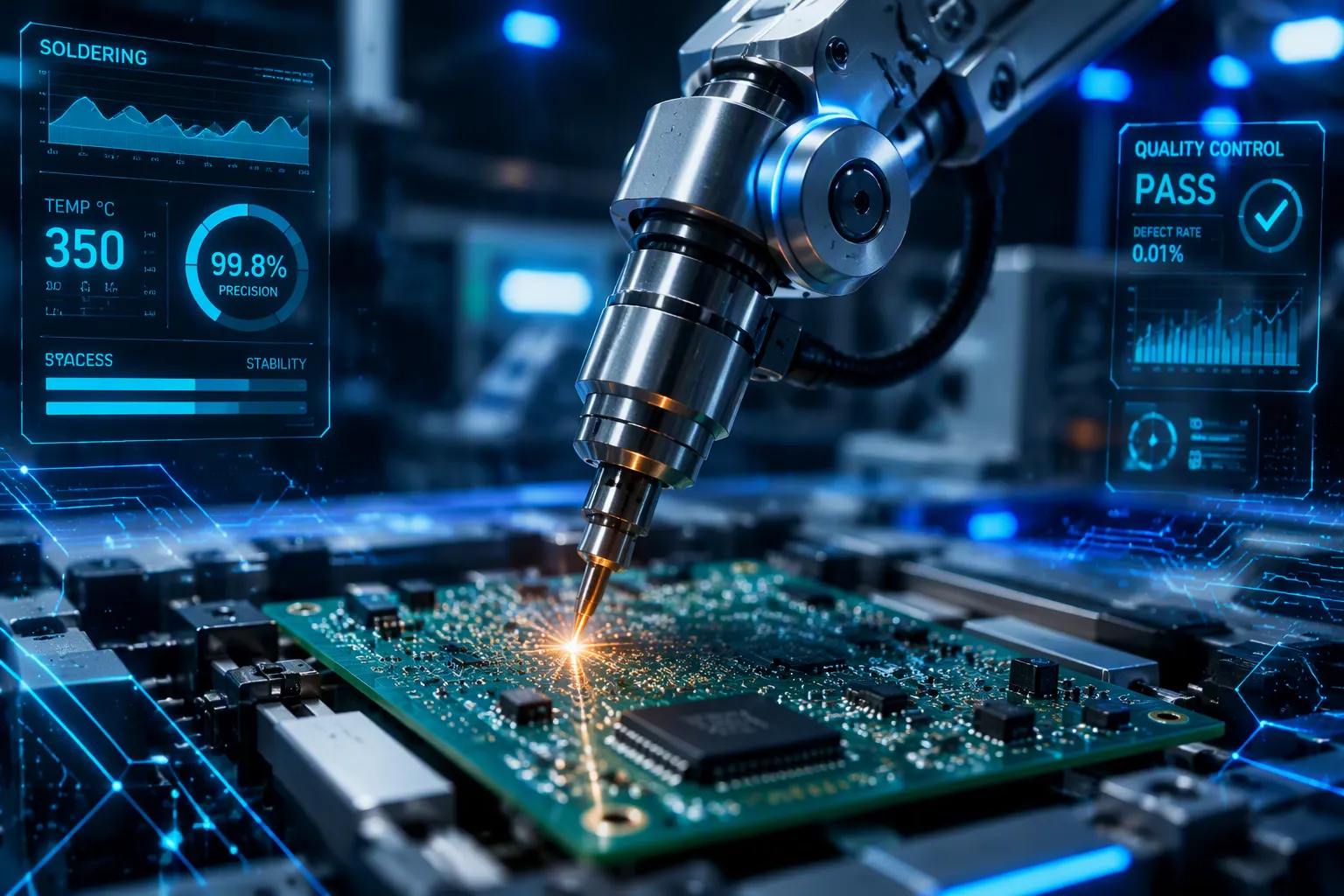
Robotic soldering replaces manual hand-soldering with programmable machines that execute precise, repeatable joints. You shift from human dexterity to machine precision, which transforms PCB assembly. This technology is becoming a powerful tool as electronics grow more complex.
Metric | Value |
|---|---|
Global soldering robot market (2026) | USD 580 Mn |
Global soldering robot market (2033) | USD 1,100 Mn |
Compound annual growth rate | 7% |
PCB assembly segment share (2026) | 25.0% |
The PCB assembly segment's 25.0% market share reflects demand for high-density devices requiring accurate, repeatable soldering. Robots deliver consistent joints, lower defects, and high throughput for multilayer boards.
Is robotic soldering the right investment for your production line? You must weigh cost, volume, complexity, and quality to decide.
Key Takeaways
Robotic soldering uses programmable machines for precise, repeatable joints, reducing defects and improving quality.
It excels in high-volume production, offering consistent quality and lower per-unit costs.
Robots handle complex tasks with precision, meeting strict standards like IPC Class 3.
Automation reduces waste and rework, saving materials and labor.
Initial investment is high, but payback can occur in 9-16 months for mid-volume lines.
Robotic systems offer scalability and easy reprogramming for future product changes.
Consider your production volume, labor costs, and growth plans before adopting robotic soldering.
How Robotic Soldering Works
Robotic soldering replaces manual skill with machine precision. You program a path, and the robot follows it exactly. Each joint receives the same temperature and the same dwell time. The robot does not get tired. It does not shake. Manual work depends on operator feel. This method depends on your software settings. This shift makes the process repeatable and predictable. You can run the same program thousands of times and get the same result.
Core Principles of Automated Soldering
Programmed Motion and Thermal Control
You control two things in an automated system: the iron position and the heat. The robot moves along a programmed path. It stops at each joint for a set dwell time. Longer dwell times can damage heat-sensitive components. Shorter dwell times help you maintain quality. It also manages recovery time. Recovery time is the time needed to bring the iron back to its setpoint after heat loss. A short recovery time keeps the tip temperature steady. This ensures uniform quality across all joints.
For consistent results, set the iron to the lowest temperature that forms a proper joint quickly. For hand work, start around 315°C for leaded solder or 330°C for lead-free. Many professionals rarely go above 350°C. A higher temperature allows a shorter contact time. A lower temperature requires a longer hold. An iron set too cold can overheat components. You end up dwelling much longer trying to melt the solder. Heat conducts into the component the whole time. This principle applies to all mass soldering techniques. You balance temperature and time to achieve the best joint.
Solder Feeding Mechanisms
It feeds solder wire automatically. A feeder pushes the wire through a guide tube. The wire reaches the joint at the right moment. You control the feed speed and the amount of wire. The Weller WTBR1000, for example, feeds wire at 2 to 32 mm per second. It accepts wire diameters from 0.5 to 1.5 mm. This automated feeding ensures each joint gets the same amount of solder. No waste. No variation. This is a core advantage of this mass soldering technique. You can set the exact amount needed for each joint type.
Types of Robots Used
Articulated Arm Robots
An articulated arm robot has joints like a human arm. It rotates at the shoulder, elbow, and wrist. This design gives you flexibility. You can reach around obstacles and solder at odd angles. These robots work well for complex assemblies. They handle parts that require access from different directions. The Hakko HU-200 achieves ±0.01 mm repeatability. The I.C.T SR530 achieves ±0.02 mm repeatability. These soldering robots maintain tight tolerances joint after joint. You can trust them for high-precision work.
Cartesian and SCARA Robots
Cartesian robots move along straight axes. They travel in X, Y, and Z directions. They are simple and rigid. SCARA robots have a different design. They move in a horizontal plane with a vertical arm. Both types work well for PCB soldering tasks. They handle through-hole components and surface-mount parts. One inline contact system soldered through-hole components in 30 seconds per cycle. It met IPC Class 2 requirements. Another inline laser system achieved a 35-second cycle time. It met the stricter IPC Class 3 requirements. This robotic approach gives you speed and precision for high-volume production. You can choose based on your space and speed needs.
Popular Tools and Systems
Benchtop Solder Robots (e.g., Weller WTBR1000)
A benchtop soldering robot fits on a workbench. The Weller WTBR1000 is a good example. It operates on 100-120V at 50-60 Hz. Its dimensions are 1100 x 900 x 950 mm. It weighs 205 kg. It has an accuracy of 20 µm. It moves at a maximum speed of 200 mm per second. The system includes a fume extractor, the Weller LL150. It is ESD-safe. The standard tool is the WT 1H with HER 120 tip. These systems handle benchtop tasks with precision and reliability. You get a complete solution in one package.
Dual-Working-Area Systems (e.g., SR250D)
Dual-working-area systems offer two separate drawers. Each drawer provides a working area of 200 x 220 x 100 mm. The total working area is 400 x 220 x 100 mm. You load one drawer while the robot works on the other. This setup saves 21 to 35 percent of working time. You eliminate the idle time between cycles. These robots keep working while you prepare the next board. This efficiency gain makes a big difference in high-volume production. You get more output from the same machine.
Key Benefits of Robotic Soldering
Unmatched Precision and Repeatability
Robotic soldering delivers consistent joint quality that manual work cannot match. A human operator experiences fatigue, distraction, and natural hand tremor. These factors create variation between joints. A soldering robot eliminates these variables entirely. You program the path once, and the machine follows it exactly every time. Each joint receives identical temperature, pressure, and dwell time.
The precision of modern systems is remarkable. The TR300 table-top robot, for example, specifies positioning repeatability of ±20 μm. That measurement means the robot returns to the same position within 20 micrometers, every cycle. For context, a human hair measures roughly 70 micrometers wide. This level of accuracy ensures you can solder fine-pitch components without bridging or misalignment. You achieve the same result on joint number one and joint number ten thousand.
This repeatability directly improves your quality metrics. You reduce rework because defects appear less frequently. You also gain confidence in your process. When you know each joint meets the same standard, you can trust your product's reliability. This consistency matters most for high-density PCB assemblies where a single poor joint can compromise the entire board.
Increased Throughput and Efficiency
Automation speeds up production cycles significantly. A robot works continuously without breaks, without rest periods, and without shift changes. You can run production lines around the clock. This capability directly helps you increase productivity. The machine maintains the same speed at hour one and hour eight.
Dual-working-area systems amplify this advantage further. You load one drawer while the robot solders in the other. This parallel operation eliminates idle time between cycles. The system saves 21 to 35 percent of working time compared to single-head alternatives. You produce more boards from the same machine footprint. This efficiency gain translates directly to lower cost per unit.
The speed advantage becomes most apparent in high-volume runs. A robot completes each joint in a consistent, optimized cycle time. You can calculate your throughput precisely because the machine never slows down. This predictability helps you plan production schedules and meet customer deadlines with confidence.
Reduced Defect Rates and Waste
Robotic soldering reduces defects through precise control of every process parameter. You control solder feed rate, iron temperature, and dwell time with exact settings. This control eliminates common manual errors like cold joints, bridges, and insufficient wetting. The automated solder feeder dispenses the exact amount needed for each joint. No excess solder, no shortage, no waste.
Process optimization also addresses specific quality issues. Spattering occurs when solder overheats or flux contaminates the tip. A robot maintains consistent temperature, preventing this problem. Poor solder spread often results from insufficient heat or incorrect tip angle. The robot's programmed motion ensures proper contact every time. These improvements raise your yield rate and reduce material consumption.
Lower defect rates mean less rework and fewer scrapped boards. You save on solder material, flux, and replacement components. You also save labor hours that would otherwise go to inspection and repair. This mass soldering technique offers a clear path to higher quality at lower cost. When you combine reduced waste with increased throughput, the financial case for automation becomes compelling. This mass soldering technique transforms your production economics.
Common Applications in Industry
Robotic soldering serves many industries that demand consistent, high-quality joints. You find these systems in electronics, automotive, aerospace, and medical manufacturing. Each sector uses the technology differently, but the core value stays the same: repeatable precision that manual work cannot match.
Electronics Manufacturing and PCB Assembly
PCB assembly represents the largest application area for robotic soldering. You use these systems for tasks like soldering coaxial cables to FPC antennas, where precision is critical. A soldering robot handles fine-pitch components and dense board layouts with ease. The machine applies the exact amount of solder to each pad, preventing bridges and cold joints.
Industry | Common Soldering Application |
|---|---|
PCB Assembly | Electronics assembly (e.g., PCB soldering) |
Automotive | Automotive electronics |
Aerospace | Aerospace components |
Medical Device | Medical devices |
You also benefit from the speed of automation in high-volume electronics production. A robot works continuously without fatigue, maintaining the same quality from the first board to the thousandth. This consistency matters when you produce consumer electronics, communication devices, or industrial control systems. The technology adapts to different board designs through simple reprogramming.
Automotive and Aerospace Components
Automotive and aerospace manufacturers rely on robotic soldering for through-hole and surface-mount components. These industries demand high reliability because failures can lead to safety incidents. You must meet strict standards like IPC J-STD-001 and IPC Class 3. These standards define materials, processes, and workmanship criteria for reliable solder joints.
Standard | Industry | Key Requirement | How Robotic Soldering Helps |
|---|---|---|---|
IPC J-STD-001 | Aerospace, Automotive | Defines materials, processes, and workmanship criteria for reliable solder joints | Programmable thermal profiles, closed-loop control, reduced operator variability, and process traceability ensure consistent compliance |
IPC Class 3 | Aerospace, Automotive (high-reliability) | Highest reliability; failure unacceptable due to mission-critical or safety-critical operations | Robotic soldering provides process repeatability, consistency, and defect reduction to meet stringent Class 3 criteria |
Robots excel in these environments because they eliminate operator variability. You program the thermal profile once, and the machine repeats it exactly. This repeatability helps you meet Class 3 requirements consistently. The process also generates traceability data, which supports quality audits and compliance documentation. You can prove that each joint met the required standard.
Medical Devices and Sensors
Medical device manufacturing demands the highest levels of quality control. You must comply with regulations like ISO 13485, FDA 21 CFR Part 820, and EU MDR. These regulations emphasize documented processes and evidence of controlled manufacturing operations. Robotic soldering supports these requirements through objective, repeatable measurement data.
Special processes demand strict controls because failures can compromise medical devices and patient safety. ISO 13485 mandates that manufacturers validate these processes to ensure patient safety and regulatory compliance. Soldering is classified as a special process where the result cannot be fully verified by subsequent inspection, requiring rigorous validation protocols (IQ, OQ, PQ) to ensure consistent quality and traceability.
You gain several advantages with robotic systems in medical production. Component-level UID traceability captures lot and date codes for all incoming parts. Closed-loop inspection data binds solder paste inspection, component placement results, and X-Ray quality testing to each board serial number. Audit-ready documentation stores all production logs and corrective actions centrally. These capabilities strengthen your compliance position during regulatory inspections.
The repeatability of robots also ensures consistent quality across production batches. You produce sensors, diagnostic devices, and implantable electronics with confidence. Each joint meets the same standard, reducing the risk of field failures. This reliability protects patients and your reputation.
Robotic Soldering vs. Manual: A Direct Comparison
You face a fundamental choice between manual and robotic soldering. Each method serves different production realities. Manual work offers unmatched flexibility for one-off prototypes and intricate repairs. A skilled operator adapts instantly to unexpected board variations. Robotic soldering excels in repetitive, high-volume operations where consistency matters more than adaptability. The right choice depends on your product mix, your labor market, and your quality requirements.
Cost Per Joint Analysis
The cost equation shifts dramatically with volume. Manual soldering requires no capital investment upfront. You pay only for labor, solder, and hand tools. However, labor costs accumulate with every joint. Operator fatigue slows production over time. Defects require rework, which adds hidden costs. For low volumes, manual work often wins on pure economics.
Robotic soldering demands a significant initial investment. You purchase the robot hardware, programming software, tooling, and integration services. This upfront cost spreads across thousands of joints. As volume increases, the per-joint cost of automation drops steadily. A soldering robot works continuously without breaks or shift changes. It never tires, never slows, and never asks for overtime. The machine also reduces material waste through precise solder application. You use exactly the amount needed for each joint. No excess, no shortage.
Aspect | Manual Soldering | Robotic Soldering |
|---|---|---|
Setup overhead in high-mix | Disproportionate time on setup and inspection; every board changeover costs time | Quick-changeover programming cuts per-board overhead; same cell handles multiple product lines |
Process consistency | Variability per product type; dependent on technician availability | Locked recipe; process unchanged by shift changes or staff absence |
Economic sustainability | Deteriorates as batch sizes shrink; overhead per joint rises | Economically viable for low-volume, high-mix due to reduced setup penalty |
The break-even point depends on your specific production numbers. You must calculate your current defect rate, labor costs, and throughput. Many manufacturers find automation pays off when they produce consistent board designs in substantial quantities.
Flexibility and Job Complexity
Manual soldering shines when you face complex, irregular tasks. A skilled operator reaches awkward angles and adapts to component variations. This flexibility proves valuable for prototype work and small batches. You cannot easily program a robot for a board you will only build once.
Robotic systems handle high-mix production more efficiently than you might expect. Standardized pallet designs with quick-release fixtures enable sub-10-minute changeovers between jobs. Pre-programmed nozzle recipes and flux patterns stored in software cut programming time from hours to minutes via drag-and-drop interfaces. You switch between product lines without lengthy retooling. Dual-lane systems process two boards simultaneously, doubling throughput without added footprint. This efficiency makes robots viable even for smaller batch sizes.
The robot handles complex joints with programmed precision. It reaches the same angle every time, applies the same pressure, and maintains the same dwell time. This consistency proves difficult for human operators, especially during long shifts. For boards with fine-pitch components or dense layouts, robotic soldering often produces better results than manual work.
Quality Control and Traceability
Quality control represents the clearest advantage of robotic soldering. A robot follows its programmed recipe exactly. It maintains closed-loop temperature regulation and real-time nitrogen flow monitoring. These systems sustain yields above 98% in high-mix runs. Cross-section analysis confirms hole fill exceeds 75%. You achieve this consistency shift after shift, without variation.
Traceability transforms your quality management. The Soldering Manager Software automatically collects and stores process data for every joint:
Heater temperature – real-time monitoring of soldering iron temperature
Solder feed amount – tracking of solder consumption per cycle
Operation cycles – total cycle counts and tip usage
PCB identity code and LOT number – for product traceability
Alarm history and tip position correction records – for maintenance traceability
Camera connection – supports capturing images and videos of the soldering process, saved in MPEG-4 format
CSV export – numerical data can be saved for archival and analysis
This data supports quality audits and compliance documentation. You can prove that each joint met the required standard. Manual soldering offers no such records. You rely on operator skill and post-production inspection.
The AI vision inspection system maintains complete image records of every joint for customer audits and failure analysis, providing visual traceability data that complements numerical process logs.
This visual evidence proves invaluable when customers request documentation or when failures occur in the field. You can trace the exact conditions of every joint. This capability strengthens your quality management system and builds customer confidence.
Key Considerations Before Adoption
Before you invest in robotic soldering, you must evaluate the full picture. The upfront cost is just the starting point. You also need to consider the long-term expenses and the operational changes required.
Initial Investment and ROI Analysis
The initial investment covers the robot hardware, programming, tooling, and integration with your existing lines. For a typical mid-volume PCB assembly line, the investment ranges from $120,000 to $180,000. However, the total cost of ownership extends beyond the purchase price. You must account for maintenance tasks like nozzle care and flux management. Programming and training also consume resources. Inconsistent recipes and weak training pull engineers into repeated support tasks. Utilities and consumables, such as nitrogen use and cleaning frequency, add to the ongoing costs. Labor and recovery from defects also impact the bottom line. Avoidable stops waste engineering time that should go to process improvement.
The payback period depends on your production volume and defect reduction. A mid-volume line can see a net annual benefit of $131,000 to $229,000. This translates to a payback period of 9 to 16 months. Selective soldering in automotive or industrial electronics achieves a 2.1 to 2.8 year payback with a 23-31% defect reduction. Wave soldering retrofits take 3.5 to 4.2 years. Regulatory risks can extend the payback from 2.8 to 4.2 years.
Payback duration depends on application, daily volume, labor cost, defect cost, and process stability. Repetitive, quality-sensitive tasks reach payback faster.
Setup Complexity and Integration
Setting up a soldering robot requires programming expertise. You must define the path, temperature, and solder feed for each joint. Offline simulation tools help you reduce downtime during setup. You can program the robot without stopping the production line. Integration with your existing line involves conveyor systems, pallet designs, and quality checkpoints. Standardized pallet designs with quick-release fixtures enable fast changeovers.
Maintenance and Skilled Labor Requirements
Maintenance is straightforward but requires trained technicians. You must perform routine tasks like nozzle care, flux management, and dross control. Preventive schedules reduce emergency repairs and unplanned downtime.
You also need skilled labor to program and troubleshoot the robots. If skilled soldering operators are scarce in your area, automation becomes more attractive. You can train existing staff to manage the robots. This investment in skills pays off through higher productivity and lower defect rates.
Is Robotic Soldering Right for Your Production?
You have reached the final decision point. The previous sections laid out the mechanics, benefits, applications, and costs. Now you must determine whether automation fits your specific operation. This evaluation requires an honest look at your production volume, your labor market, and your long-term growth plans.
Volume and Product Mix Evaluation
Production volume drives the financial case for automation. High-volume runs with consistent board designs justify the capital investment. The machine operates continuously, spreading its upfront cost across thousands of joints. Each additional board lowers your effective cost per unit. This economy of scale makes robotic soldering attractive for manufacturers who produce the same products repeatedly.
Low-volume operations face a different reality. The high initial expenditure becomes difficult to justify when you only assemble a few boards per day. The machine sits idle, and your investment earns no return. You must carefully calculate your monthly output before committing to automation.
Product variety also shapes your decision. The table below summarizes how these factors interact:
Factor | Impact on ROI | Why It Matters |
|---|---|---|
High production volume | Positive | High utilization rates spread fixed costs across more units, improving returns |
Low production volume | Negative | Upfront costs remain unjustified when output stays low |
High product variety | Positive | Modular, reconfigurable systems adapt quickly, reducing retooling and setup times |
Low variety or highly customized production | Negative | Limited flexibility increases downtime during reprogramming and raises tooling costs |
You should evaluate your product mix honestly. If you build many different board types in small batches, manual soldering may serve you better. If you produce a few designs in large quantities, automation becomes compelling. Some manufacturers find a middle path: they automate their high-volume products and keep manual stations for prototypes and low-volume work.
Labor Cost and Skill Shortage Assessment
Your labor market plays a decisive role in this calculation. Skilled soldering operators are becoming harder to find. Experienced technicians command higher wages, and their availability continues to shrink. When you cannot hire qualified workers, your production capacity suffers regardless of demand.
Automation changes this equation. A soldering robot does not require years of training to master. It does not tire, does not take breaks, and does not leave for another employer. You can train existing staff to program and supervise the machine. This investment in skills pays off through higher productivity and lower defect rates.
You should compare your current labor costs against the total cost of ownership for automation. Include wages, benefits, training, turnover, and rework expenses. In regions where skilled labor is scarce or expensive, the payback period shortens considerably. The machine becomes not just a quality improvement but a strategic necessity.
Scalability and Future-Proofing
Robotic systems offer a significant advantage: they grow with your business. Logic controllers make it easy to adjust parameters as production needs evolve. You can reprogram the machine for new products without extensive retooling. This flexibility protects your investment against market changes.
Consider the expansion paths available to you:
Easy reprogramming: Robots adapt quickly to new production needs through software updates
Modular expansion: Add more robots to the system as your operations grow
Faster product diversification: Pivot to new products without lengthy setup periods
This scalability transforms automation from a fixed expense into a long-term asset. You can start with a single benchtop system and expand to a multi-station line as demand grows. Each new product design becomes an opportunity rather than a disruption.
The key question becomes: where will your production be in three to five years? If you anticipate growth, automation positions you to capture that opportunity. If you expect stable or declining volume, the investment may not pay off. You must project your future needs honestly.
The decision ultimately rests on your specific circumstances. High volume, scarce skilled labor, and growth potential all point toward automation. Low volume, abundant labor, and stable product lines favor manual methods.
You have the framework now. Evaluate your numbers, assess your market, and make the choice that serves your operation best. The right answer depends on your unique situation, but the analysis path remains the same for every manufacturer.
Robotic soldering delivers unmatched precision, consistency, and efficiency for high-volume or high-precision manufacturing. You gain repeatable joints that manual work cannot match. The upfront investment and setup complexity remain significant. However, long-term gains in defect reduction, labor savings, and throughput often justify the cost.
You must weigh your production volume, labor market, and growth plans. High volume, scarce skilled operators, and expansion potential point toward automation. Low volume and stable product lines favor manual methods.
As electronics grow more complex and labor markets tighten, robotic soldering becomes a strategic necessity. You position your operation for competitiveness by adopting this technology now.
FAQ
How does a robotic system differ from manual hand work?
A robot follows programmed paths with precise temperature control. You get consistent joints every cycle. Manual work relies on operator skill and varies with fatigue.
What is the typical investment for a robotic system?
A mid-volume PCB assembly line costs between $120,000 and $180,000. This includes hardware, programming, tooling, and integration costs.
Can you program a robot for different board designs?
Yes. You store recipes in software and switch between product lines with quick-change fixtures. Changeovers take less than 10 minutes.
What maintenance does a robotic system require?
You perform routine tasks like nozzle care, flux management, and dross control. Preventive maintenance schedules reduce unplanned downtime.
Is robotic automation suitable for small production runs?
It is most cost-effective for high-volume runs. Low-volume operations may not justify the upfront investment. Evaluate your monthly output carefully.
What quality standards can a robotic system meet?
Systems meet IPC Class 2 and Class 3 requirements for soldering. You achieve consistent hole fill above 75% with yields above 98%.
See Also
How To Execute Double-Sided Reflow Soldering In PCBA Manufacturing
Why Nitrogen Reflow Soldering Matters For Automotive And Other PCBA Products
Essential Process Requirements For Reflow Soldering In SMT Assembly
Technical Guidelines For Wave Soldering In SMT Assembly Processes
Performing Reflow Soldering For Through-Hole Components After SMT Processing
