Industry 4.0 and Smart PCBA Manufacturing
You see Industry 4.0 and smart manufacturing change pcb assembly. They use strong technologies like AI, iot, and automation. These tools help workers do more and work faster. They give real-time data so people can make quick choices. Many factories now use predictive maintenance and connected systems, as shown below:
Statistic Description | Percentage |
|---|---|
Manufacturers using predictive maintenance systems | 42% |
Manufacturers using Industry 4.0 technologies | 58% |
Expected connected factory control systems via IoT by 2025 | 60% |
Smart factories help stop downtime and make products better. Automated inspections find millions of defects. Real-time monitoring makes work more flexible. The fourth industrial revolution also helps the environment by supporting cleaner and smarter production.
Key Takeaways
Industry 4.0 uses AI, IoT, and automation to make PCB manufacturing better. These tools help make work faster and more efficient.
Predictive maintenance stops machines from breaking down. This saves time and lowers costs in PCB assembly.
Real-time monitoring and feedback loops help control quality. They let workers find and fix problems quickly.
Automation and robotics make PCB assembly more precise. This means fewer mistakes and more products made.
Smart manufacturing helps protect the environment. It cuts down waste and saves resources.
Industry 4.0 in PCB Manufacturing
Key Principles and Objectives
Industry 4.0 is changing how people make pcbs. Factories now use smart tools and connected machines. These new tools help workers do their jobs better and safer. The main goals are to make things faster, easier, and cheaper. Here is a table that shows the main ideas and goals in today’s pcb manufacturing:
Core Principle/Objective | Description |
|---|---|
Makes work faster and helps stop mistakes by using machines. | |
Predictive Maintenance | Uses iiot and sensors to find problems early, so machines do not break down suddenly. |
Uses AI and machine learning to find defects faster and better than people can. | |
Data Analytics | Gives real-time information about how things are made, so you can make good choices and improve work. |
Safety Improvement | Keeps workers safe by letting machines do dangerous jobs and following safety rules. |
Cost Reduction | Saves money by using machines and managing resources well. |
Scalability | Lets factories change how much they make quickly when needed. |
You can see these ideas in action every day when making pcbs. Automation and iiot help find problems before they stop the work. Data analytics helps you make smart choices quickly.
Digital Transformation and Smart Factories
Today, digital transformation is changing pcb manufacturing. Robots and machine vision help with drilling and checking pcbs. These changes help save money and make work faster. You get the same good results every time, which is important for smart factories.
Did you know? If machines stop working without warning, it can cost more than $250,000 each hour in pcb manufacturing. Smart factories use iiot and predictive maintenance to help avoid these big losses.
You get help from iiot, ai, and automation working together. These tools help stop downtime and make factories stronger. Smart manufacturing also makes pcbs better by watching the process closely. Using these systems can cut mistakes by more than 65%. Smart factories let you make more or less pcbs when you need to. The industrial internet of things connects your machines and gives you real-time data, making pcb manufacturing smarter every day.
Smart Manufacturing and PCB Assembly
Feedback Loops and Real-Time Monitoring
Smart manufacturing changes pcb assembly by using feedback loops. Real-time monitoring helps you find problems early and fix them fast. In smart pcb assembly, you get feedback from machines, workers, and customers. This feedback helps improve each step. You track changes as they happen, so your team knows what is going on. Here is a table showing common feedback loop mechanisms in smart pcb assembly:
Feedback Loop Mechanism | Description |
|---|---|
Cross-Functional Collaboration | Teams meet often to share feedback and solve problems together. |
Real-Time Documentation and Tracking | You keep records of changes as they happen for clear communication. |
Prototyping and Iterative Testing | You test new ideas and use feedback to make quick improvements. |
Simulation Tools | You use software to find issues before making real pcbs. |
Review and Validation Milestones | You set checkpoints to review designs and fix issues on time. |
Customer and Stakeholder Feedback | You listen to users and use their ideas to make better pcbs. |
Real-time monitoring helps you find defects before they get worse. You can check things like volume, height, and area coverage. This helps you stop mistakes and keeps the pcb assembly line running well. You start stopping problems before they happen instead of fixing them later.
Automation and Adaptive Production
Automation in pcb assembly uses robots and smart machines for hard jobs. You can use robotics for soldering and placing parts. Artificial intelligence helps predict when machines need care and stops defects early. In smart pcb assembly, you use digital twins and IoT to make work more accurate and efficient.
IoT connectivity makes smart pcb assembly even stronger. You use wireless protocols like Wi-Fi and Bluetooth to send data fast. Sensors in pcbs collect real-time data from the environment. Cloud and edge computing help process this data quickly, so you can make smart choices. On-board processing units let machines decide what to do next without waiting. This smooth data flow makes automation in pcb assembly flexible and scalable.
Core Technologies in Smart PCBA
Artificial Intelligence and Machine Learning
AI changes how you make pcbs in assembly. You use AI to spot defects and manage equipment. It also helps make things work better. Machine learning finds problems before they get big. AI helps lower scrap rates and makes high-performance pcbs. The table shows how AI helps with different jobs in pcb assembly:
Application Area | Benefits |
|---|---|
Performance | Improved performance |
Asset Management | Effective asset management |
Scrap Rate | Reduced scrap rate |
Supply Chain Management | Better supply chain management |
Equipment Maintenance | Better maintenance of equipment |
Quality Control | Better quality control |
Issue Detection | Detects potential issues using image recognition |
Machine learning catches small mistakes people might not see. This means you get more good boards and fewer bad ones. You can do important work while AI checks for errors. Here are some ways machine learning helps you:
You make fewer mistakes when finding faults.
Automated checks find tiny errors.
AI in pcb assembly spots more defects.
You get more good boards at the end.
You spend less time checking by hand.
You fix repeating problems faster.
AI also helps you make pcbs better. Deep learning finds patterns in your data. AI designs help you plan trace routings for strong pcbs. You keep getting better at your job because you use AI every day.
IoT and Wireless Connectivity
You use IoT and wireless tech to link machines and sensors. IIoT lets you get data from all parts of the pcb line. Wi-Fi gives fast connections, and Bluetooth works for short distances. NB-IoT and LoRa cover big areas with little power. Zigbee is good for mesh networks. The table shows common wireless tech and what to think about when making pcbs:
Technology | Description | Considerations for Design |
|---|---|---|
Wi-Fi | Commonly used for high-speed internet connectivity. | Excellent RF performance required. |
Bluetooth | Short-range communication, ideal for personal devices. | Must ensure low power consumption. |
NB-IoT | Narrowband IoT, suitable for low-power wide-area networks. | Requires stable dielectric materials. |
LoRa | Long-range, low-power wireless technology for IoT applications. | Impedance control is crucial to minimize signal loss. |
Zigbee | Low-power, low-data-rate wireless mesh network standard. | Grounding design and trace length matching are important. |
You also use new tech like 5G and Wi-Fi 6/7. These give you faster data and better results. You need special skills to design antennas and use the right materials for these systems.
Technology | Description | Design Expertise Required |
|---|---|---|
5G | Next-generation wireless technology for high-speed communication. | Expertise in RF design and antenna layout is essential. |
Wi-Fi 6/7 | Advanced Wi-Fi standards for improved performance in dense environments. | Use of low-loss dielectric materials to reduce attenuation. |
IIoT sensors show you what is happening with your machines right now. You can see your factory’s status at any time. You use this data to plan repairs and check quality. The table shows how IIoT sensors help you:
Aspect | Description |
|---|---|
Real-time Monitoring | iiot sensors provide continuous updates on machine status, enabling immediate visibility into operations. |
Predictive Maintenance | Data analysis helps predict failures, reducing downtime and maintenance costs through proactive measures. |
Quality Control Systems | Sensors monitor production parameters, ensuring product quality meets standards and reducing defects. |
Smart Manufacturing Systems | Integration of iiot in manufacturing execution systems allows for dynamic adjustments to production schedules and workflows. |
You use data from IIoT sensors over time to find trends. Quality control uses IIoT to check things like heat and size. If something is wrong, you get an alert right away. This helps you keep your pcbs at top quality.
Robotics and Automation
Robotics make electronics work faster and more exact. Robots put tiny parts on pcbs with great care. They also solder, check, and test pcbs. The table shows how robotics and automation help you:
Role of Robotics and Automation | Description |
|---|---|
Enhances Throughput | Integrates advanced technologies that streamline processes, allowing for faster production rates. |
Reduces Manual Errors | Replaces manual steps with precise machinery, minimizing variability from human factors. |
Improves Precision | Achieves sub-millimeter accuracy for fine-pitch components, ensuring high-quality assembly. |
Enables Data-Driven Troubleshooting | Provides closed-loop feedback for process refinement and compliance with industry standards. |
Supports Scalability | Facilitates operations from prototyping to volume runs, adapting to production needs efficiently. |
Robotics in electronics get better every year. Cobots work with you on the line. Cobots do boring jobs fast, so you can do harder work. Cobots place parts with very high accuracy and solder well. They check pcbs and find almost all defects. Cobots also help with testing and packing.
Cobots make work faster and smoother.
Cobots are very good with small parts.
Cobots can learn new jobs quickly.
Cobots cost less than old robots.
Cobots handle delicate parts safely.
Some cobots use AI to adjust solder paste with heat images. Many cobots work together on hard jobs. Some use special tools to check at the atomic level. Robotics help you get better results and fewer mistakes.
Data Analytics and Digital Twins
You use big data to gather and study info from your pcb line. Data analytics help you see patterns and guess problems before they happen. Digital twins let you make a virtual copy of your factory. You can test changes and fix things without stopping work.
Digital twins show you your machines in real time.
You test new ideas quickly.
Digital twins help you know when machines might break.
You can fix problems from far away.
Big data helps you make better pcbs. You collect info from IIoT sensors and use analytics to find trends. Digital twins help you try new ways to work and make your line better. You have less downtime and use your machines more. Data analytics help you spot defects early and keep your pcbs high quality.
Digital twins help you make choices with AI advice.
You change machine settings right away for best results.
AI analytics help you see patterns and find problems.
The chart below shows how digital twins help save money and energy in pcb making:
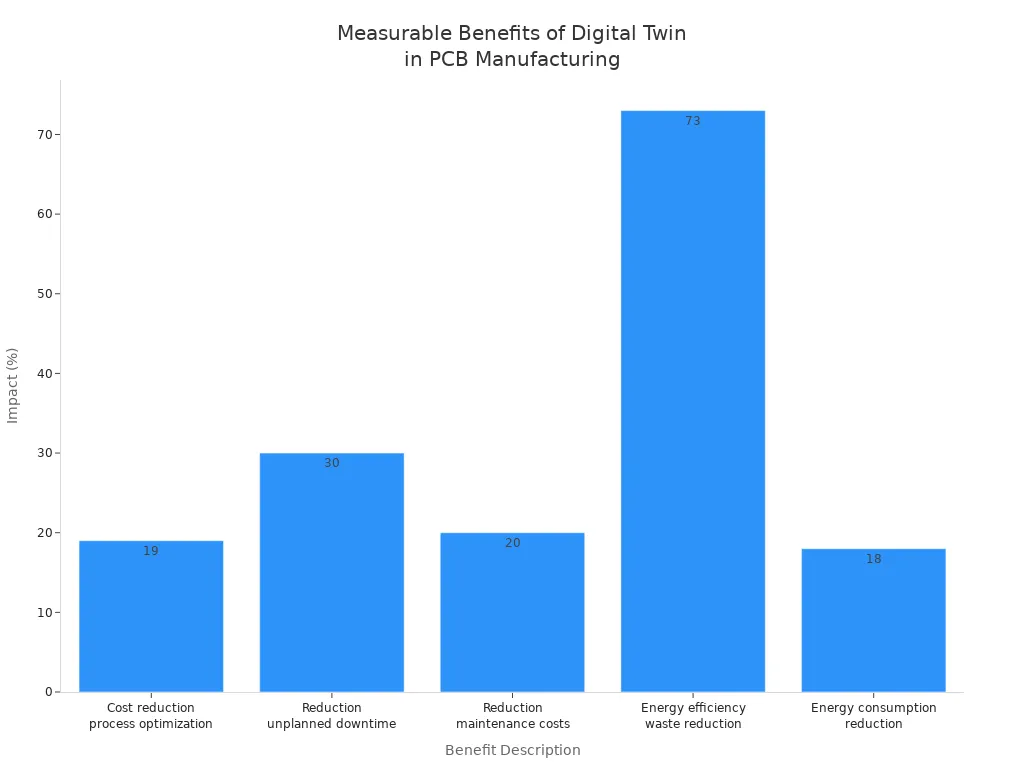
You see costs drop by 19% and less downtime by 30%. You cut repair costs by 20%. Most factories use less energy and waste. Big data and analytics help you keep making your pcbs and factory better.
Practical Applications in PCB Assembly
Predictive Maintenance
Predictive maintenance helps keep your pcb assembly line working well. Sensors on machines collect data as pcbs move through each step. This data shows if something is wearing out or might break soon. You can fix machines only when they need it. This saves both time and money. You also stop sudden breakdowns that can ruin many pcbs. Many pcba factories use predictive maintenance to make lines efficient and cut waste.
Automated Quality Control
Automated quality control uses AI and machine vision to check pcbs for problems. You do not have to depend only on people checking by hand. AI systems learn from lots of pictures and data. They find tiny mistakes that people may not see. These systems also lower false alarms and help you fix earlier steps. You get alerts right away if something is wrong. Automated optical inspection tools with AI find problems quickly. Using AI inspection means you get fewer bad boards. Factories using these systems have seen 40% fewer defects. You can trust your pcbs are good every time.
AI uses smart models instead of just rules.
Machine learning finds mistakes better than people.
AI learns from your data and gets better over time.
Production Traceability and Scalability
Traceability is very important in pcb assembly today. You must know where each pcb comes from and where it goes. Barcode systems help track every part and batch. RFID tags let you read data without touching the pcb. Manufacturing execution systems link machines and gather real-time data. IoT sensors watch the environment and how each pcb is made. Relational databases keep all this info, so you can trace each pcb from start to finish. This helps you find problems fast and show customers your quality. Traceability also helps you grow. As you make more pcbs, these systems help you stay in control.
Technology | Description |
|---|---|
Barcode Systems | Used for component identification and tracking. |
RFID | Stores more data and works without line of sight. |
Manufacturing Execution Systems | Tracks production in real-time and captures process data. |
IoT Sensors | Monitors conditions that affect product quality. |
Relational Databases | Stores and organizes traceability data for easy reporting. |
Tip: Good traceability helps you follow rules and keeps customers happy.
Benefits of Smart PCBA Manufacturing
Efficiency and Productivity Gains
Smart pcba manufacturing helps you work faster and better. You can make pcb assembly quicker by changing how you plan your work. Dual-pallet operation lets you load and cut boards at the same time. This keeps your line moving without stopping. Smart alignment and scanning tools help you fix mistakes fast. Machines scan the whole board and fix marks by themselves. This saves you time and effort. High-power dust collectors keep your area clean and safe. This helps you do your job faster and makes it easier.
Depaneling speed helps you finish more boards.
Dual-pallet operation means you never have to stop.
Smart alignment and scanning help you avoid mistakes.
High-power dust collection keeps you safe and working well.
These tools help you make more pcbs in less time. You do not spend as much time fixing mistakes or cleaning up. You finish more boards every day.
Enhanced Quality and Consistency
Smart pcba systems help you make better and more reliable pcbs. Laser marking gives you clear, permanent marks on each board. You do not have to worry about labels falling off or fading away. Laser marking puts marks right on the pcb, so they cannot be changed. This is very important for things like medical devices and airplanes, where you need to track every board.
FlexLink’s laser marking scans each pcb and makes a 3D map. You get very exact marks every time. The laser does not touch the board, so it does not hurt it. You can mark hard designs that stickers cannot do. You only buy the laser system once and do not need to buy labels again. You save money over time because you do not pay for extra things.
These systems help you make sure every pcb is good. You get the same results every time and make fewer mistakes. You can trust your boards to work well.
Cost Reduction and Resource Optimization
Smart pcba manufacturing helps you save money and use things better. You find problems early, so you can fix them before they get worse. You do not have to redo your work as much, so you save time and materials. Better pcb layouts make it easier to put boards together and need less hand work. You save money by picking the best parts and materials. Built-in test features make it easy to check boards and find problems fast.
Finding risks early saves you money.
Fewer redesigns mean you waste less time and stuff.
Better layouts help you work faster and with fewer mistakes.
Picking the right parts saves money on buying things.
Built-in tests help you check boards quickly.
You use these ideas to make pcbs in a smart way. You do not spend as much on repairs or waste. You get more out of your materials and machines.
Environmental Sustainability
Smart pcba manufacturing helps the environment in many ways. The eSmart Factory idea shows you can make factories with no liquid waste. Whelen’s pcb factory recycles all its water and most of its chemicals. This helps save water and keeps the earth clean. Automation means you do not need as many workers, so you use less energy and help the planet.
Factories do not make liquid waste.
All water is recycled to save resources.
Most chemicals are recycled to stop pollution.
Automation uses less energy and helps the earth.
You use smart ways to make pcbs cleaner. You recycle water and chemicals. You help keep the planet safe while making good boards.
Note: Smart pcba manufacturing lets you use industry 4.0, ai, iot, and automation to work faster, make better boards, save money, and help the earth. You help build a better and greener future for pcb assembly.
Challenges and Solutions in Industry 4.0
Legacy System Integration
It can be hard to connect old machines to smart tools. Many factories still use old equipment for making pcbs. These old machines do not always work with new systems like ai or automation. You need special adapters and software to help them connect. Sometimes, you must add sensors or upgrade some parts. You can make a plan to upgrade step by step. This way, you do not have to stop your factory. You keep working while moving toward industry 4.0.
Data Security and Privacy
Keeping your data safe is very important in smart pcb factories. You have important information about pcbs, customers, and designs. Hackers might try to steal or damage this data. You can use strong security steps to protect your factory. The table below shows ways to keep your data safe:
Strategy | Description |
|---|---|
Cybersecurity Measures | Use strong security tools to protect your data and keep your factory safe. |
Employee Training | Teach workers about security rules to stop mistakes. |
Collaboration with Suppliers | Work with suppliers to keep security strong across the supply chain. |
Network Segmentation | Divide your network to stop threats from spreading. |
Encryption | Use encryption to keep data safe when you store or send it. |
Incident Response Planning | Make plans to recover quickly if a breach happens. |
Regular Security Audits | Check your systems often to find weak spots. |
Multi-Factor Authentication (MFA) | Use MFA so only trusted people can access important data. |
Disaster Recovery Planning | Prepare for disasters to keep your factory running. |
Testing and Revising Plans | Test and update your plans to stay ready for new threats. |
You can follow these steps to keep your pcbs and factory safe.
Workforce Skills and Training
Smart factories need workers with new skills. Making pcbs with ai and automation needs special training. Workers must learn how to use digital tools and fix robots. You can give training programs to help your team learn. Here are some skills and programs to focus on:
Digital literacy helps workers use and fix smart machines.
Continuous learning keeps your team ready for new technology.
Soft skills like problem-solving and teamwork help manage automated systems.
Projects teach workers about robotics, automation, and ai.
These programs attract new talent to advanced manufacturing jobs.
You can offer rewarding career paths in the changing industry.
You build a strong team by teaching new skills and helping workers grow.
Investment and ROI
You might worry about the cost of making your factory smart. Smart tools can be expensive at first. You want to know if you will get your money back. Companies that improve logistics in pcb factories often see big returns. You can get ROI between 150% and 300% in the first two years. The size of your factory and how you start will change your results. Better logistics save money, speed up delivery, and make customers happy. You can use smart tools to make your factory work better and earn more.
Tip: Start with small upgrades and check your results. This helps you see the value of industry 4.0 in your pcb factory.
Future Trends in Smart PCB Assembly
Emerging Technologies and 5G
Smart PCB assembly will change a lot soon. New technology like 5G and 6G is coming fast. These networks need pcbs that work with very high speeds. You have to watch signal integrity and impedance control closely. Fast signals make this even more important. High-Density Interconnect pcbs help you make smaller devices. You can use microvias and more layers to fit extra parts. This saves space and makes devices stronger. Flexible pcbs bend and last longer for wearables. Rigid-flex pcbs mix strength and bending for tough jobs. These new ideas help you build pcbs for new products and markets.
Note: 5G and 6G mean you need tiny, powerful pcbs. You will face new design problems but also find new ways to grow.
Human-Machine Collaboration
You will work with smart machines more in the future. Cobots and robots will help you place and check parts. AI will guide these machines and help you do better work. AI can find small defects and give you tips to fix them. Workers will learn to control machines and use sensor data. You will see feedback from your pcbs right away and change your process fast. People and machines working together make factories smarter and safer. You will do less boring work and spend more time solving problems.
Cobots help with hard or risky jobs.
AI checks your work and gives advice.
You use data to make good choices every day.
Long-Term Industry Impact
The pcb industry will change a lot in the next ten years. More people want electronics in cars and homes. This means the market for pcb assembly will grow. Automation and AI will make your work faster and more exact. You could see your productivity go up by 40% with more AI. Companies will need better pcb assembly as they add new tools. More factories will use smart systems to meet demand. Your skills with AI and smart machines will matter more.
Trend | Impact on PCB Assembly |
|---|---|
Market Growth | More need for pcbs in many areas |
Automation and AI | Faster, safer, and better work |
High-Quality Requirements | Need for top-quality pcbs goes up |
Smart Systems Adoption | More factories use real-time data |
You will shape the future of pcb assembly by learning new skills and using smart tools.
You notice industry 4.0 and smart manufacturing change how PCBs are made. You use ai to help you work faster, make better boards, and help the planet. Sometimes, old machines and security problems make things hard, but you can fix these with good plans. You get quick data and feedback from ai systems. You get ready for new technology and smarter factories.
You help shape the future of PCB assembly by learning new things and using ai every day.
You make your factory better and help the earth.
You get ready for new ideas and more growth.
FAQ
What is Industry 4.0 in PCB assembly?
You use Industry 4.0 to connect machines, sensors, and software. This helps you collect data and improve your PCB assembly process. You get faster production and better quality.
How does AI help you in PCB manufacturing?
AI helps you find defects and predict machine problems. You use AI to check boards quickly and fix issues before they grow. This saves you time and money.
Why is traceability important in smart PCBA?
You track every PCB from start to finish. This helps you find problems fast and prove your quality to customers. You also meet safety rules more easily.
What are digital twins in PCB factories?
You use digital twins to make a virtual copy of your factory. You test changes and spot problems without stopping real machines. This keeps your line running smoothly.
How do smart factories help the environment?
You recycle water and chemicals in smart factories. You use less energy and make less waste. This helps you protect the earth while making PCBs.
See Also
Enhancing Business Efficiency Through PCBA Contract Manufacturing Solutions
Exploring Industrial Serial Screen PCBA Applications in Today's Industries
Sourcing Electronic Components for Efficient PCBA Production
DIP PCBA Manufacturing: Process, Quality Assurance, and Uses
Comprehensive Overview of PCBA Manufacturing for All Skill Levels
