What You Need to Know About PCBA for Vending Machines and Kiosks
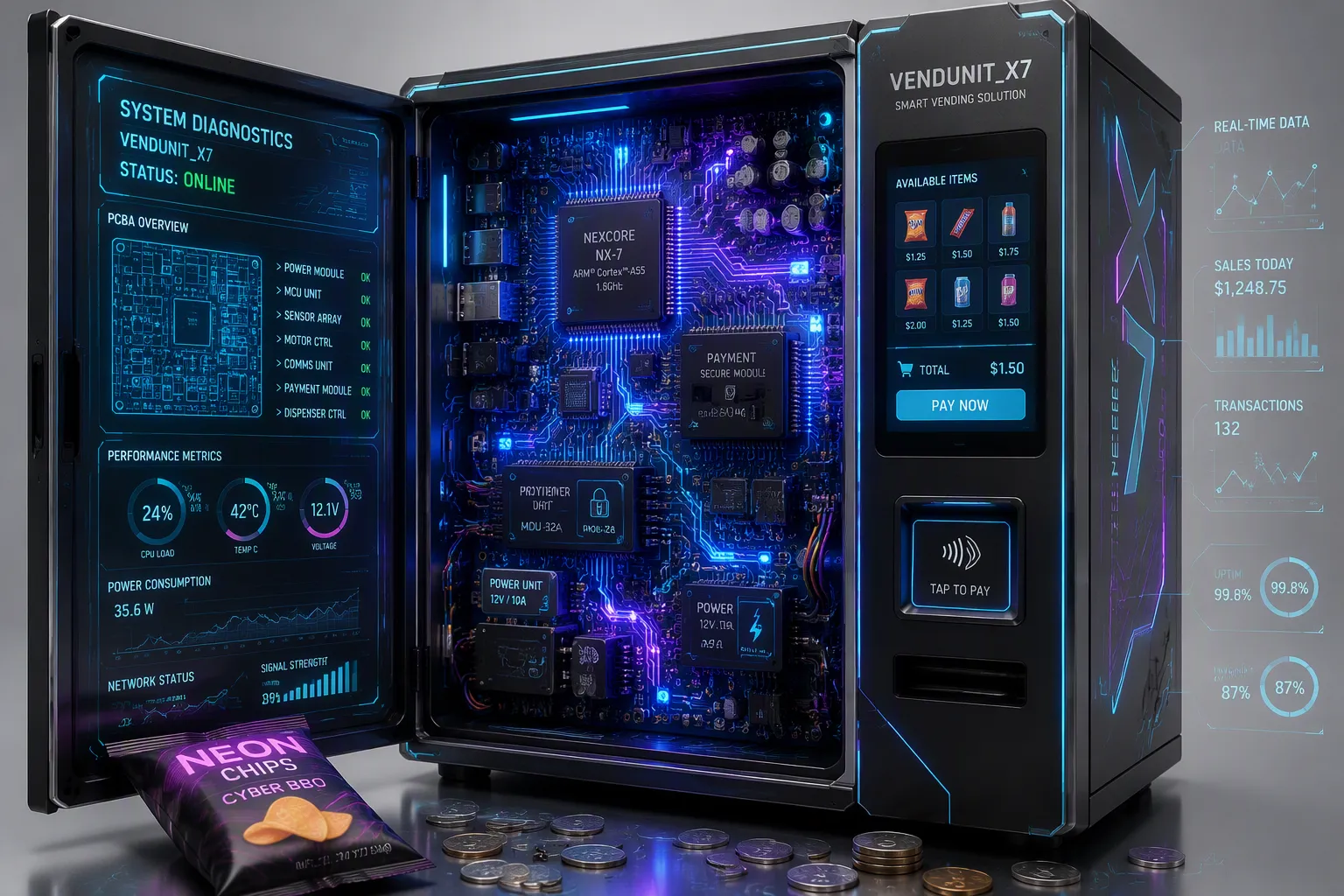
PCBA means putting electronic parts onto a printed circuit board and soldering them in place. This finished board acts as the main control unit for the machine. A bare PCB is just a plain board with no working ability. The assembled board allows automation, payment handling, and user interaction.
This difference matters for self-service machines. A vending machine gives out physical items right after payment. A kiosk may start transactions finished later, like ticketing or check-in services. Both depend on reliable pcba for vending machines to work correctly. Each vending machine needs strong circuitry to manage payments and product delivery. Every kiosk needs dependable controls for its own tasks. These systems serve the public every day, so quality assembly is vital.
Key Takeaways
PCBA turns a plain board into the brain that controls vending machines and kiosks.
Rigid PCBA works well for main control boards. Flexible PCBA is good for tight spaces.
Payment systems use the MDB protocol and follow PCI DSS rules to keep transactions safe.
Membrane switches give tough buttons for people to press in public places.
Good heat control and protection from electronic noise keep the machine working well.
What is PCBA for Vending Machines?
PCBA vs. PCB: The Core Difference
A bare PCB is the base layer. It holds parts and connects them with copper paths. But by itself, it cannot do anything. The PCBA turns that base into a working control system. Makers place processors, connectors, sensors, and other parts onto the board. They solder each part into place. They check and test the finished board. This makes a working electronic circuit ready to use.
This difference matters for anyone buying pcba for vending machines. A bare board only links copper traces. An assembled board runs commands. It handles payments. It controls motors. It talks to remote servers. The table below shows the main differences.
Category | PCB (Printed Circuit Board) | PCBA (Printed Circuit Board Assembly) |
|---|---|---|
Definition | Fabricated laminate board with patterned copper; no components | PCB populated with SMD/THT parts, soldered, inspected, and tested |
Function | Provides mechanical support and interconnects | Executes designed functionality as an electronic circuit |
Composition | Core/prepreg (FR-4, Rogers, etc.), copper, solder mask, silkscreen, surface finish | PCB + components (ICs, passives, connectors), solder joints, flux residues cleaned per spec |
Manufacturing Flow | Imaging/etch, drilling, plating, lamination, surface finish, profiling, bare-board test | Solder paste print → SPI → PnP → reflow (or wave/selective) → AOI/X-ray → ICT/FCT |
Testing Level | Electrical continuity/isolation (E-test), visual inspection | AOI/AXI, ICT, flying probe, boundary-scan, FCT, burn-in (as needed) |
Use Stage | Pre-assembly validation, mechanical fit, basic continuity | Functional prototypes, EVT/DVT/PVT, production, service spares |
A PCB is the starting point, the blank canvas for the electronic design. A PCBA is the finished product, tested and ready to go.
The Central Role of PCBA in Machine Operations
The assembled board acts as the main coordinator for every vending machine. It gets input signals from the user interface. It checks the selection against its product map. It confirms enough payment credit from the payment module. After checking, it triggers the correct coil motor driver. It watches the infrared drop sensor to confirm delivery. It updates inventory counts. All this happens in a few hundred milliseconds.
The control board uses a Microcontroller Unit (MCU) as its brain. Motor drivers control dispensing motors, handling up to 1A per motor for 25-30 motors. Sensors detect coin insertion, bill validation, or product availability. Communication modules allow network access through Wi-Fi or cellular. A display interface runs LCD or LED screens for menus and transaction details.
Surface-mounted parts make up most of the assembly. Temperature sensors watch cooling systems. Weight sensors track product inventory levels. Optical sensors confirm product dispensing. Door sensors detect unauthorized access. Motion sensors detect customer interaction. These sensors allow real-time inventory tracking and secure transactions.
The market shows how important this technology is becoming. The global vending machine market hit USD 21.55 billion in 2025. Projections put it at USD 36.12 billion by 2035. Smart and connected vending is the fastest-growing segment at 8.2% CAGR. The kiosk market follows a similar path. It stood at about USD 4.2 billion in 2023. It should pass USD 9.8 billion by 2030.
This growth drives demand for reliable pcba for vending machines. Each unit needs strong circuitry for payment handling and product delivery. Every kiosk needs dependable controls for its own tasks. The choice of assembly directly affects uptime and maintenance costs. Operators who invest in quality assemblies cut service calls and boost customer satisfaction. The right PCBA ensures smooth operation across thousands of transaction cycles. This equipment serves the public daily, so quality assembly remains vital.
Types of PCBA for Self-Service Equipment
Rigid PCBA: The Workhorse for Main Control Boards
Rigid PCBA is the most common type for self-service equipment. Manufacturers choose it for main control boards where durability and cost-effectiveness matter most. The rigid board provides a stable platform for critical components. It handles the physical demands of daily operation in public spaces.
A typical vending machine requires quality pcba for vending machines to function properly. Several types of rigid PCBA modules work together inside the unit. These modules include:
Control board as the central processing unit managing vending mechanisms, payment interactions, displays, and diagnostics.
Payment systems module integrating card readers, NFC sensors, and secure elements for PCI-compliant transactions.
Telemetry and communication module supporting cellular (LTE/5G), Wi-Fi, or Ethernet for remote monitoring and inventory tracking.
Sensor arrays including delivery confirmation, temperature, door, and presence sensors for accuracy and reliability.
User interface components such as touchscreens, buttons, LED indicators, and audio elements for frequent use.
Each module performs a specific function in the vending machine. The control board coordinates all activities. The payment module handles transactions securely. The telemetry module connects the machine to the network. The sensor array monitors conditions inside the cabinet. The user interface allows customer interaction with the vending machine. Each module connects to the main board through dedicated traces. The board handles multiple signal types at the same time. Power management circuits regulate voltage for each component. Protection circuits guard against surges and electrostatic discharge.
Flexible and Rigid-Flex PCBA for Space and Connectivity
Self-service equipment often requires PCBA in tight spaces or areas with moving parts. Flexible and rigid-flex PCBA solve these challenges. Manufacturers use them in a carousel-style vending machine for disc dispensing. These boards bend without breaking. They allow placement in unusual locations where rigid boards cannot fit.
Rigid-flex PCBA provides clear connectivity advantages for space-constrained designs. The table below shows these benefits.
Connectivity Advantage | Technical Detail |
|---|---|
Space efficiency | Integration of rigid, flex, FFC, and MCPCB reduces connector count and air gaps, allowing more electronics in less volume. |
Hinge reliability | Rigid-flex is used at hinges and doors for millions of cycles, while FFC handles long, static spans. |
These advantages matter for custom kiosk layouts where space is limited. A self-service kiosk with a touchscreen, card reader, and printer needs compact wiring. Rigid-flex PCBA allows designers to fit all electronics into a slim cabinet. HDI PCBA offers another option for a compact, high-performance kiosk with complex processing needs. HDI boards pack more traces into each layer. They support faster signals and smaller components. This suits advanced kiosks with multiple functions.
The choice between PCBA types depends on the specific requirements of each unit. Each type serves a different purpose in the self-service market.
Key Applications in Vending and Kiosks
Payment Processing and Communication Modules
Payment processing is the most important job for any self-service machine. The PCBA uses payment modules that follow PCI DSS rules. This security system keeps cardholder data safe during every transaction. A vending machine must handle cash, cards, and mobile payments without mistakes. Each payment type needs different hardware connections on the same board.
The Multi-Drop Bus (MDB) protocol is the standard way vending machines talk to payment parts. This protocol lets payment devices send messages to the main controller. Coin acceptors, bill validators, and cashless payment systems all use MDB. The protocol keeps communication reliable between parts from different makers.
Modern machines also need network access. Wi-Fi and 4G/5G modules sit right on the PCB. These modules allow remote monitoring, software updates, and data analysis. Ethernet gives a wired option for machines in fixed spots. Operators can check sales, change prices, and fix problems from a central office.
Kiosks do different jobs than vending machines. A kiosk handles bill payment, ticketing, check-in, or order entry. These transactions often finish later, not right away. The PCBA must support these different functions with the same reliability. Both machine types depend on quality pcba for vending machines to process transactions safely.
Push buttons inside a controlled industrial area are usually used by trained staff. Buttons on vending machines and self-service kiosks are used by the public, often without instructions about the correct pressing force. The electrical signal from the button may be simple, but a failure can stop an essential part of the machine.
User Interfaces and Membrane Switches for Kiosk and Vending Equipment
The user interface connects customers to the machine's functions. Membrane switches give a tough, sealed way to enter input. These switches work well in busy or outdoor places. Their flat, sealed surfaces resist dust, moisture, and harsh chemicals. Advanced UV coatings protect against sunlight and fading.
Tactile feedback comes from metal or poly domes under the overlay. These domes make a clear "click" when pressed. This touch feedback lowers input errors and accidental presses. The sealed surface also makes cleaning easy, a useful feature for public equipment.
Membrane switches face specific failure modes in vending use. Conductive rubber domes wear out after many presses. Incandescent backlight bulbs burn out and need panel disassembly. Adhesive layers can separate when exposed to moisture. Silver ink traces corrode in sulfur-rich environments.
Failure Mode | Contributing Factor |
|---|---|
Excessive force damage | Public users pressing too hard on keys |
Graphic degradation | Scratching or fading of printed graphics |
Label unreadability | Sunlight exposure reducing contrast |
Wiring damage | Service replacement mishandling of tail/connectors |
Designers must follow specific rules when adding membrane switches:
Domes need proper centering under graphics with consistent actuation force.
Flex tails require correct length, bend radius, and pitch for ZIF connectors.
Material selection affects flexibility and durability.
ENIG surface finish provides stable contact performance.
ESD protection and grounding design protect the electronics.
Temperature control adds another layer of complexity. Refrigerated vending machines need PCBA to manage cooling systems. Sensors track temperature and trigger compressors as needed. Inventory tracking uses weight sensors and optical detectors. These systems report stock levels in real time.
The choice of durable membrane switches directly affects uptime. A vending machine with quality input components serves customers longer between service calls. A kiosk with reliable controls builds trust with public use. Operators who invest in robust assemblies reduce maintenance costs significantly. These units face constant public use, so every component must withstand repeated interaction.
Reliability and Durability Considerations
Thermal Management and Power Efficiency
The assembled board inside a vending machine or kiosk makes heat from processors and power supplies. This heat builds up inside closed cabinets. Without proper care, high temperatures shorten part life. Operators must pick the right cooling method based on the environment.
The selection process follows a clear decision path.
If the cabinet needs an IP rating for dust protection, open fan systems are not allowed. The choice narrows to closed-loop heat exchangers or active air conditioners.
If the needed internal temperature is lower than the outdoor temperature, passive cooling cannot work. This requires active refrigerant-based cooling.
Engineers must figure out the total heat load. The cooling unit must exceed this load by an appropriate margin.
Common cooling methods serve different situations.
Cooling Technique | Application Context |
|---|---|
Passive cooling | Low heat load, indoor, ambient conditions |
Fan cooling with filters | Medium heat load, industrial environments |
Closed-loop heat exchangers | Dusty outdoor environments, maintains sealing |
Enclosure air conditioners | High-temperature sealed cabinets, precise cooling |
Thermoelectric coolers | Small devices or localized cooling needs |
The heat load calculation uses a standard conversion between equipment power and heat output. Designers must think about ambient temperature and solar radiation.
EMI Shielding and Compliance for Vending Machine Environments
Vending machines have motors and wireless modules that create electromagnetic interference. This interference can disrupt payment processing. Proper shielding keeps the system stable for public use.
The choice of metal housing material affects shielding effectiveness. Different materials offer varying levels of protection.
Designers must follow rules for effective shielding.
Conductive finishes on mating surfaces keep conductivity across seams.
EMI gaskets need proper type, thickness, and compression specs.
Large unbent flanges should be sized appropriately to avoid acting as antennas.
Tight tolerances apply only to critical features like connector mounting holes.
Board-level techniques also reduce interference.
Solid ground and power planes spread return currents evenly.
Mains inputs need filtering with common-mode chokes and X/Y capacitors.
Snubbers on relays driving motors dampen inductive spikes.
Guard traces tied to ground enclose noisy sections.
Ferrite beads on cables suppress external coupling.
Compliance with relevant safety standards requires testing. Conformal coating protects boards against moisture and dust. This coating is essential for outdoor locations. Anti-vandal construction adds protection for public use equipment. The metal housing of the machine provides a natural shield. Anti-vandal construction ensures the equipment withstands rough handling. Operators who invest in proper shielding reduce service calls and extend equipment life.
Choosing the right PCBA affects more than just how well the machine works. It also affects the business. A reliable assembly keeps a vending machine running through thousands of transactions. It cuts down on service calls and protects revenue. When choosing between rigid and flexible boards, you balance cost against space limits. Rigid PCBA lasts longer and costs less. Rigid-flex solutions fit compact designs but cost more. Both serve the public well when built properly.
Membrane switches offer durable input surfaces that handle heavy use. Their sealed design keeps out moisture and dirt in busy places. This reliability directly reduces how often maintenance is needed.
Quality PCBA is the foundation of a successful self-service setup. Operators who choose assemblies wisely and work with knowledgeable manufacturers set their vending machine and kiosk operations up for long-term profit. The public relies on these systems every day, so dependable electronics are a smart investment.
FAQ
How long does a PCBA last in a vending machine?
Quality PCBA assemblies last many years with proper care. Conformal coating protects against moisture damage. Thermal management prevents heat buildup. Regular maintenance checks help extend the service life a lot.
What certifications should a vending machine PCBA meet?
The PCBA must meet relevant safety standards. Payment modules must follow PCI DSS rules for safe transactions. Industry standards for solder joint reliability ensure quality.
How does the PCBA process payments securely?
The PCBA uses standard communication protocols to talk to payment modules. It handles cash, card, and mobile payments. The system follows PCI DSS rules to keep cardholder data safe in every transaction.
Can a PCBA handle outdoor operating conditions?
Yes, conformal coating protects the board from moisture and dust. Metal housing stops EMI interference. Anti-vandal design resists rough use. Sealed membrane switches keep out dirt and grime.
See Also
The Understanding Of PCBA And Its Essential Components
Exploring The Meaning Of PCBA In Electronics Industry
The Essential PCBA Processing Needs For Medical Equipment
Ways PCBA Contract Manufacturing Boosts Your Business Efficiency
