What Are the Differences Between FR4, Rogers, and Aluminum PCB Substrate Materials
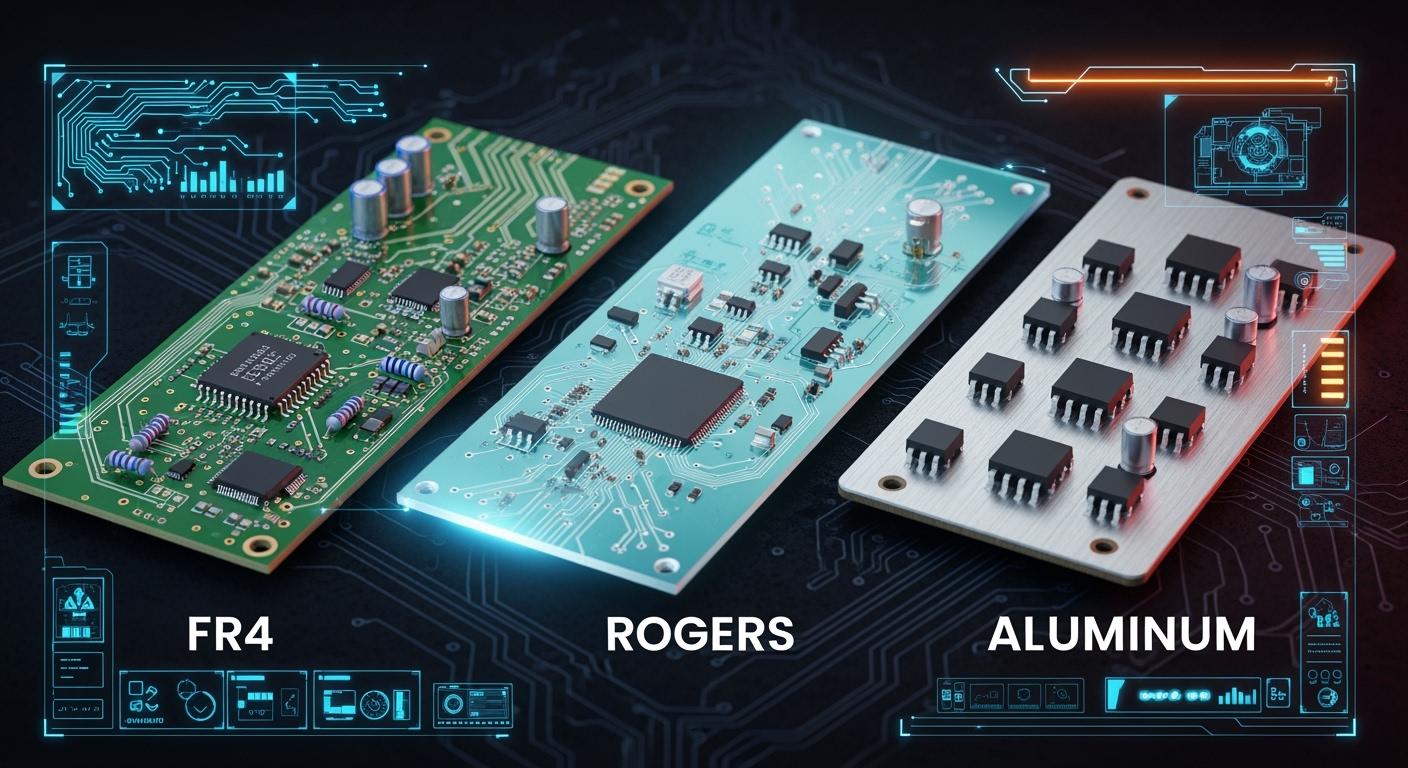
You have to make important choices when picking pcb substrate materials for your project. FR4 is a cheaper choice for most electronics. Rogers works well for high-frequency needs. Aluminum is best for handling heat in hot designs. The table below shows how these materials are different in cost, electrical, and thermal properties:
Material | Cost | Electrical Performance | Thermal Management |
|---|---|---|---|
FR4 | Low | Good for general use | Adequate |
Rogers | High | Best for high-frequency | Moderate |
Aluminum | Medium | Good for power, not high-freq. | Excellent |
What you pick changes signal quality, heat control, and how long it lasts.
Key Takeaways
FR4 costs the least and works well for most electronics and daily devices.
Rogers substrates work best for high-frequency uses and give clear signals for new technology like 5G and planes.
Aluminum PCBs handle heat well, so they are good for power electronics and LED lights.
Picking the right substrate changes how well your device works, how much it costs, and how long it lasts; think about what your project needs.
You should always match performance with your budget; FR4 saves money, but Rogers and Aluminum have special uses.
Types of PCB Substrate Materials
PCB substrate materials are very important in making printed circuit boards. These materials are the base layer of the board. They help decide how well your circuits work. The type you pick changes how electricity flows, how heat moves, and how strong the board is. There are many kinds used in making PCBs. Each one has its own special features.
Here is a table that lists the main types of PCB substrate materials:
Type of PCB Substrate | Description |
|---|---|
Paper-based PCB | Made from fiber paper and resin. These are common in Asia. FR-1 and FR-2 are examples. |
Epoxy Glass Fiber Cloth PCB | This is the most used type. It is made with epoxy resin and glass fiber. FR-4 is a type of this. |
Composite Substrate PCB | These use different materials for the top and middle. CEM-1 and CEM-3 are examples. |
Special Substrate PCB | These include metal and ceramic types. They are picked for special uses because of their properties. |
Organic Substrates (FR4)
Organic substrates like FR-4 are used a lot in electronics. They have epoxy resin and glass fiber inside. These materials stop electricity from leaking and make the board strong. Most home gadgets use them because they are not too expensive and work well. PTFE is another organic substrate. It does not get damaged by chemicals and can take high heat. Fillers or fibers are added to make these materials even stronger.
High-Performance Substrates (Rogers)
High-performance substrates like Rogers use special materials for better results. You see them in things that need fast signals. They use special ccl, such as ceramic or PTFE. These materials move heat well and keep electricity from leaking. People use them in planes, the military, and tough places. They cost more money but work the best.
Metal Substrates (Aluminum)
Metal substrates have a thin layer that does not let electricity pass. This layer sits on a thick metal base. Aluminum is the metal used most often. These materials are picked because they handle heat very well. Metal substrates help move heat away fast. You find them in LED lights and motor drives. They use special ccl to stick the metal and the other layer together.
Tip: Pick the substrate material that fits your project. Each type gives special benefits for printed circuit boards.
FR4 PCB Substrate Materials
Structure & Properties
FR4 is a very common material for printed circuit boards. It is made from woven glass cloth and epoxy resin. The glass fiber epoxy makes the board strong and keeps it steady. The epoxy resin helps stop water from getting in. FR4 is a kind of ccl, so it has a thin copper layer on top. This copper layer is used to make circuits.
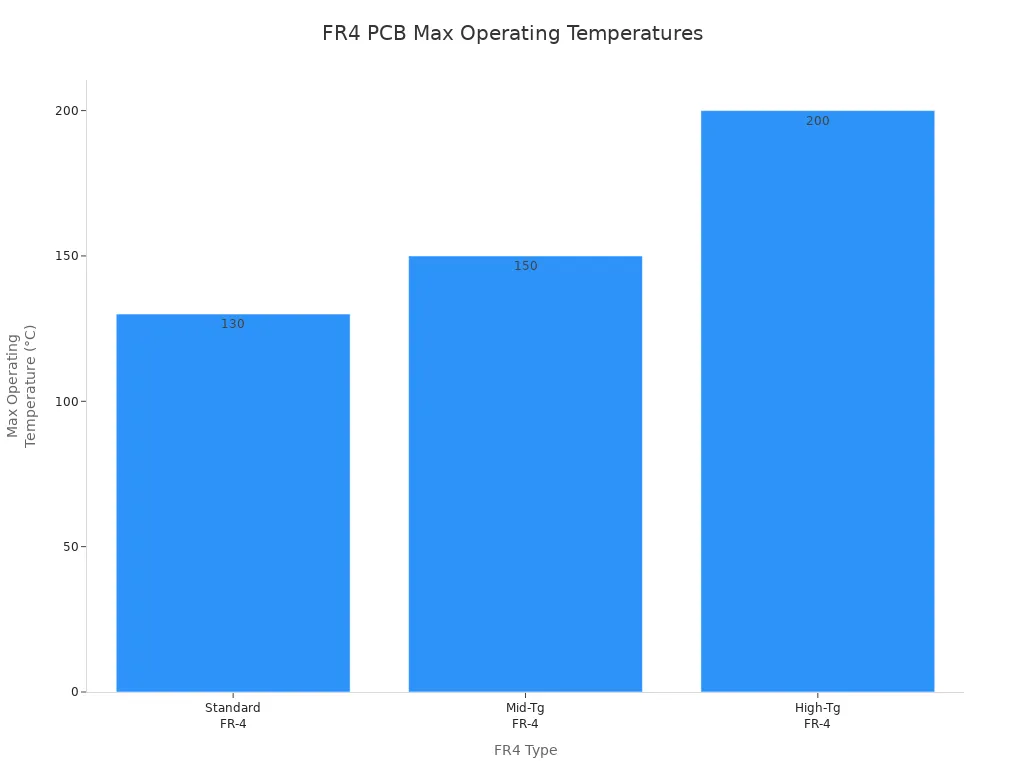
The glass transition temperature (Tg) shows how much heat FR4 can take before it changes shape. Here is a table with the Tg ranges for FR4:
Tg Category | Temperature Range (°C) |
|---|---|
General Tg | 130-140 |
Medium Tg | around 150 |
High Tg | above 170 |
FR4 has a dielectric constant between 3.8 and 4.9. This means it works well for most circuits. But it is not the best for high frequency or high heat. FR4 also does not let water in easily. It keeps its size steady when it gets hot or cold. This helps signals stay clear.
Pros & Cons
Here are the main good and bad things about FR4:
Advantages of FR4 PCB | Disadvantages of FR4 PCB |
|---|---|
Cost-effectiveness | Poor performance at high frequency |
High mechanical strength | Limited thermal conductivity |
Excellent electrical insulation | Moderate temperature resistance |
Good thermal stability | Brittleness |
Easy to fabricate | Environmental concerns (halogen) |
FR4 ccl and laminates are easy to cut and shape. They let you put lots of wires close together. But FR4 can break if bent too much. It does not move heat as well as some other materials.
Applications
FR4 is used in many printed circuit boards. It is common in LED lights and power electronics because it is cheap. In cars, high-Tg FR4 is used for driver-assist systems and power parts. Factories and robots use FR4 because it is strong and works well. Medical tools like ECG monitors and trackers use FR4 for clear signals. Planes and the army use FR4 in radar and radios, but not in the hardest places.
Tip: Pick FR4 if you want something that is not too expensive, strong, and works well for most jobs.
Rogers PCB Substrate Materials
Structure & Properties
Rogers PCB substrate materials are special because of their structure. They use advanced resins and fillers, not the usual epoxy in FR4. Rogers ccl has very low dielectric loss. This means signals stay strong at high frequencies. The dielectric constant stays steady, even if temperature or frequency changes. This stops signals from getting distorted. Rogers ccl does not expand much when heated or cooled. The board does not crack or peel easily. You can use normal PCB processes with Rogers. This makes it easier to build complex boards.
Very low dielectric loss for high-frequency signals
Stable dielectric constant in different temperatures and frequencies
Great thermal expansion properties for lasting boards
Works well with regular PCB processes
Pros & Cons
Rogers PCB substrate materials have many good points. They are great for high-speed and radio frequency designs. You get strong high-frequency performance because of low dissipation factor. This keeps your signal clear, even above 10 GHz. The dielectric properties stay steady. You can trust your board in tough places. Rogers materials resist moisture. This helps in outdoor or wet areas.
But there are some downsides. Rogers costs more than other materials. You may need special tools and skills to use it. For simple or low-frequency projects, Rogers may not be the best choice.
Advantages | Limitations |
|---|---|
Great high-frequency operation | High cost |
Steady dielectric properties | Harder manufacturing process |
Excellent thermal stability | Not good for simple or low-frequency use |
Low moisture absorption |
Tip: Pick Rogers only if your design needs top performance at high frequencies or in tough conditions.
Applications
Rogers PCB substrate materials are used in advanced technology. These boards are found in 5G communications, radar systems, and satellites. Cars use them for radar and driver-assist systems. Aerospace and defense use Rogers for reliability in extreme places. High-speed digital and IoT devices use Rogers to keep data clear and reduce crosstalk.
Application/Industry | Performance Requirements |
|---|---|
High-frequency low-loss, stable dielectric, high temperature resistance | |
Automotive Radar and ADAS | Precise signal detection, low signal spread, reliable in tough places |
Aerospace and Defense | High reliability, durability, great thermal stability, and strength for extreme conditions |
High-Speed Digital and IoT Connectivity | Low dielectric loss, less crosstalk, and strong high-speed data |
For example, if you make a 5G antenna that works at 28 GHz, Rogers with a dielectric constant of 3.0 helps signals go farther without losing strength. Standard materials could cause delays or losses in these cases.
Note: Rogers PCB substrate materials are the best choice when you need reliable, high-frequency performance and strong durability.
Aluminum PCB Substrate Materials
Structure & Properties
Aluminum PCB substrate materials have a special structure. These boards use a metal core made of aluminum. The metal core sits under a thin layer that insulates. On top, there is a copper ccl. This setup helps heat move away fast from hot parts. The table below shows how aluminum is different from other materials:
Material | Structure Description | Thermal Conductivity (W/m·K) |
|---|---|---|
Aluminum PCB | Thermally conductive metal core | 1 |
FR4 | Woven fiberglass core with epoxy resin | ~0.3 |
Rogers | Varies, often higher than FR4, depends on type | Varies |
Aluminum PCBs are great at moving heat. The quality of the insulating layer matters for heat control. If you use a good ccl, your board stays cool and works better. These materials do not bend or crack easily. Your board stays strong even when it gets hot.
Pros & Cons
Aluminum PCB substrate materials have many good points:
They move heat away fast and keep things cool.
They are light, so devices are easy to carry.
They do not bend or crack easily.
They last a long time and stay stable.
Aluminum is easy to find, so these boards are cheap and good for the planet.
But there are some things to watch out for:
Most aluminum PCBs are best for single-sided boards. Double-layer boards are harder to make.
Small problems can happen if the board gets too much stress.
Tip: Pick aluminum PCBs if you need strong heat control and a tough board for high-power electronics.
Applications
Aluminum PCB substrate materials are used where heat is a big problem. You see these boards in:
LED lighting
Power electronics
Street lights and stop lights
Household lighting
Aluminum PCBs help devices last longer by moving heat away. They keep power electronics and lights working well because they handle heat. Their light and strong design makes them a smart pick for many new products.
Comparison of PCB Substrate Materials
Electrical Performance
Electrical performance is important when picking pcb substrate materials. Each material changes how signals move in your board. FR4 is good for most electronics. It does not work well with high-frequency signals. Rogers is better for high-frequency needs. Rogers has low dielectric constant and loss tangent. This keeps signals strong and clear at high frequencies. Aluminum is not good for high-frequency circuits. It works well for power electronics.
Here is a table that shows dielectric constant and loss tangent for FR4 and Rogers:
Material | Dielectric Constant (Dk) | Loss Tangent (Df) |
|---|---|---|
FR4 | 4.0 (3.9 - 4.8) | 0.02 |
Rogers | 2.2 - 12.85 | 0.0009 - 0.0037 |
Rogers ccl, like RO4350B, keeps signal loss low. You get strong signals for frequencies over 500 MHz. FR4 ccl works up to 10 MHz. It loses more signal at higher frequencies. Aluminum does not have steady dielectric properties for radio frequency circuits.
Note: Low dielectric loss means signals do not fade much. A steady dielectric constant gives you predictable circuit behavior.
Thermal Management
Thermal management helps your board stay cool and last longer. FR4 does not move heat away fast. Rogers handles heat better than FR4. Aluminum is the best for getting rid of heat.
Here is a table that compares thermal conductivity and best uses:
Material | Thermal Conductivity (W/m·K) | Best Applications |
|---|---|---|
FR4 PCB | 0.3–0.4 | General electronics |
Rogers | Varies, often higher than FR4 | High-frequency, high-temp |
Aluminum PCB | 1–3 | LED, power circuits |
Aluminum PCBs move heat away very well. You use them in LED lights and power circuits. FR4 PCBs do not move heat well. You should not use them for high-power jobs. Rogers materials have a glass transition temperature (Tg) over 280°C. This makes them good for high-temperature uses.
Tip: Aluminum substrates move heat much better than FR4. You get cool boards and strong designs for high-power projects.
Cost
Cost is important when picking pcb materials. FR4 is the cheapest choice. Rogers or Teflon cost three to five times more than FR4. Aluminum costs more than FR4 but less than Rogers.
Here is a table that compares material costs:
Material | Cost Comparison |
|---|---|
FR-4 | Most affordable option |
Rogers or Teflon | 3–5× more expensive than FR-4 |
Aluminum | $10 to $20 per square foot, higher than FR-4 |
FR4 saves money for regular electronics. Rogers gives top performance but costs more. Aluminum is a good middle choice for power electronics and lighting.
Note: Balance performance and cost. Pick the material that fits your budget and needs.
Best Uses
You need to match the right material to your project. Each substrate is best for certain jobs.
FR4 is good for general electronics and simple circuits.
Rogers is best for high-frequency and radio frequency designs. You use it in 5G antennas, radar, and aerospace.
Aluminum is perfect for LED lights, power circuits, and jobs that need strong heat control.
Here is a quick guide:
Material | Best Uses |
|---|---|
FR4 | General electronics, consumer devices |
Rogers | High-frequency, RF, aerospace, 5G, radar |
Aluminum | LED lighting, power electronics, heat control |
Tip: Pick FR4 for cheap, everyday electronics. Choose Rogers for high-frequency and tough jobs. Use aluminum for power and lighting projects that need good heat control.
You should pick pcb substrate materials that fit your project needs. FR4 is good for most electronics and does not cost much. Rogers ccl is best if you need clear signals or have hard jobs. Aluminum ccl is great for moving heat away in power circuits and lights. Look at this table to see how they compare:
Material | Best For | Key Benefit |
|---|---|---|
FR4 | General electronics | Low cost, versatile |
Rogers | High-frequency, RF | Signal clarity |
Aluminum | Power, lighting | Heat control |
Think about what you need, try out your design, and talk to PCB experts if you have hard choices.
FAQ
What is the main reason to choose Rogers over FR4?
You should pick Rogers if your project needs high-frequency performance. Rogers keeps signals clear and strong at high speeds. FR4 works for most electronics, but it loses signal quality at higher frequencies.
Can you use aluminum PCBs for double-sided circuits?
You can use aluminum PCBs for double-sided circuits, but it is harder to make. Most aluminum PCBs work best as single-sided boards. Double-sided designs cost more and need special manufacturing steps.
How do you know which PCB substrate to pick?
Think about your project’s needs:
For low cost, pick FR4.
For high-frequency, pick Rogers.
For heat control, pick aluminum.
Match the material to your main goal.
Are aluminum PCBs safe for high-power devices?
Yes, aluminum PCBs work well in high-power devices. They move heat away fast and keep your circuits cool. You can use them in LED lights, power supplies, and motor drivers.
See Also
Essential Materials Required For PCBA Manufacturing And Production
Choosing The Right PCB Materials For SMT Assembly
Understanding Solder Paste Types And Components In SMT Assembly
