How to Spot DFM Issues Early and Prevent Costly Mistakes

You can stop costly mistakes if you find dfm issues early. When you use CAD analysis and follow dfm checklists, you find problems before pre-production. This helps save money, makes quality better, and speeds up delivery. Tools like DFMPro and DFMExpress help you check if things can be made and give you quick feedback. The DFM Review Process shows you a clear way to find and fix problems. See how dfm practices help:
Metric | Impact of DFM Practices |
|---|---|
Defect rates in production | Went down a lot |
First-pass yield improvements | Went up with better designs |
Field failure rates | Went down because of DFM |
Warranty claim reductions | Went down with better quality |
Success Story | A medical device company cut defect rates by 60% after using full DFM guidelines. |
Key Takeaways
Begin DFM reviews early to save money and make better products. Early checks can lower costs by half.
Use DFM tools like DFMPro and DFMExpress to find problems fast. These tools give you quick feedback on your designs.
Work with your manufacturing team from the start. Teamwork helps find problems early and keeps projects moving.
Use a DFM checklist to make sure you check everything important in your design. This helps stop expensive mistakes and makes production faster.
Learn from old mistakes to make your DFM process better. Use feedback to make smarter design choices and stop delays.
Why Early DFM Review Matters
Cost Impact
You can save a lot of money by finding dfm issues early. Many companies say early dfm review cuts costs by 15-30%. Some companies save up to 50% when they improve their designs. Tooling costs go down because parts are easier to make. This means you spend less money and tools last longer. Production gets faster, so each part costs less and quality is better. Fixing manufacturability problems early stops waste and defects. Here is a table that shows how early dfm review saves money:
Aspect | Description |
|---|---|
Tooling Costs | Early dfm lowers tooling costs by making parts easier to produce. |
Production Efficiency | You get higher yields and lower per-part costs. |
Defect Reduction | Fewer defects mean less waste and fewer repairs. |
Long-term Maintenance Savings | Simple designs make tools last longer and need less maintenance. |
Production Delays
You can stop delays if you check manufacturability early. Waiting too long can cause expensive changes and slow things down. Early dfm review helps you find problems before you cut tools or start assembly. You can see bottlenecks and fix them before they cause trouble. Designs that pass dfm review get 90% fewer engineering questions during production. Here is a chart that shows how often dfm errors cause delays:
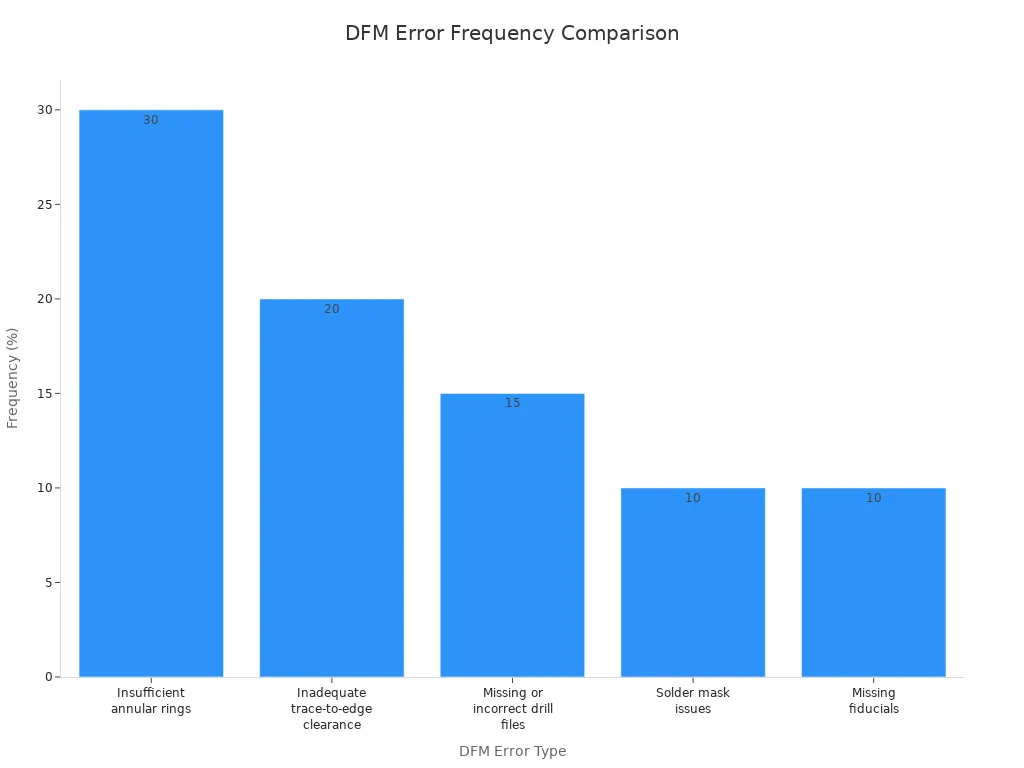
Tip: If you think about dfm early, you can plan materials and steps. This helps you avoid last-minute surprises.
Quality Risks
You keep quality high when you catch dfm issues early. If you find problems late, you need to change designs and make more prototypes. This takes more time. You might see things like solder bridging or hard-to-check parts. These problems can cause failures and upset customers. Early dfm review stops these risks before production starts. Your product stays reliable and customers stay happy.
Common DFM Issues
When you design something, you need to watch for common dfm issues. These problems can make your part hard to build. They can also make it cost more or even fail when used. If you know what to look for early, you can avoid many problems in the design for manufacturing process.
Tight Tolerances
Tight tolerances often cause problems in manufacturability. If you set very small size or fit limits, the part gets harder to make. You might need special tools and skilled workers. This can make costs go up and slow down production. You also might get more rejected parts and waste more material.
Tight tolerances make setup harder and need more precise fixtures.
You might need special cutting tools and inspection equipment.
Quality control gets harder and takes more time.
More rejected parts mean you must make extra parts.
You might need to control temperature and stop vibrations.
Skilled workers are needed for precision work, which costs more.
Tip: Only use tight tolerances when they are really needed for function. This keeps costs lower and makes manufacturability easier.
Poor Tool Access
Poor tool access is a common dfm issue. If tools cannot reach some areas, you may not be able to cut, drill, or put the part together. This can lead to extra steps, special tools, or changes to the design late in the process. You want every feature to be easy to reach with normal tools.
Check that all holes, slots, and surfaces can be reached.
Do not use deep pockets or narrow spaces that block tools.
Plan for easy assembly and inspection.
If you ignore tool access, you may have delays and higher costs during manufacturing.
Thin Walls and Weak Features
Thin walls and weak features can make your product break. These design mistakes often cause stress points and bad load sharing. The U.S. Consumer Product Safety Commission says there are over 300 product recalls each year. These recalls cost more than $1 trillion. Many recalls happen because of design and manufacturing problems like thin walls.
Thin walls can break or bend during use or assembly.
Weak retention geometry in insert molding can make things less strong.
Walls that are not the same thickness can warp or get sink marks.
You can stop these problems by making walls thick enough and features strong. This makes your product safer and lowers the risk of recalls.
Over-Specified Requirements
Over-specified requirements can make manufacturing harder and cost more. If you ask for very tight tolerances or special checks everywhere, you make machining and inspection take longer. This can lead to more scrap, rework, and higher costs.
Over-specified tolerances make machining and inspection take longer.
Complicated requirements make buying and making parts harder.
Over-engineering adds costs but does not add value.
Custom inspection steps can slow down production.
Note: Use standard requirements when you can. Save special requests for important features only.
Manufacturing Constraints
You need to think about manufacturing constraints during design for manufacturing. Many designers forget about these limits, which can cause big problems later.
Over-engineering adds extra features that make manufacturing harder.
Hard-to-find materials can slow down production and raise costs.
Custom parts make things more complex and harder to buy.
Too many fasteners make assembly take longer and add mistakes.
Bad assembly access makes installation hard.
Drawings that are not clear or missing inspection steps can cause delays.
Not planning for fixtures can make assembly hard.
You can avoid these problems by working with your manufacturing team and checking your design for manufacturability at every step.
Callout: The top five dfm issues found in industry surveys include floating copper or solder mask slivers. These can cause shorts or noise problems. Always check for these risks in your design.
By knowing these common dfm issues, you can make your design better for manufacturing and avoid costly mistakes.
DFM Review Process Steps
A strong dfm review process helps you find problems before production. You can use a step-by-step plan to make sure your design is good for manufacturing. Each step gives you a chance to make your product better and avoid expensive mistakes.
CAD Design Analysis
You begin by checking your CAD model. CAD design analysis lets you test your design on a computer. You can see how your part will work in real life. Virtual tests show where parts might be hard to make or put together. You can change features that cause problems and fix the shape of parts. CAD model validation helps you solve issues early, which makes your product more reliable and cuts down on extra work. This step helps you get your product to market faster and saves money.
CAD lets you test production and find problems early.
You can spot features that may cause trouble in manufacturing.
Feedback from CAD analysis helps you improve your design.
You spend less on development and avoid mistakes before making prototypes.
Tip: Always check your CAD model for manufacturability before moving to the next step in the dfm review process.
Collaboration with Manufacturing
You need to work with your manufacturing team during the dfm review process. Working together helps you know what can be done and what cannot. When you share your design and listen to feedback, you find answers faster. You break down barriers and get everyone working toward the same goals. This teamwork leads to better talking and fewer surprises.
Benefit | Description |
|---|---|
Improved Efficiency | You make production smoother and faster. |
Reduced Costs | Early feedback helps you save money by avoiding mistakes. |
Enhanced Product Quality | Your design fits what manufacturing can do. |
Faster Time to Market | Working together makes development go quicker. |
Better Communication | Shared goals make talking easier and clearer. |
Callout: DFM review process works best when you include manufacturing early. You get helpful advice and avoid last-minute changes.
DFM Checklist Use
You use a dfm checklist to help your review and make sure you do not miss anything. The dfm checklist helps you add manufacturing needs to your design from the start. You can find problems early and make your part design simpler. The dfm checklist also helps you pick the right materials and make production run better. This way, you have fewer redesigns and better product quality.
DFM checklist helps you spot problems before production.
You pick materials that are easy to use and build parts easier.
You make production more efficient and cut down on mistakes.
You avoid last-minute problems and keep your schedule on track.
DFM checklist makes sure you cover all important steps in the dfm review process.
Here are key things you should check in your dfm checklist:
Look at product needs and important features
Check material choices and if they are available
See if the manufacturing method fits the process
Study part shape and if it can be made easily
Decide how tight tolerances need to be
Count parts and see if you can use standard ones
Think about how to put parts together and the order
Set inspection and quality rules
Check drawings, bill of materials, and production papers
Think about where parts come from and supplier limits
Plan for how many parts you need and how fast you need them
Note: Use your dfm checklist every time you review a design. This keeps your dfm review process careful and complete.
Iterative Feedback
You make your design better by using feedback again and again in the dfm review process. Feedback from prototypes and early builds helps you improve your design for easier manufacturing. You make changes based on what you learn and test again. This cycle helps you fix problems with performance and manufacturing before full production. You see this method in industries like aerospace and consumer electronics, where small changes make products stronger and easier to put together.
Iterative feedback helps you improve your design for manufacturability.
You fix problems early and do less extra work.
Many redesigns make products last longer and easier to assemble.
Tip: Always ask for feedback and make changes during the dfm review process. This helps you build a product that works well and costs less to make.
By following these steps in the dfm review process, you get your design ready for manufacturing. You use CAD analysis, work with your team, use a dfm checklist, and ask for feedback. This plan helps you avoid mistakes, save money, and deliver high-quality products.
Design for Manufacturability Checklist
A good design for manufacturability checklist helps you find problems early. You use a checklist to make sure your design follows important rules. This makes production easier and cheaper. Using a pcb dfm checklist lowers mistakes and improves your product.
Key Checklist Items
You must check many things when you review your design for manufacturability. The table below lists the most important items for your pcb dfm checklist. These items help you cover everything from what your product does to how you design each part.
Category | Critical Items |
|---|---|
Product Definition | Make sure the part name matches the design files. Give each part a clear number. Write down what the product is for. Note how it will be used, like temperature or load. List needed standards, such as UL or CE. Guess how many you will make each year. Set a target price and the highest price allowed. |
Material Selection | Pick the material type, like metal or plastic. Choose the exact grade and supplier. Check if you can get the material easily and how long it takes. Make sure the material fits the way you will make the part. Check strength, hardness, and elasticity. Match heat and chemical needs to where the part will be used. Try to use materials that can be recycled or are renewable. |
Part Design | Remove shapes or features you do not need. Keep wall thickness the same to stop warping. Add draft angles to help with molding or machining. Take away sharp corners and use rounded edges. Make parts stronger with ribs and bosses instead of thick walls. Avoid undercuts to make tooling simple. Make sure tools can reach all areas for machining or molding. |
Tip: Always use your pcb dfm checklist at every step of design. This habit helps you remember key steps and keeps your manufacturability review complete.
Systematic Review Approach
You get better results when you follow a clear plan with your pcb dfm checklist. This method gives you a way to check your design for manufacturability every time. You find problems early and keep your process steady.
You set up a process that mixes design and manufacturing needs from the start.
You find problems early, so people do not misunderstand each other.
You make sure your design fits both electrical and mechanical needs.
You keep your production schedule on track and waste less.
When you use a pcb dfm checklist and follow a clear review, you trust your process. You know your design for manufacturability review will find problems before they cost too much. This works for any team, big or small.
Best Practices for DFM
Early Team Involvement
You get better results when your team joins early. Designers, engineers, and manufacturing experts should work together from the start. This lets everyone share ideas and find problems before they get bigger. If you include manufacturing engineers in your first design talks, you can spot manufacturability issues right away. You also make sure your design goals fit what you can build. Early teamwork helps you avoid expensive changes and keeps your project moving.
Tip: Talking clearly between teams helps you balance design needs and production limits.
Here are ways to involve your team early:
Invite manufacturing partners to design meetings.
Do quick manufacturability checks during concept planning.
Set up clear dfm guidelines for your product.
Use of DFM Tools
You can use many tools to check if your design can be made. These tools help you find problems fast and fix them before production starts. Some popular tools are DFMPro, DFMExpress, and DFMNow. These tools work with your CAD software and give you easy-to-read reports. You can also use PCBflow, VayoPro-DFM Expert, and Altium Designer for printed circuit boards. Autodesk Fusion 360, SolidWorks, and Creo by PTC have built-in dfm checks for 3D models.
DFMPro gives you simple reports on complex checks.
DFMExpress works inside your CAD program for instant feedback.
PCBflow and VayoPro-DFM Expert help with PCB manufacturability and assembly.
Autodesk Fusion 360 and SolidWorks let you test your design before making anything.
Note: Using these tools saves time and helps you avoid mistakes.
Continuous Improvement
You should always look for ways to make your dfm process better. When you use easy-to-find materials and simple designs, you waste less and save money. This also helps the environment. Products that follow manufacturability rules have fewer defects and meet industry standards. You spend less on prototypes and tools, and your team works faster.
Cost Saving Aspect | Description |
|---|---|
Fewer Prototypes | You save time and money by making fewer test parts. |
Lower Tooling Costs | Simple designs need less expensive tools. |
Reduced Material Waste | You use materials better and throw away less. |
Faster Assembly Processes | Your team builds products quicker and with fewer mistakes. |
Callout: Keep improving your dfm process to boost quality and cut costs every year.
Real-World DFM Examples
Success Story
You can see the power of DFM in real companies. Many top brands use DFM to save money and speed up production. Here are some examples:
Company | What They Did | Savings Achieved |
|---|---|---|
BMW | Used DFM for electric vehicles. | Cut manufacturing costs by 25%. |
Whirlpool | Applied DFMA to kitchen appliances. | Reduced parts by 29%, assembly 26% faster. |
John Deere | Redesigned linkage assembly with DFM. | Increased production throughput. |
CNH | Used DFM software for new projects. | Saved $312,000 in two weeks. |
You can also learn from Toyota and Apple. Toyota uses common parts across models and error-proofing to stop mistakes. This helps them save money and build reliable cars. Toyota ranked fifth in the J.D. Power Vehicle Dependability Study in 2022. Apple thinks about manufacturing early in design. The iPod’s unibody case made assembly simple and strong. Apple uses standard connectors to keep costs down and manage inventory better. In 2022, Apple held 23% of the global smartphone market and scored 80 out of 100 in customer satisfaction.
Tip: When you use DFM early, you can cut costs, make assembly faster, and improve quality.
Lessons from Mistakes
You can avoid big problems by learning from others’ mistakes. Sometimes, skipping DFM leads to costly delays.
A US-based electronics startup designed a thin smart home hub. They sent CAD files to the factory without a DFM review. The first parts had sink marks and warping because the walls were too thin and draft angles were missing. The mold needed three re-cuts. The launch was delayed by four months, and costs went up by 40%.
Here are key lessons you should remember:
Always check manufacturability early in the design.
Work with your team to spot problems before production.
Pick materials for how they perform, not just price.
Use feedback from past projects to make better choices.
Note: You can save time and money by making DFM a habit in every project.
You gain big advantages when you start dfm reviews early. You save money, improve quality, and make your process smoother. The table below shows how a structured dfm review helps you:
Benefit Type | Description |
|---|---|
Cost Savings | Save up to 50% on total costs. |
Product Quality | Get higher yields and fewer defects. |
Risk Reduction | Avoid late surprises and keep projects on track. |
You should use dfm checklists and review steps to catch problems before production. To build strong habits, follow these steps:
Involve your team from the start.
Use a dfm checklist for every design.
Review and improve your process often.
Make dfm part of every design phase to boost results and avoid costly mistakes.
FAQ
What does DFM mean?
DFM stands for Design for Manufacturability. You use DFM to make sure your design is easy and cost-effective to produce. This process helps you avoid mistakes and delays.
When should you start a DFM review?
You should start a DFM review as soon as you finish your first design draft. Early reviews help you catch problems before they become expensive.
What tools help with DFM checks?
You can use tools like DFMPro, DFMExpress, and PCBflow. These tools work with your CAD software and give you quick feedback on your design.
Tip: Try free DFM tools first to learn how they work.
How does a DFM checklist help you?
A DFM checklist helps you remember important steps. You can use it to check materials, tolerances, and part shapes. This keeps your design on track.
Checklist Benefit | How It Helps You |
|---|---|
Fewer mistakes | You catch errors early |
Faster reviews | You save time |
Better quality | You meet standards |
What happens if you skip DFM?
You may face higher costs, more defects, and long delays. Skipping DFM can lead to rework and unhappy customers.
Note: Always include DFM in your design process to avoid these problems.
See Also
Tips for Steering Clear of BGA Assembly Errors
Identifying SMT Circuit Board Assembly Flaws and Prevention Tips
Conducting Thorough Inspections for SMC and SMD Components
Essential SMT Assembly Techniques for Superior Electronic Production
Crucial Strategies to Enhance PCBA Durability and Performance
