Aqueous vs Solvent Cleaning in PCBA
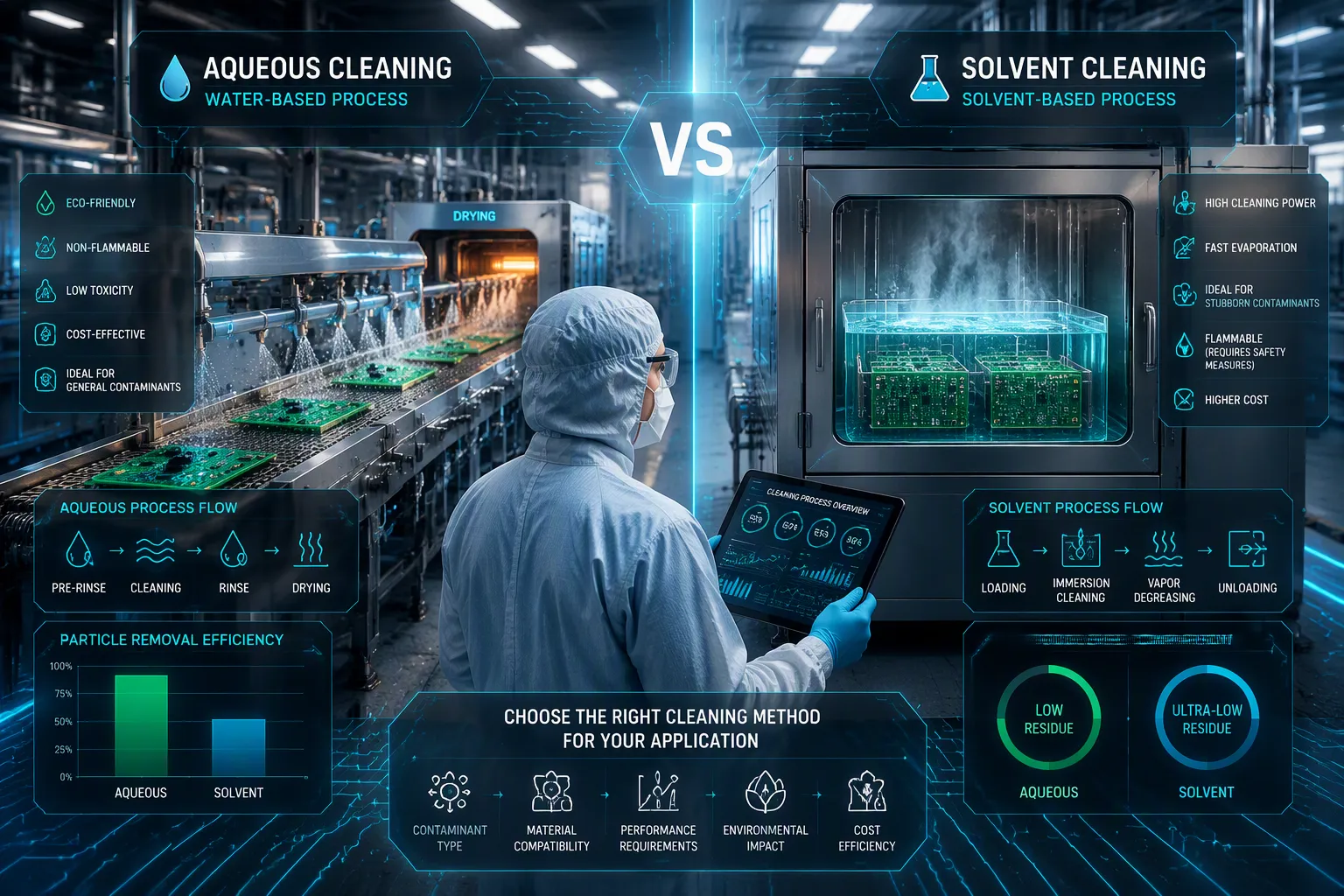
You might wonder, 'Which is better for pcba cleaning: aqueous or solvent?' Aqueous cleaning uses water and detergents. It is flashpoint-free and more environmentally friendly. Solvent cleaning uses organic chemicals. It is faster and does not need a rinse step. Your choice depends on factors such as flux type, contamination level, and industry standards like IPC-CH-65. You must clean your pcb fully to make sure it lasts long. A clean pcb stops electrochemical migration and other problems. The pcb's cleanliness is very important for how well it works. You must clean it well after assembly. Make sure the surface is clean before coating. This guide compares aqueous and solvent methods. You will learn how to pick the right cleaning process. Then you can make a smart choice for your pcb.
Key Takeaways
Clean your PCBA well to stop problems like short circuits and rust.
Aqueous cleaning uses water and detergents. It is safe but takes longer.
Solvent cleaning uses chemicals; it is fast but needs careful handling.
Pick your method based on the flux you use and what your production requires.
Always test your PCBA’s cleanliness using ROSE or other methods.
Why PCBA Cleaning is Critical
Cleaning your pcb after assembly directly affects its long-term reliability. You must clean the pcb to achieve proper cleanliness. Contaminants left on the surface cause electrical failures. A clean pcb performs better. This section explains what contaminants exist and what happens if you do not clean them.
The Role of Flux and Common Contaminants
Flux is the main source of contamination on a pcb. Different flux types leave different residues. Here is a breakdown of the common types:
Flux Type | Activity Level | Residue & Cleaning Requirement |
|---|---|---|
RMA (Rosin Mildly Activated) | Moderate | Small residue; typically cleaned off |
RA (Rosin Activated) | Aggressive | Larger residue; post-soldering cleaning required |
No-Clean (R0) | Low | Minimal residue; no cleaning required |
Water-Soluble | High | Conductive/corrosive residue; must be water-washed |
Rosin-based flux leaves a sticky residue on your pcb. This residue attracts dust and moisture. It can cause corrosion over time. For high-impedance circuits above 1 MΩ, this residue becomes a real problem. Water-soluble flux leaves a highly conductive residue. You must clean it thoroughly with water. Without clean water, you risk leaving conductive salts behind. If you do not clean it thoroughly, it causes short circuits or corrosion. This risk grows in humid environments. No-clean flux leaves minimal non-conductive residue. However, in extreme conditions above 85°C or 85% RH, even no-clean residue can pose reliability issues. You should not assume no-clean products are always safe. Every no-clean formulation has limits. Testing your no-clean process is essential. No-clean does not mean no risk. A truly no-clean process still requires inspection.
Beyond flux, you find other contaminants on your pcb. Dust and particulate matter block airflow and cause overheating. Fingerprints add oils and salts. Machining oils and grease also accumulate during assembly. These contaminants mix with humidity to create conductive paths. They can lead to short circuits over time. Good industrial parts cleaning practices remove all these contaminants.
Consequences of Inadequate Cleaning
When you skip proper pcba cleaning, you risk several failure mechanisms. The most common is electrochemical migration or ECM. IPC-TR-476A defines ECM as the growth of conductive metal filaments or dendrites on or through a printed board under a DC voltage bias.
ECM requires three conditions: ionic contamination must be present on the circuit assembly, moisture must be present, and a voltage bias must exist between conductors.
The process works like this. Ionic contaminants dissolve in surface moisture. An electric field causes metal ions to migrate from the anode to the cathode. These ions deposit and form dendrites. When dendrites bridge the gap, they create a conductive path. This results in a short circuit on your pcb.
Another failure mode is creep corrosion. This happens when sulfur attacks exposed copper or silver on your pcb. Humidity above 60-70% RH is required, but no voltage is needed. The sulfur compounds react with moisture to form weak sulfuric acid. This acid attacks the metal. The corrosion can grow slowly over months or years. It eventually causes shorts or open circuits on your pcb.
Both ECM and creep corrosion threaten the safety of the assembly. You must test for cleanliness to prevent these failures. Proper defluxing removes the ionic residues that start the ECM process. Proper defluxing also removes corrosive compounds. You must clean every pcb thoroughly. A clean pcb ensures long-term performance. A clean pcb is a reliable pcb.
Aqueous Cleaning: A Water-Based Approach
Aqueous cleaning uses water as the main solvent. You mix deionized water with special detergents. This mixture removes flux residues and other dirt from your pcb. The electronics industry often uses this method to get rid of flux residues that hurt electrical performance.
How the Aqueous Process Works
Your system follows a set of steps. Each step has a specific job.
Precision Wash: The system applies aqueous chemistry with spray pressure and heat. This breaks down flux residues and dirt on the pcb surface.
Flood Box Immersion: For dense assemblies, the pcb sits in liquid for a short time. This helps clean under low-standoff components.
Multi-Stage Rinsing: Fresh or deionized water washes the pcb. This removes leftover chemistry and dissolved dirt.
Heated Drying: Controlled drying removes leftover moisture. The pcb is then ready for more work.
A clean pcb comes out of this process. You get high cleanliness levels. The system works well for high-volume production lines.
Advantages and Limitations
Aqueous cleaning offers clear safety benefits. Solutions heavily diluted with water have a high flashpoint. They only catch fire at high temperatures. Some aqueous solvents have no flashpoint at all. They are non-flammable. This makes them a great safety feature in any work area.
The environmental impact is also low. Aqueous cleaners produce little to no VOCs. They break down naturally. They create fewer emissions. The EPA does not regulate them because they are water-based. However, the EPA may regulate a cleaner if it has hazardous chemicals. You must pick cleaning solutions with safe ingredients.
Attribute | Aqueous Cleaners | Solvent Cleaners |
|---|---|---|
VOCs | Little to none; non-volatile | High; contains volatile organic compounds |
Environmental Impact | Low; biodegradable, fewer emissions, less hazardous waste | High; contribute to air and water pollution, hazardous waste, and greenhouse gas emissions |
Safety | Non-flammable, safer for handling, minimal inhalation risk | Flammable, toxic fumes, requires PPE and ventilation; higher health risks |
Disposal Requirements | Easier, less regulated; wastewater may need treatment | Strict; hazardous waste regulations, costly and complex disposal |
However, aqueous cleaning has limits. You must handle several cost factors. Water needs 970.4 BTU/pound to vaporize. Aqueous systems use about 10 times the energy of a vapor degreaser. Heating water during washing adds significant cost. Getting rid of spent agent and rinse water is costly. Most manufacturers cannot release rinse water without treatment. You need deionized or RO water. This adds pre-treatment costs.
Semi-aqueous cleaning offers another option. You mix semi-aqueous solvents with water for certain jobs. Semi-aqueous cleaning methods work well for some flux types. A semi-aqueous process can handle unique dirt problems. Your pcb benefits from this approach. For no-clean flux residues, you may not need to clean them at all. No-clean formulations leave very little residue. However, you should still test for no-clean residue in extreme conditions. A no-clean process still needs inspection. No-clean products have limits. No-clean flux does not mean no risk. Defluxing with aqueous methods works well for soluble flux types. You must do defluxing correctly. Industrial parts cleaning practices ensure good results. You must keep cleanliness throughout the process. Aggressive dirt removal needs the right chemistry. Your pcba cleaning process must match your flux type. Your pcb reliability depends on proper handling. A clean pcb ensures long-term performance. You must keep your pcb clean.
Solvent Cleaning: A Chemical Solution
Solvent cleaning uses organic chemicals to remove dirt from your pcb. Isopropyl Alcohol (IPA) at 90% or higher purity is a common and good choice. These solvents break down flux residues fast. They work well for precise jobs. They also do well when no rinse is needed. The PCB cleaning market for electronic cleaning solvents had a 25.0% share in 2025. It was worth USD 347.5 million. This market is expected to grow at 6.0% per year. The total PCB cleaning market was US$ 2.1 billion in 2024.
How the Solvent Process Works
Vapor degreasing works in a closed-loop system. Solvent vapors turn into liquid on your pcb surface. They dissolve dirt without water or scrubbing. The basic setup has a boil sump, rinse sump, metal basket, and cooling coils. You lower parts into the vapor zone above the boiling solvent. Desiccants like 3 Angstrom Molecular Sieve take water out of the solvent. This is important when the solvent has alcohol. Water in the solvent makes cleaning less effective. For complex shapes with blind holes, you need changes. These changes help remove solvent and dry the pcb properly.
Several methods exist for cleaning with solvents. Vapor-only cleaning works for light dirt. Vapor-spray-vapor adds spray force. Liquid-vapor and boiling liquid-warm liquid-vapor handle tougher residues. Spray-under-immersion and vacuum degreasing offer special options. Ultrasonic agitation adds extra cleaning power. Sound waves create bubbles that burst on your pcb surface. This breaks up stubborn flux residues. Batch or inline systems use spray equipment. Manual cleaning uses aerosol sprays or pans and brushes.
Advantages and Limitations of Solvent Cleaning
Solvent cleaning is very good at removing rosin flux residues. IPA works well for standard rosin. RA residues may need special solvents. For no-clean formulas, IPA sometimes does not work. Commercial flux removers like MicroCare VeriClean handle tough residues better. You should test your residue first. Drop water on a spot. If it dissolves, the residue is ionic. If not, test with IPA. If that dissolves it, the residue is organic. Pick your cleaner based on that.
Safety concerns need your attention. Solvents are often flammable. You must control things that can cause fire. Store solvents away from flames, sparks, and hot surfaces. Used solvents are often hazardous waste. You must check this under EPA's F-list or hazardous traits. You must manage waste from start to finish under RCRA. You need DOT/UN-rated containers with tight lids. Spill kits must be nearby. You cannot pour solutions into city sewers. A hazardous waste transporter must take care of disposal. Dirty rags and filters may also be hazardous waste.
Solvent cleaning offers speed and accuracy. It does not need a rinse step. But you must balance these benefits against safety rules and disposal costs. For many jobs, semi-aqueous cleaning is a middle option. Semi-aqueous methods mix solvents with water. Semi-aqueous cleaning handles unique dirt problems. You still need good industrial parts cleaning practices. Your defluxing process must match your flux type. Your defluxing steps must make sure everything is clean. A clean pcb gives reliable performance. You must keep your pcb clean during production. No-clean flux may skip cleaning, but no-clean does not mean no risk. No-clean formulas have limits. No-clean residues can cause problems in extreme conditions. No-clean processes still need inspection. Your cleaning solutions must match your specific needs. Strong cleaning power matters for dense assemblies. You must check cleanliness after every batch. A clean pcb prevents failures. Your pcba cleaning process decides your product's reliability. Your pcba depends on proper cleaning.
Aqueous vs. Solvent: Key Differences
Effectiveness, Safety, and Environmental Impact
You need to see how each method works at the chemical level. Solvent cleaning surrounds dirt molecules and breaks the bonds that hold them to your pcb surface. This works very well for water-hating contaminants that water cannot touch. Aqueous cleaning uses water-based solutions with soaps, heat, and movement to break up soils instead. This basic difference affects everything else about the two methods.
The table below shows the main effectiveness differences you should think about:
Cleaning Aspect | Aqueous Cleaning | Solvent Cleaning |
|---|---|---|
Mechanism | Water-soluble fluxes ionize; saponifiers break rosin/halide bonds for emulsification | Solvents penetrate organic matrices, solvating colophony acids without hydrolysis |
Residue Removal | Effective for polar contaminants and water-soluble fluxes | Excels at dissolving non-polar residues like oils and greases |
Key Risk | Redeposition if rinse water quality drops below 1 µS/cm | May swell plastics if incompatible |
Your choice of cleaning method also affects safety and environmental fit. Aqueous systems run flashpoint-free, so you avoid fire hazards in your facility. Solvent systems often need careful handling because many solvents are flammable and give off toxic fumes. You must control ignition sources and provide proper ventilation. For environmental fit, aqueous cleaning produces little to no VOCs and creates fewer emissions. Solvent cleaning creates hazardous waste that requires strict disposal steps under RCRA rules. You must weigh these factors against your facility's abilities and local laws.
Cost, Equipment, and Throughput Considerations
Your budget and production volume play a big role in this choice. The cost comparison below shows the key differences:
Cost Category | Vapor Degreasing | Aqueous Cleaning |
|---|---|---|
Capital Cost | $10,000-$250,000+ | Similar range |
Labor per part | Very low | Low-Medium |
Cycle time | 1-5 minutes | 15-45 minutes |
Energy | Medium | Medium-High |
Solvent/chemistry consumption | Low (closed loop) | Medium (drag-out, rinse) |
Wastewater treatment | None | Required ($0.10-$0.50/gal) |
Floor space | Low | Medium-High |
Rework rate | Very low | Low-Medium |
Compliance cost | Moderate | Low-Moderate |
You can see the trade-offs clearly. Solvent systems clean a pcb in 1-5 minutes. Aqueous systems take 15-45 minutes for the same job. That difference affects your throughput a lot. However, aqueous systems avoid the hidden costs of solvent disposal and compliance. A study by MicroCare found that a well-tuned vapor degreaser can achieve cost-per-part-cleaned as low as 1/10th of an aqueous cleaner, with nearly three times the capacity of a similar-sized aqueous system. Yet production-scale vapor degreasing units can cost $100,000 to $500,000, while an ultrasonic aqueous system operates at a fraction of that cost.
You must also think about your flux type. No-clean flux residues may not need cleaning at all, but you should test them under extreme conditions. No-clean does not mean no risk. No-clean formulations have limits. No-clean residues can cause problems above 85°C or 85% RH. No-clean processes still need inspection. For water-soluble flux, aqueous cleaning works best. For rosin-based flux, solvent cleaning excels. Semi-aqueous cleaning offers a middle ground. Semi-aqueous methods mix solvents with water. Semi-aqueous cleaning handles unique contamination problems. Semi-aqueous approaches give you flexibility for mixed production lines.
Your final choice depends on your specific pcb assembly needs. You must evaluate your flux type, production volume, and cleanliness standards. You must also consider your budget for equipment and ongoing operations. A clean pcb prevents failures. A clean pcb ensures reliability. Your pcba cleaning process must match your needs. Your pcba depends on proper cleaning. You should talk with equipment suppliers to get tailored advice for your operation.
Choosing the Right PCBA Cleaning Method
Your choice between aqueous and solvent cleaning starts with your flux type. Water-soluble flux needs aqueous cleaning. The leftover acidic residues are very corrosive and conduct electricity. Solvent methods cannot handle this residue well. Rosin-based fluxes (R, RMA, RA) work well with solvent cleaning. Isopropyl alcohol, ketones, or hydrofluoroethers break down the non-ionic resin and activator leftovers. No-clean flux is in the middle. You may skip cleaning entirely, but for high-reliability jobs or conformal coating, solvent-based removers work best. The table below shows a bigger decision guide:
Soil/Application | Recommended Cleaning System |
|---|---|
Heavy mineral oil or gear oil | High-solvency hydrocarbon or co-solvent blend; think about semi-aqueous if inline rinsing is available |
Stamping and drawing lubricants on steel | Alkaline aqueous spray washer at 60-70°C with saponifier-boosted builder |
Cutting fluid emulsion residues | Neutral to mildly alkaline aqueous (pH 8-10) with nonionic surfactant blend |
Wax-based mold release | Semi-aqueous co-solvent system or terpene-based blend followed by aqueous rinse |
Precision medical or aerospace parts | Validated aqueous system with deionized water rinse and ROSE testing |
Silicone contamination | Specific solvent families; aqueous systems usually do not work |
Industry standards guide your cleanliness targets. IPC-A-610 section 10.6.4 sets rules for visible residue. IPC J-STD-001 defines limits for ionic contamination. For Class 2 electronics, you must stay below 1.56 μg NaCl per cm². Class 3 needs stricter control at 0.78 μg NaCl per cm². Both classes require no visible residues on your pcb. Your pcba cleaning process must meet these numbers every time.
Matching Cleaning Method to Flux and Industry Standards
Your production volume matters too. High-volume lines with water-soluble flux do well with automated aqueous systems. These systems handle continuous output well. Low-volume or precision work fits solvent cleaning. Vapor degreasing cleans a pcb in 1-5 minutes. Aqueous systems take 15-45 minutes. That speed difference affects your cycle time directly. Semi-aqueous methods offer flexibility for mixed production. You combine solvent power with water rinsing. This approach handles unique dirt problems that single-method systems miss.
Your compliance needs also shape the choice. Aqueous cleaning makes little to no VOCs. You avoid strict air quality rules. However, you must manage wastewater treatment. Solvent cleaning creates hazardous waste under RCRA rules. You need proper disposal contracts and spill containment. Semi-aqueous systems balance both concerns. They use less solvent than pure solvent methods. They also make less wastewater than full aqueous systems.
Best Practices for Implementation and Testing
Start with proper equipment setup. For benchtop cleaning, follow this four-step rule:
Wet the pcb with a non-aqueous, solvent-based flux remover.
Scrub the contaminant off gently with a good quality scrubbing brush.
Rinse away the dissolved contaminant with extra cleaning fluid.
Dry the pcb using a lint-free wipe or high-quality air duster.
Sealed fluid dispensing systems make this process better. They replace pump bottles and brushes. A controlled dispensing system keeps the flux remover clean for each use. It delivers the right amount of fluid to wet your pcba fully. You use 50-60% less fluid, which cuts cleaning costs. Worker safety improves because operators have less exposure to the flux remover.
Process control keeps your results steady. Develop detailed Standard Operating Procedures. Specify solution types, temperatures, durations, and equipment settings. Calibrate your cleaning equipment regularly. An uncalibrated ultrasonic cleaner runs at uneven frequencies. That leads to uneven cleaning across your pcb. Control humidity and temperature in the cleaning area. A cleanroom environment with humidity below 50% stops secondary contamination.
Verification shows your process works. ROSE testing measures overall ionic residue conductivity. It reports results as NaCl equivalents per area. However, ROSE cannot find specific ions. It may miss local contamination under low-standoff components. Ion Chromatography extracts residues and finds individual ions like chlorides and sulfates. Surface Insulation Resistance testing measures leakage currents under controlled conditions. This test takes 7 days but gives the most complete picture. For sensitive components, local ionic testing works best. A case study showed ROSE indicated acceptable cleanliness even when boards showed dendritic growth. Local ionic and SIR testing showed a 76% match. Combine methods for root-cause analysis. Your clean pcb ensures long-term reliability. Your pcba cleaning process must stay verified at every step.
No single cleaning method wins for every pcba. Your flux type, safety rules, and budget decide the best fit. Aqueous cleaning suits most modern, eco-conscious operations. It runs flashpoint-free and meets strict environmental standards. Solvent cleaning remains valuable for high-throughput or sensitive applications where speed matters.
Cleaner Type | Pros | Cons | Industry Trend |
|---|---|---|---|
Water-Based | Eco-friendly, effective for ionic residues | Longer drying times | Preferred for compliance |
Solvent-Based | Powerful against tough residues | VOC risks | Necessary for heavy-duty tasks |
Semi-Aqueous | Balances effectiveness and environment | May need specialized equipment | Hybrid middle ground |
Experts Umut Tosun and Karl Seelig warn that IPA cannot properly remove no-clean flux residues. They recommend testing via SIR and electro migration to verify your clean pcb.
Evaluate your own process. Consult cleaning equipment and chemistry suppliers for tailored advice. A clean pcb ensures long-term reliability.
FAQ
Can you skip cleaning with no-clean flux?
No-clean flux leaves behind very little residue. In many cases, you can skip cleaning. But extreme conditions above 85°C or 85% RH can cause issues. You should still test your pcb to make sure it works well. No-clean does not mean no risk.
How do you verify your pcb is clean enough?
Use ROSE testing to check ionic residue on your pcb. IPC-A-610 Class 2 needs less than 1.56 μg NaCl per cm². For important jobs, use Ion Chromatography or Surface Insulation Resistance testing. These methods find hidden dirt.
What safety concerns come with solvent cleaning?
Solvents often catch fire easily. You must control things that can start a fire. Keep solvents away from sparks and hot surfaces. Make sure there is good airflow. Used solvents are hazardous waste under RCRA rules. You need proper disposal steps.
Which cleaning method works best for water-soluble flux?
Aqueous cleaning works best for water-soluble flux. Water-based solutions fully dissolve the conductive residue on your pcb. Solvent methods cannot handle this residue well. You must wash thoroughly to stop short circuits.
See Also
Ultrasonic Cleaning Methods For Printed Circuit Board Assemblies
Post-SMT Board Cleaning Techniques For Optimal Performance
Medical Device PCBA Manufacturing Standards And Specifications
