Wave Soldering vs Selective Soldering in PCBA
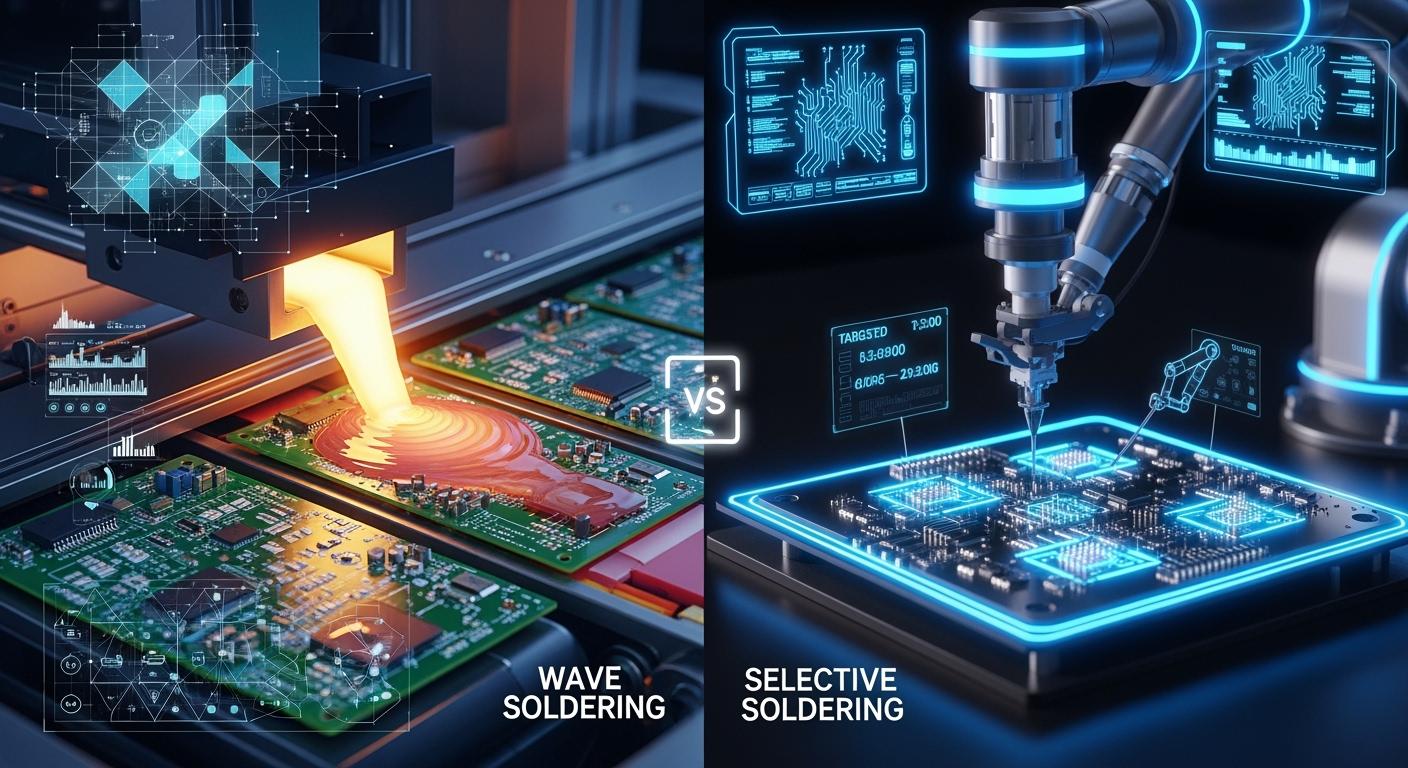
If you want great results in printed circuit board assembly, your soldering method is important. Wave Soldering is good for big projects because it is quick and costs less, but it can cause more problems from heat. Selective soldering gives better quality and fewer mistakes, especially with tricky boards.
Wave Soldering works well for lots of boards and saves money on workers.
Selective soldering works with many part shapes and stops heat damage.
Key Takeaways
Wave soldering works best for big jobs with easy boards. It saves time and money because it solders many boards together.
Selective soldering gives better quality for hard boards. It stops heat damage and lets you solder certain joints exactly.
Pick wave soldering if you need to make lots of through-hole parts. Use selective soldering for boards with different types of parts that are delicate.
Knowing how these methods are different helps you pick the right one. Think about how your board is made and how many you need.
Talking to PCBA experts can help you avoid mistakes. It also makes sure your solder joints are strong and last a long time.
Quick Answer: Which Is Best?
Main Factors
When you pick between wave soldering and selective soldering, you should think about a few key things. Each method is best for certain jobs. Here are the main points to look at:
Component Height: Wave soldering does not work with tall parts. Tall parts can block the solder and cause issues.
Component Spacing: If your board has through-hole parts close to surface-mount parts, wave soldering may not fit. There might not be enough room for special holders.
Board Thickness and Heating: Thick boards or boards with thick copper can heat up unevenly. Wave soldering or hand soldering may not work well for these boards.
Pin Density: Boards with big connectors and lots of pins are hard to solder by hand. Selective soldering can do this job better.
Complex Pin Layouts: Selective soldering can handle tricky pin setups. It uses special tools and heaters to reach tough spots and keep heat even.
Selective soldering lets you solder many rows of pins at once. It can reach places that other methods cannot. This makes it faster and better for boards with lots of parts.
Summary Recommendation
You can use this table to see how wave soldering and selective soldering compare:
Criteria | Wave Soldering | Selective Soldering |
|---|---|---|
Production Volume | Best for high-volume production | Suitable for low-to-medium volume or prototypes |
Board Complexity | Ideal for simple designs with through-hole components | Better for complex designs with mixed technologies |
Cost | More cost-effective for large batches | Higher upfront costs but better quality |
Component Sensitivity | Less suitable for heat-sensitive components | Minimizes thermal risks for sensitive components |
Quality Requirements | Higher defect rates (2-5%) | Lower defect rates (below 1%) |
To choose the best way, think about what your project needs. Wave soldering is good for simple boards and big jobs. Selective soldering is better for tricky boards, sensitive parts, or when you want top quality. This soldering comparison helps you pick the right way for your board.
"Our engineers have a lot of experience and know which soldering process is best for your PCBA. You can trust that your board will get the soldering process that fits your needs.
Wave Soldering Basics
What Is Wave Soldering?
Wave soldering helps connect lots of parts to a circuit board fast. This process is good when you need to work quickly and want every board to look the same. In wave soldering, the board moves over a wave of hot, melted solder. The wave touches the bottom and connects the leads to the pads. This is a common way to solder through-hole circuits.
Here is how wave soldering works:
Flux is put on the bottom to clean the leads and pads.
The board is heated to make the flux work and get ready for soldering.
The board goes over the wave of melted solder, making the connections.
The board cools, and the solder joints get hard.
This process lets you solder lots of boards at once. It is a good choice for big jobs in pcb assembly.
Pros of Wave Soldering
Wave soldering has many good points, especially for making lots of boards at once. You can see the main benefits in this table:
Advantage | Description |
|---|---|
High Throughput for Mass Production | You can finish many circuit boards quickly with wave soldering. |
Cost-Effectiveness in Bulk | Using machines saves money and cuts down on worker costs. |
Reliable Joint Formation | The process makes strong and even solder joints for your boards. |
Other good things are:
You do not need to spend a lot on equipment compared to hand soldering.
You use standard solder bars and flux, so you use materials well.
Maintenance is easy, which is good for making lots of boards.
It gives a good mix of cost and quality for jobs with fewer boards.
Tip: If you need to solder many boards that look alike, wave soldering can help you save time and money.
Cons of Wave Soldering
Wave soldering has some problems. You might have trouble if your board has different kinds of parts or sensitive pieces. This process works best for boards with mostly through-hole parts. If your board has lots of surface-mount parts, you may need another soldering method.
Common problems with wave soldering are:
Solder bridging can happen if you use too much solder or if parts are too close.
Not enough solder joints can happen if you do not use enough flux or if the board is not hot enough.
Parts can get damaged if the board heats up too fast.
Flux left on the board can cause rust if you do not clean it well.
You can fix these problems by changing the wave height, checking the flux, and using the right heat. Always follow good rules when you design your boards to stop these problems.
Note: Wave soldering may not work well for boards with both surface-mount and through-hole parts. For these boards, selective soldering or another method may be better.
Selective Soldering Basics
What Is Selective Soldering?
Selective soldering is used when you need to join parts carefully. This process lets you heat and solder only certain spots. You do not heat the whole board at once. Selective soldering works for boards with both through-hole and surface-mount parts. It is good for tricky layouts and keeps sensitive parts safe.
Here is how selective soldering works:
A machine puts flux just on the joints you want.
The board heats up in small areas, not everywhere.
A nozzle comes up and touches the pad you want to solder.
The nozzle stays for a few seconds, then moves away.
The machine repeats these steps for each spot.
You can see the main differences between selective soldering and wave soldering in this table:
Feature | Selective Soldering | Wave Soldering |
|---|---|---|
Solder Application | Targeted to specific joints only | Entire board bottom exposed |
Heat Exposure | Minimal, localized heating | Board-wide thermal stress |
Flux Application | Precise, drop-jet or micro-spray | Full board flux coating |
Throughput | Lower (sequential soldering) | Higher (all joints at once) |
Tooling Required | Minimal or none (toolless) | Pallets/carriers often needed |
Best For | Mixed-technology boards, low-medium volume | High-volume, through-hole only boards |
Setup Time | Quick program changes | Carrier/pallet changes needed |
Material Waste | Lower solder and flux consumption | Higher consumption |
Selective soldering gives you control over where you solder. You can tell the machine to solder only certain places. This makes it a smart choice for boards with many different parts.
Pros of Selective Soldering
Selective soldering has many good points for your assembly work. You get high accuracy and less chance of damage. It is great for boards with both through-hole and surface-mount parts. You can use it for prototypes or small batches. This process saves solder and flux because you use only what you need.
Here are the main benefits of selective soldering:
Benefit | Description |
|---|---|
Precision | You can solder tiny spots on crowded boards. |
Efficiency | The process is fast and accurate. |
Adaptability | Machines can change programs quickly for new jobs. |
Error Minimization | You reduce mistakes by soldering only where needed. |
Consistency | Every joint looks the same, every time. |
Control | You decide where and how much solder to use. |
Selective soldering is good for mixed-technology boards.
You can use it for tricky layouts.
It helps you avoid heat damage to sensitive parts.
You get steady results with selective soldering.
Tip: If you want to keep your boards safe and get strong joints, selective soldering is a great choice.
Cons of Selective Soldering
Selective soldering has some limits you should know. It can be slower than wave soldering for big jobs. It may cost more for each board if you make many at once. You need to watch for problems like solder bridging, solder balling, and holes not filled right.
Here are some common problems with selective soldering and how you can fix them:
Defect | Description | How to Fix It |
|---|---|---|
Solder Bridging | Solder connects pads that should not touch. | Use clean nozzles, set the right angle, and control flux volume. |
Solder Balling | Small solder balls form on the board. | Use low-speed flux, preheat well, and filter the solder pot often. |
Insufficient Hole Fill | Holes do not fill with enough solder. | Check pin size, add more flux, and use X-ray to check fill. |
Fillet Lifting | Solder lifts off the pad. | Limit heat time, use good pad finishes, and inspect after solder. |
You can stop most problems by setting up your machine the right way. You should check your boards after soldering to find any issues. Selective soldering gives you lots of control, but you need to pay attention to details.
Note: Selective soldering is best for tricky boards, but you must check your process to get the best results.
Key Differences Between Wave and Selective Soldering
Process Comparison
There are big differences in how these two methods work. Wave soldering moves the board over a wave of hot solder. This covers the whole bottom of the board at once. Selective soldering uses a small nozzle to put solder only where you want. The table below shows how each step is different:
Step | Wave Soldering | Selective Soldering |
|---|---|---|
Flux Application | Spray flux coats the entire board bottom | Precision drop-jet applies flux only to target joints |
Preheating | IR or convection heaters raise the board to 100-130°C | Bottom-side IR preheats localized areas to 80-110°C |
Soldering | Board passes over a standing solder wave at 245-265°C | Small nozzle contacts specific pads |
Dwell & Withdrawal | N/A | Nozzle holds contact for 2-5 seconds, then retracts |
Cooling/Indexing | Board exits the wave; cooling solidifies joints | Machine moves to next programmed solder point |
Throughput | 60-120 boards per hour | N/A |
Wave soldering is best when you need to solder lots of boards fast. Selective soldering gives you more control and only solders the spots you choose.
Tip: If your board has both through-hole and surface-mount parts, selective soldering helps protect sensitive pieces from heat.
Quality and Cost
You want every board to have strong and reliable joints. Selective soldering lets you control where you put the solder. This means less heat and fewer mistakes. You will see fewer problems like solder bridges or holes that do not fill. Wave soldering is good for making many boards, but it can make more mistakes if your board is complicated.
Selective soldering makes better joints and has fewer mistakes.
Wave soldering can cause more repairs, especially with mixed boards.
When you think about cost, wave soldering is cheaper if you make a lot of boards. The price for each board goes down when you make more. Selective soldering costs more for each board, but you save money because you fix fewer mistakes and waste less. Here is a table that compares the costs:
Soldering Type | Average Cost per Board | Total Cost at 1,000 Units |
|---|---|---|
Wave Soldering | $3.50 | $8,500 |
Selective Soldering | $3.25 | $4,050 |
You can see that selective soldering can cost less if you only need a small batch. Wave soldering is cheaper when you need thousands of boards.
Note: Selective soldering uses less solder and flux, so it makes less waste and is better for the planet.
Speed and Efficiency
Speed is important when you have many boards to finish. Wave soldering is the fastest way for big jobs. You can solder hundreds of boards every hour. Selective soldering is slower because it solders one spot at a time. This method is best for small or medium jobs.
Aspect | Wave Soldering | Selective Soldering |
|---|---|---|
Speed | Fastest (high-volume) | Medium-Fast to Slowest (depending on method) |
Throughput | Highest (200–1000+/hr) | Low-Medium to Medium-High (20–100+ boards/hr) |
Wave soldering helps you finish big batches quickly. Selective soldering lets you change designs fast and switch jobs with less waiting.
Selective soldering can store programs for different boards.
You spend less time fixing mistakes with selective soldering.
If you need to finish a big order fast, wave soldering is the best choice.
PCB Design Suitability
You need to pick the right soldering method for your board. Wave soldering is best for simple boards with mostly through-hole parts. It works well for open layouts and big jobs. Selective soldering is better for boards with many part types, tight spaces, or sensitive pieces.
Soldering Method | Best Suited PCB Designs |
|---|---|
Wave Soldering | - Primarily through-hole components |
- High production volumes | |
- Simple and open board layouts | |
- Cost-per-unit minimization | |
Selective Soldering | - Mix of SMT and THT components |
- High component density | |
- Concerns about thermal sensitivity | |
- Frequent design changes | |
- Need for flexibility without pallets |
Use wave soldering for lots of simple boards. Use selective soldering when your board has many parts close together or needs special care.
Remember: Knowing the differences between these methods helps you choose the right one. Think about your board design, how many you need, and how good you want them to be before you decide.
When to Use Wave Soldering
Best Applications
Wave soldering is good for making lots of boards fast. It works best when your boards have many thru-hole pins and simple layouts. You can use wave soldering if the parts are not too close together. If your board does not have many sensitive parts, you will get good results.
Many companies use wave soldering because it saves money and time. You can find this system in:
Consumer electronics, like TVs and radios
Automotive electronics, such as dashboard controls
Industrial devices, including PLCs and sensors
Medical equipment, like heart monitors and ventilators
Energy products, such as solar panels
Wave soldering is best for boards without mixed technology. If your project does not need special care for sensitive parts, this method helps you finish faster and spend less.
Tip: If you want to finish a big job quickly and save money, wave soldering is a smart way to go.
Example Scenarios
Think about a factory that makes thousands of remote controls each week. You want every board to look the same and work well. Wave soldering helps you do this. You can also use wave soldering for car dashboards, where most parts are thru-hole and not many sensitive parts are used.
Suppose you need to make sensors for a factory. These boards have lots of thru-hole pins and few sensitive parts. Wave soldering gives strong joints and quick production. You can use this method for solar panel controllers, where saving money matters and the design is simple.
If your board has some sensitive parts, you can protect them with shields or take them off before soldering. This way, you still get the benefits of an automated system and keep your parts safe.
Note: Always check your board for sensitive parts before you pick wave soldering. This step helps you avoid problems and keeps your work running smoothly.
When to Use Selective Soldering
Best Applications
Selective soldering is good when your board has many kinds of parts. It works well for boards with surface mount and through-hole components. If parts are close together, selective soldering helps you avoid errors. You can solder single leads or small groups of pins. You do not need to heat the whole board. This process gives you control and keeps sensitive parts safe.
Here are times when selective soldering is the best choice:
Boards with lots of parts and tricky layouts
Mixed technology boards with surface mount and through-hole parts
Places where you need to solder only certain pins or leads
Boards with things underneath that block other soldering methods
Projects that need careful soldering for strong connections
Selective soldering helps you work on hard boards and keeps your connections strong. You can use it for prototypes or small batches when you need careful soldering.
Example Scenarios
Selective soldering is used in many industries. This method helps you build products that need careful assembly. The table below shows where selective soldering is important:
Industry | Applications |
|---|---|
Automotive Electronics | Engine control modules, Transmission controllers, Safety system electronics, Infotainment systems, EV battery management systems, Charging infrastructure |
Medical Devices | Patient monitoring equipment, Diagnostic instruments, Implantable device components, Laboratory analyzers, Imaging system electronics |
Aerospace and Defense | Flight control systems, Communication equipment, Radar and sensor systems, Navigation electronics, Satellite components |
Telecommunications | High-frequency RF modules, Power distribution boards, Network switching equipment, Fiber optic transceivers |
Industrial Automation | PLC controllers, Motor drives, Sensor interfaces, HMI displays |
You might need selective soldering for a medical device with tiny parts close together. You can use it for an automotive controller with surface mount chips and through-hole connectors. Selective soldering helps you build flight control systems for airplanes, where every connection must be perfect. You can also use it for network equipment that needs strong and careful solder joints.
If your project needs careful soldering and has a tricky design, selective soldering gives you the best results.
You can easily see that wave soldering and selective soldering are not the same. The table below shows how each one works for different jobs:
Feature | Wave Soldering | Selective Soldering |
|---|---|---|
Process | Fast, covers whole board | Precise, targets specific joints |
Advantages | High volume, cost-effective | Reliable, flexible, low defect rate |
Best Use Case | Simple, through-hole boards | Complex, densely populated boards |
Pick your soldering method by thinking about how many boards you need, how hard your board is, and how good you want it to be. Here are some things to remember:
Check what your board is made of and how it is set up.
Make sure the way you solder matches your goals for making boards.
Ask PCBA experts for help if your board design is tricky.
Getting advice from experts helps you stop mistakes and makes sure your solder joints are strong and last a long time.
FAQ
What is the main difference between wave soldering and selective soldering?
Wave soldering covers the whole board with melted solder at once. Selective soldering only puts solder on certain joints. You use wave soldering for simple boards made in large numbers. Selective soldering is better for tricky boards with different kinds of parts.
Can you use both soldering methods on the same PCB?
Yes, you can use both ways on one board. Wave soldering works for through-hole parts. Selective soldering is good for spots with sensitive or crowded parts. Using both helps you make strong joints and keep delicate pieces safe.
Why does selective soldering cost more per board?
Selective soldering takes longer because the machine solders each joint by itself. You also need special machines and programs. This way gives you better control and fewer mistakes, but it costs more for each board.
How do you choose the right soldering method for your project?
Look at your board’s design, how many boards you need, and what parts you use. Pick wave soldering for easy boards and big jobs. Choose selective soldering for hard layouts or when you need to protect sensitive parts.
What defects can happen during soldering, and how do you prevent them?
You might get solder bridges, cold joints, or holes that do not fill. To stop these, set the right heat, use enough flux, and check your boards after soldering. Good setup and checking often help you avoid most problems.
See Also
Techniques for Double-Sided Reflow Soldering in PCBA Manufacturing
Importance of Nitrogen Reflow Soldering in Automotive and PCBA Applications
Best Practices for Wave Soldering in SMT Assembly Processes
Reflow Soldering Techniques for Through-Hole Parts Post-SMT Assembly
