RoHS Compliance for PCBA Manufacturing
You must focus on RoHS compliance when you work with PCB assembly. RoHS keeps dangerous substances out of your PCB and protects both people and the planet. If you ignore compliance, you face big risks. Non-compliant products can be blocked from the EU market or even recalled. Your company could pay fines, lose reputation, or face legal action. You need to choose safe materials and check every step. RoHS rules change often, so you must control your process at all times.
Key Takeaways
RoHS compliance is very important for PCB assembly. It stops dangerous substances from getting into electronics. This keeps people and the environment safe.
Not following RoHS rules can cause big problems. You might get fines or have to recall products. You could also lose access to markets. Make sure your products follow compliance standards.
Use lead-free solder and halogen-free laminates for RoHS compliance. These materials are safer for users and the planet.
Test materials often and keep good records. This helps you stay compliant. It lets you fix problems fast and keep your products in the market.
Keep up with RoHS regulations. The rules can change. Check for updates often so you do not use banned substances.
What Is RoHS Compliance?
RoHS Directive Overview
Before you start pcb assembly, you should know what RoHS compliance means. RoHS stands for Restriction of Hazardous Substances. This rule keeps dangerous substances out of electronics. RoHS helps protect people and the environment. It also supports making products in a better way. If you want to sell in Europe, you must follow RoHS rules.
RoHS limits some harmful substances. These are lead, cadmium, mercury, hexavalent chromium, polybrominated biphenyls, polybrominated diphenyl ethers, and four phthalates. The directive has changed over the years:
Directive | Year | Key Changes | Restricted Substances |
|---|---|---|---|
RoHS 1 | 2002 | First rules, started in 2006 | Lead, Mercury, Cadmium, Hexavalent chromium, PBB, PBDE |
RoHS 2 | 2011 | CE marking, more types | Same as RoHS 1 |
RoHS 3 | 2015 | Four phthalates added | Lead, Mercury, Cadmium, Hexavalent chromium, PBB, PBDE, DEHP, BBP, DBP, DIBP |
To be RoHS compliant, you must not use these substances in your parts or materials. RoHS also helps recycling by lowering dangerous chemicals. This makes recycling easier and helps you compete in Europe.
Tip: Always look at the newest RoHS checklist for designers. RoHS rules can change, so keep checking for updates.
Importance for PCB Manufacturing
When you follow RoHS compliance in pcb manufacturing, you help keep people and the planet safe. PCBs have many parts and materials. Using restricted substances can hurt workers and users. Lead can damage the brain and nerves. The World Health Organization says lead poisoning causes 1.5% of deaths worldwide each year.
RoHS compliance cuts down on toxic waste from pcb manufacturing. PCBs that do not follow the rules make more e-waste. Dangerous chemicals can get into soil and water. Burning or dumping e-waste puts bad chemicals in the air. By following RoHS, you help stop skin problems, breathing issues, and serious health risks like cancer.
You also make recycling safer and better for the planet. RoHS compliance lets you sell your products in many countries. Now, many places need RoHS certification. If you do not follow the rules, you may not be able to sell in other countries.
Note: RoHS compliance keeps workers, users, and the environment safe. You must pick safe materials and check every step in pcb manufacturing.
RoHS Restricted Substances for PCB
List of Restricted Substances
You should learn about the rohs restricted substances for pcb before starting pcb assembly. The rohs directive controls ten dangerous substances. These substances can hurt people and nature. RoHS compliance means you must keep these substances under strict limits in your printed circuit boards.
Here is a table that shows the rohs restricted substances for pcb and their highest allowed amounts:
Substance | Maximum Allowable Concentration |
|---|---|
Lead (Pb) | <1000 PPM |
Mercury (Hg) | <1000 PPM |
Cadmium (Cd) | <100 PPM |
Hexavalent Chromium (Cr6+) | <1000 PPM |
Polybrominated Biphenyls (PBB) | <1000 PPM |
Polybrominated Diphenyl Ethers (PBDE) | <1000 PPM |
Bis(2-ethylhexyl)-phthalate (DEHP) | <1000 PPM |
Butyl benzyl phthalate (BBP) | <1000 PPM |
Dibutyl phthalate (DBP) | <1000 PPM |
Di-isobutyl phthalate (DIBP) | <1000 PPM |
You can also see the comparison in this chart:
RoHS rules set these limits to keep people and nature safe. For example, cadmium must stay under 0.01% by weight. Lead and mercury must stay under 0.1%. The rohs directive updates the list sometimes. In 2019, four phthalates were added. This means rohs compliance is not just one task. You must check the rohs compliance checklist for designers often to keep up with changes.
Note: The rohs restricted substances for pcb include metals, flame retardants, and plasticizers. Each one can cause serious health problems if you do not control them.
Impact on Materials and Components
The rohs restricted substances for pcb change how you pick materials and parts for pcb manufacturing. You must avoid dangerous materials that do not meet the rohs compliance definition. RoHS compliance means you must check every part and material to make sure they follow the rules.
Here is how the restricted substances affect your choices:
You cannot use regular solder with lead. You must use lead-free solder alloys like tin-silver-copper (SAC). These alloys need higher reflow temperatures. You must make sure your parts can handle these temperatures.
You must avoid parts with mercury, cadmium, or hexavalent chromium. These substances can be found in switches, batteries, or surface finishes.
You must check flame retardants in laminates and plastics. PBB and PBDE are common in older pcb materials. You need to use halogen-free or rohs-compliant laminates.
You must watch for phthalates in cables, connectors, and coatings. DEHP, BBP, DBP, and DIBP are often used to make plastics soft. You must pick materials that do not have these restricted substances.
RoHS compliance helps you lower dangerous waste during making, using, and throwing away products. You protect workers and users from bad chemicals. You also make recycling safer and easier. If you do not follow the rules, you could face product recalls, fines, and lose market access.
Tip: Always ask your suppliers for certificates of conformance. Test your materials and parts to make sure they meet rohs compliance.
You must remember that rohs compliance is always ongoing. The directive can add new substances at any time. You need to keep good records and check your supply chain often. This will help you keep your pcb manufacturing safe and legal.
RoHS Directive for PCB Design
The way you design your pcb is very important. You need to think about every material and process you use. Good choices help you avoid banned substances. This keeps your products safe for people. It also helps you pass the rohs compliance checklist for designers. Smart design means your boards can be sold around the world.
Lead-Free Solder Practices
You have to use lead-free solder to follow the rules. Lead-free solder is now the normal choice for rohs compliant materials for pcb. It keeps people and nature safe by removing dangerous lead. Lead-free solder melts at a higher temperature than old solder. You must check if your parts can handle more heat.
Here are some tips for using lead-free solder:
Make sure your suppliers give you rohs compliant materials for pcb with all the right papers.
Keep a list of trusted vendors who follow rohs and update it often.
Check all new materials and use XRF testing to make sure they match rohs.
Store lead-free and leaded materials in different places to stop mixing.
Teach your workers about rohs and how to check for compliance.
Pick materials from good sources with test reports.
Test new materials for banned substances and heat strength.
Design your pcb with bigger pads and more space for lead-free soldering.
Show your team how to use lead-free solder and handle materials the right way.
Lead-free solder is not the same as leaded solder:
Lead-free solder melts at 217–221°C, but leaded solder melts at 183°C.
Leaded solder flows better and looks shiny, but lead-free joints are stronger.
Lead-free solder can handle stress and heat changes better if you use the right design.
Lead-free solder is safer for people, animals, and the earth.
You must follow the rohs directive because it bans lead in electronics. Following these rules helps people trust your products and lets you sell in more places.
Halogen-Free Laminates
Halogen-free laminates are also important for the rohs directive for pcb design. These materials do not use brominated flame retardants, which are dangerous. Using halogen-free laminates lowers the risk of toxic gas in fires and makes recycling easier. This helps you follow rohs and keeps workers and the planet safe.
Halogen-free laminates have good and bad points:
Advantages | Limitations |
|---|---|
Better for the environment | Higher dielectric constant |
Meet rohs rules | Take in more water |
May come apart during hot assembly |
You avoid banned substances when you use halogen-free laminates. These materials help cut down on pollution from e-waste. They also make recycling your boards easier. But halogen-free laminates can take in more water and may come apart when heated. You should test your materials and make sure they work for your design.
Tip: Always ask for test reports and certificates when you buy rohs compliant materials for pcb. This helps you avoid dangerous substances and follow the rules.
Surface Finish Compliance
The finish you pick for your pcb matters for rohs compliance and how long your board lasts. The rohs directive for pcb design lets you use finishes that do not have lead or other banned substances. You need to choose the best finish for your use, cost, and storage needs.
Here is a table of common rohs compliant materials for pcb surface finishes:
Surface Finish | Shelf Life | Flatness | Cost | Best For |
|---|---|---|---|---|
Lead-Free HASL | 12+ months | Moderate | Low | General-purpose, through-hole heavy designs |
ENIG | 12+ months | Excellent | Medium-High | Fine-pitch BGAs, wire bonding, long storage |
OSP | 6 months | Excellent | Low | High-volume, single-reflow assemblies |
Immersion Silver | 6-12 months | Excellent | Medium | RF/microwave, membrane switch contacts |
Immersion Tin | 6 months | Excellent | Medium | Press-fit connectors, backplanes |
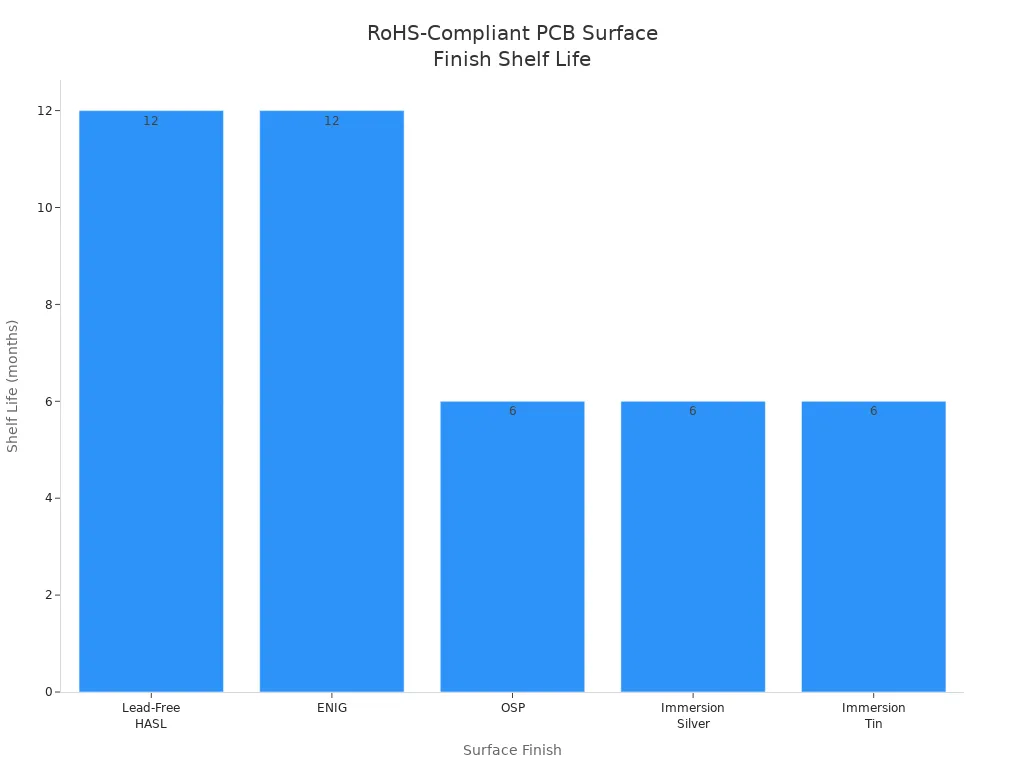
ENIG is a great choice for hard jobs because it gives a flat surface and lasts a long time. It also stops nickel from spreading. But ENIG costs more and needs careful control to stop black pad problems. OSP is cheaper and flat, but its coating wears off with heat. You must pick the finish that fits your product and can handle the higher heat of rohs compliant assembly.
RoHS compliant materials for pcb must handle higher heat and still work well. Always check that your finish follows the rules and fits your design.
Note: The right surface finish helps you avoid dangerous substances, follow rohs, and keep your pcb working well.
You should check your design choices often. The rohs directive can change and add new banned substances. Keep good records and test your materials and parts. This will help you stay ahead and keep your products safe and legal.
Material Traceability and Compliance Testing
You need good tracking and testing to meet rohs compliance in pcb manufacturing. Traceability lets you follow every material and part from start to finish. This gives you control and helps you see everything clearly. If something goes wrong, you can find and fix it fast.
Documentation and Supplier Audits
You must keep careful records for each step in pcb manufacturing. These records help you show rohs compliance and pass checks. Top manufacturers use safe data storage and reports ready for audits. This means you can prove compliance whenever needed.
Here are the main things you need for traceability:
Requirement | Description |
|---|---|
Component Lot Tracking | Save lot codes, date codes, and supplier info for every part used |
Process History | Write down solder profiles, placement data, reflow cycles, and inspection results for each pcb |
Unique Board Identification | Give barcodes or serial numbers that connect each pcb assembly to its full production history |
You also need to collect these papers for rohs certification:
Documentation Type | Details |
|---|---|
Company Information | Company name, address, and contact details. |
Product Identification | Model numbers, product names, and specifications. |
Directives Cited | RoHS Directive 2011/65/EU and amendments. |
Standards Used | Technical standards like IEC 62321. |
Responsible Signatory | Name and signature of the legal authority. |
Supporting Technical Documentation | Supplier declarations, lab test reports, BOM risk assessments, and exemption justifications. |
You should check new suppliers with XRF screening. For trusted suppliers, do yearly checks or test samples. This keeps your supply chain safe and helps you keep rohs certification.
Tip: Always ask your suppliers for certificates of conformity and material test reports.
In-House and Third-Party Testing
You must test your pcb and materials to make sure they meet rohs compliance. In-house testing helps you spot problems early. Third-party labs give extra trust and follow industry rules.
Here are common ways to test:
Testing Method | Description |
|---|---|
X-Ray Fluorescence (XRF) | Non-destructive, fast way to estimate elements in materials. |
ICP-AES | Accurate for heavy metals, but needs sample to be dissolved. |
GC-MS | Finds brominated flame retardants and phthalates, but costs more. |
You can use XRF to quickly check parts and materials. ICP-AES gives exact results for metals. GC-MS is best for finding flame retardants and phthalates. Third-party labs break down the pcb into materials, collect supplier data, test with XRF or ICP-MS, and make technical files.
Note: Regular testing and keeping good records help you stay rohs compliant and pass audits. This keeps your products and company safe.
To make sure your pcb manufacturing meets RoHS compliance, you need to do a few things. First, use lead-free solder and pick laminates that do not have halogen. Next, pick surface finishes for your pcb that follow the rules. You should keep track of all your materials and test them often. Work closely with your suppliers and use digital tools to see everything clearly. If you have hard problems, ask experts like UL Solutions for help. Managing these steps early helps you avoid big mistakes and keeps your products ready to sell around the world.
FAQ
What does RoHS conformance mean for PCB fabrication?
RoHS conformance means you do not use dangerous materials. You pick safe parts for your pcb fabrication. You keep records to show you follow the rules. This helps you meet laws and sell in more places.
How do you identify RoHS boards?
You can spot RoHS boards by looking for special marks or labels. You should also ask your supplier for a certificate of conformance. These steps help you know your boards follow RoHS rules.
Why is testing for hazardous materials important?
Testing for hazardous materials keeps people and nature safe. It helps you find unsafe parts before they reach anyone. Testing also shows you follow RoHS rules.
What happens if you do not follow RoHS regulations?
If you do not follow RoHS, you could get fined or lose sales. Your products might be taken back. You must prove you follow the rules to keep your business safe.
Who checks RoHS conformance during PCB fabrication?
Your team checks RoHS conformance, and sometimes outside labs help. Auditors may look at your records and test your boards. Good tracking helps you show your boards follow every rule.
See Also
Sourcing Electronic Parts for Efficient PCBA Production
Essential PCBA Processing Standards for Medical Devices
Key Materials Required for Successful PCBA Manufacturing
An Introductory Guide to BOM Procurement for PCBA
Enhancing Business Efficiency Through PCBA Contract Manufacturing
