Should wires be pre-tinned before robotic soldering?
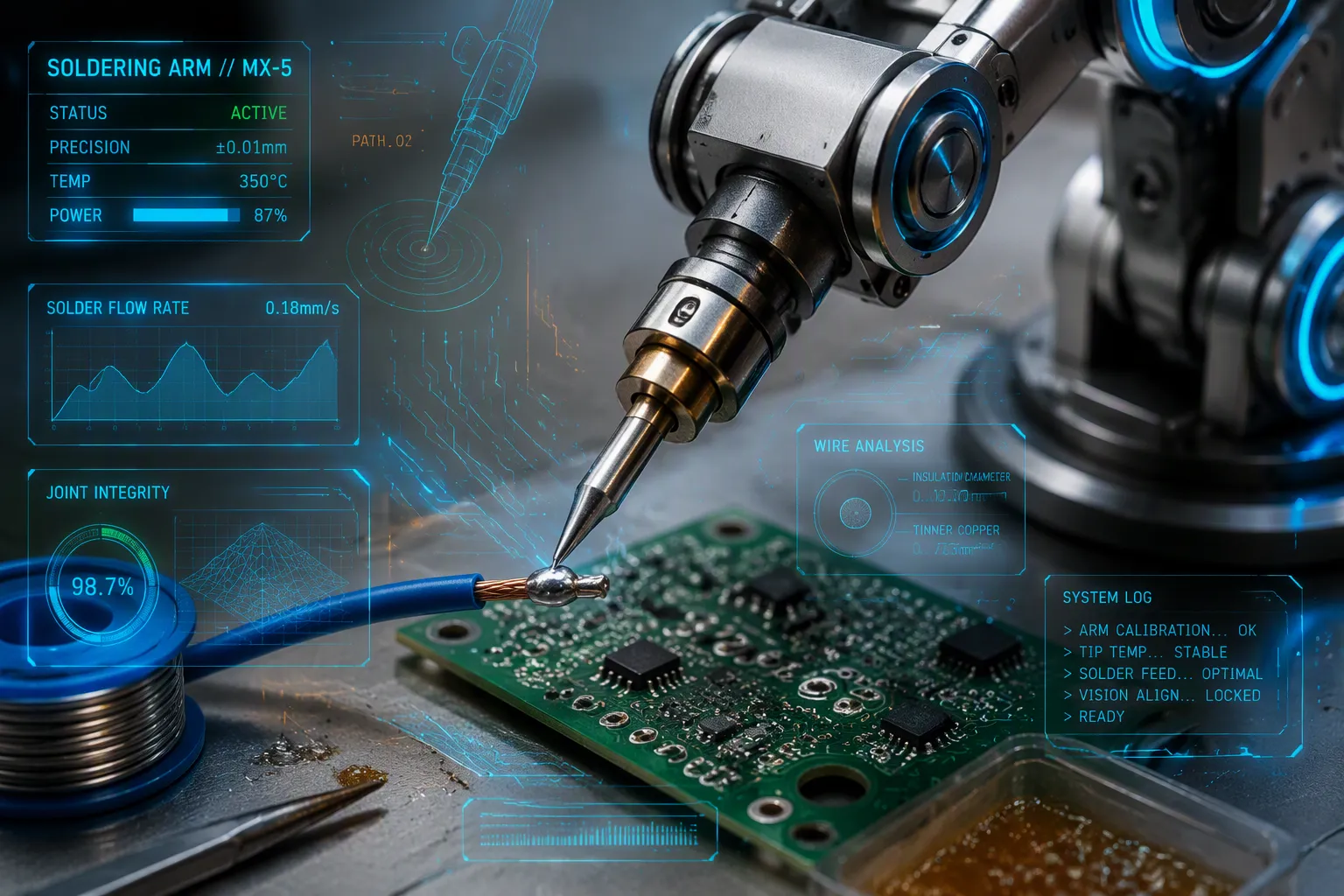
Yes, pre-tinning wires before robotic soldering is usually a good idea, especially for stranded wires. This step helps the solder stay even, cuts down on empty spots, and makes the joint stronger. It also makes the process more repeatable. Pre-tinning shields the wire from oxidation and helps it heat up faster, which matters for robotic consistency. Stranded wires gain the most because they tend to fray easily. Solid wires may not need pre-tinning. When you solder wires, you have to think about the type of conductor. Soldering wires with pre-tinning gives you stronger joints. For dependable soldering, pre-tinning is essential.
Key Takeaways
Pre-tinning wires before robotic soldering makes the joints stronger and more consistent, especially for stranded wires.
Pre-tinning stops oxidation and helps the metal heat up faster, which makes the soldering process more dependable.
Very reliable applications, like aerospace and medical devices, need pre-tinning to meet zero-defect standards.
Solid wires and controlled environments might not need pre-tinning, which saves time and money.
Adjust pre-tinning settings like temperature, dwell time, and flux choice to make sure quality is good and to fit with automated workflows.
Pre-Tinning Wires Before Robotic Soldering: Key Benefits
Pre-tinning your wires before they enter the robotic cell delivers measurable advantages. Two areas stand out: how you handle stranded conductors and fine gauges, and how you manage oxidation and thermal response. Each factor directly affects joint quality and process repeatability.
Stranded Wires and Fine Gauges
Stranded wires present a fundamental challenge for robotic assembly. The individual strands create gaps and voids between them. When you apply solder to a bare stranded wire, the molten alloy must wick into every crevice. This process is difficult to control with a robot alone. The machine may not apply enough heat or flux to reach all strands. The result is a joint with hidden voids or inconsistent coverage.
You solve this problem by pre-tinning the wire before the robot touches it. Tinning a wire means coating the entire conductor bundle with solder in a separate step. This process fills every gap between strands. The wire becomes a single, uniform conductor. When the robot later applies additional solder, the joint forms quickly and evenly. The pre-tinned layer ensures that current distributes uniformly across all strands. This uniformity is essential for reliable electrical connections. Without it, one strand may carry more current than the others. That strand can overheat and fail over time.
Fine gauges, such as smaller stranded wires, benefit even more from pre-tinning. These thin wires are fragile. The strands can break or fray during handling. A robot may struggle to position frayed wires correctly. Pre-tinning stiffens the wire bundle. It locks every strand in place. The wire becomes easier to insert into a terminal or through-hole. The robot can then perform soldering wires with greater precision. You reduce the risk of cold joints and incomplete wetting. The entire process of soldering wires becomes more predictable.
Pre-tinning also improves solder flow during the robotic step. The pre-tinned layer acts as a bridge between the iron and the wire. Heat transfers faster through the tinned coating. The solder flows smoothly into the joint area. You avoid the hesitation that occurs when a robot tries to melt solder onto a bare, cold wire. The result is a consistent, repeatable joint every cycle. When you plan for soldering wires in your production line, you must consider this thermal benefit.
Oxidation Prevention and Faster Heating
Copper wires oxidize rapidly when exposed to air. The oxide layer forms a barrier that resists wetting. Solder cannot bond to oxidized copper. A robot has limited ability to compensate for poor wetting. It follows a programmed cycle. If the wire is oxidized, the robot may not detect the problem. The joint will appear dull or incomplete. You risk field failures.
Pre-tinning wires before robotic soldering prevents this oxidation. The solder coating seals the copper from air. The wire remains in a clean, solderable state even after storage. When you store pre-tinned wires, you can keep them for days without degradation. The robot then encounters a consistent surface every time. This consistency is critical for automated processes.
Faster heating is another key benefit. A bare copper wire has high thermal conductivity. It rapidly pulls heat away from the solder joint. The robot must supply more energy to compensate. This extra heating can damage nearby components or insulation. Pre-tinned wires reduce this thermal demand. The solder coating has lower thermal conductivity than bare copper. It slows the heat loss. The joint reaches process temperature faster. The robot can complete the cycle in less time. You achieve higher throughput without sacrificing quality.
The combination of oxidation prevention and faster heating makes your production process more reliable. You eliminate two common sources of variation. The robot operates under stable conditions. Joints become more uniform. You reduce rework and scrap rates. For high-volume production, these savings add up quickly.
Essential Pre-Tinning Scenarios
Some production settings require pre-tinning wires before robotic soldering, no matter what. You cannot risk joint quality when failure leads to serious problems. Knowing these situations helps you decide where to spend money and why the extra step is worth it.
High-Reliability Applications
Aerospace and medical electronics must meet zero-defect rules. One bad solder joint can ground a plane or break an implanted device. These fields follow strict specs for every part of assembly, including wire prep. Aerospace standards clearly require pre-tinning for splices and connections. This requirement exists because tinning a wire removes the unknowns that cause random failures.
Tinning wires improves wetting and joint strength, which is essential for meeting zero-defect soldering standards in demanding aerospace environments.
The reason for this requirement is simple. Bare copper strands oxidize fast. Oxidation stops solder from sticking. A robotic soldering system cannot see this tiny barrier. It uses heat and solder based on its set program. If the wire surface resists wetting, the joint forms poorly. You might not see the flaw until final tests, or worse, until the product is in use.
Pre-tinning wires before robotic soldering removes this risk completely. The solder coat shields the copper from oxidation during storage and handling. When the robot adds more solder, the pre-tinned surface bonds right away. You get steady wetting on every cycle. This steadiness leads to strong electrical connections that handle vibration, heat changes, and mechanical stress.
The rules for high-reliability assembly are clear:
Requirement: Pre-tin stranded and braided wires.
Purpose: To improve solder joint strength and prevent strand fraying under vibration.
Context: This is a mandatory step to achieve zero-defect soldering in high-reliability aerospace PCBs.
Medical device makers follow similar steps. Implantable electronics must work perfectly for years inside the body. A cold joint or hidden void can cause signal problems or total failure. The cost of a recall is far higher than pre-tinning every wire. You protect your name and your patients by using these proven methods.
Thin Stranded Conductors
Fine-gauge stranded wires have special issues that make pre-tinning a must. Think of a fine-gauge stranded wire with many tiny strands. Each strand is very thin. These thin wires fray easily when you strip or handle them. Strands can bend, break, or pull apart from the bundle. A robot has trouble placing such an unstable part correctly.
Tinning a wire fixes this by turning the weak bundle into a stiff, even conductor. The solder fills the gaps between strands and holds them together. You remove the fraying problem for good. The robot can now grip and place the wire with ease. Insertion into holes or terminals becomes exact and repeatable.
The heat benefits matter even more with thin wires. Fine wires hold little heat. They lose heat fast when you touch them with the iron. The robot must adjust with exact temperature and timing. Any change in wire condition affects the heat profile. Pre-tinned wires react the same every time because the solder coat controls heat flow. You lower the chance of melting insulation or harming nearby parts.
Thin stranded wires also have capillary wicking issues. Solder can move up the wire under the insulation during soldering. This wicking creates a weak point where the solder ends and the flexible wire starts. Bending over and over can snap the wire at that spot. Pre-tinning controls this by filling the strands before assembly. The solder stays where you want it.
For high-volume production of medical devices, sensors, and aerospace harnesses, pre-tinning wires before robotic soldering is not a choice. It is a must for hitting the quality your customers expect. The extra step costs pennies per wire. A field failure can cost thousands. The money case matches the technical needs perfectly.
When Pre-Tinning May Be Unnecessary
Pre-tinning takes extra time and money. You should not use it for every job. Some cases let you skip this step without hurting quality. Knowing these exceptions saves you money and makes your work easier.
Solid Wires and Thick Gauges
Solid wires work differently than stranded ones. They do not fray. The single wire goes easily into holes and connectors. A robot can place and move them without pre-tinning. The wire stays strong during handling and assembly. You can remove the extra step completely.
Thick wires, such as larger gauges, are another case. These wires have a lot of mass. They hold heat during the process of applying solder. The robot can put solder straight onto the bare wire and get good wetting. Pre-tinning does little to help here. The wire's own mass already helps make a good joint.
You must keep screw-down terminal blocks separate from robotic soldering. Pre-tinning is not a good idea for screw terminals. The tinned coating can flow under pressure over time. This makes the connection loose. That use is different from soldering wires onto boards or connectors. Solid wires and thick gauges do not need pre-tinning for robotic soldering.
Controlled Environments with High-Quality Solder
Your work area matters. Controlling humidity and temperature in your shop slows copper oxidation a lot. Clean, dry air keeps the wire surface fresh. You can store bare wire longer without damage. The robot sees the same surface each time.
High-quality solder also lowers the need for pre-tinning. Good solder has active flux that removes light oxidation. The flux cleans the wire surface during soldering. You do not need a separate pre-tinning step when the solder can do the job. This benefit works mainly for solid wires. Soldering wires in controlled conditions lets you skip the extra step. Think about soldering wires without pre-tinning if your process data supports it.
You should still check your own setup. Run tests with and without pre-tinning. Measure joint quality, wetting angles, and void amounts. If results meet your IPC or internal rules, you can skip the step. The savings in time and materials add up over large production runs.
Remember: pre-tinning becomes a safety net for stranded wires and high-reliability jobs. You remove it only when the wire type and environment support direct soldering. The choice depends on your process data, not guesses.
Pros and Cons of Pre-Tinning
Pre-tinning wires before robotic soldering offers clear benefits but also adds extra work. You must compare the good and bad points for your own production line.
Benefits: Consistency and Strength
Pre-tinning gives every wire the same surface. The robot sees the same condition each time. This consistency removes a big variable from the soldering process. You cut down on cold joints by a large amount. A pre-tinned wire heats up faster and more evenly. The robot finishes each joint with the same outcome.
Joint strength goes up because the solder bonds fully to the pre-tinned layer. No gaps stay between strands. The coating acts as a base for the robotic joint. Current spreads evenly across all strands. This uniformity creates dependable electrical connections that handle vibration and temperature changes. You get stronger joints with fewer flaws. Soldering wires in a production setting needs this strength for long-term dependability.
The pre-tinned layer also stops oxidation during storage. Copper oxidizes fast in air. An oxidized wire resists solder sticking. The robot cannot fix this changing surface condition. Pre-tinning keeps the wire in a clean state. The soldering process becomes predictable. Every soldering wires operation gains from this steady starting point. You avoid the differences that come from wires with varying oxidation levels.
Drawbacks: Cost and Defect Risks
Pre-tinning adds one more step to your process. You need extra equipment, flux, and solder. Each wire takes more time. In high-volume production, these costs build up. You must train workers or set up a pre-tinning station. The added complexity needs careful planning.
Over-tinning presents a real defect risk. Too much solder on the wire causes problems. Solder can move up under the insulation during pre-tinning. This creates a stiff area where the wire can break from repeated bending. The wicking point becomes a weak spot. You also risk solder bridging between nearby wires in a connector. These defects need inspection and rework. They add cost instead of removing it.
The pre-tinning process itself can leave flux residues. Poor cleaning allows residues to cause corrosion or contamination. Soldering wires over a dirty surface leads to joint failure. You must control the pre-tinning settings carefully. The soldering wires operation depends on clean surfaces. The savings from less rework may balance out the pre-tinning cost.
Pre-tinning works best when you match the process to the wire type. Stranded wires benefit the most. Solid wires gain little. The choice depends on your specific application.
Practical Guidelines for Implementation
You can get steady results by controlling three things during pre-tinning: temperature, dwell time, and flux choice. Each one directly changes how good the final robotic joint is.
Optimizing Pre-Tinning Parameters
Temperature controls how fast solder spreads on the copper surface. Set your pre-tinning station to match your solder alloy's melting point plus a safety margin. For standard lead-free alloys, this usually means working at a temperature sufficient for good flow. You want enough heat to help flow without burning the flux or harming fine strands. Check the actual wire temperature, not just the iron tip reading.
Dwell time controls how much solder coats the conductor. Too short a dwell leaves gaps between strands. Too long a dwell makes solder move up under the insulation. Start with a short dwell time and adjust based on your wire gauge. Fine wires need less time. Thick stranded conductors need more. You should test each wire size in your stock and write down the best settings.
Flux choice matters more than most operators think. Use a flux that matches your solder alloy and wire condition. Rosin-based fluxes work well for copper that has light oxidation. Water-soluble fluxes clean more strongly but need thorough rinsing afterward. Your flux choice affects whether you need a separate cleaning step before robotic assembly.
Parameter | Recommended Range | Effect on Joint Quality |
|---|---|---|
Temperature | Sufficient for solder flow | Too low causes poor wetting |
Dwell Time | Short baseline | Too long causes wicking |
Flux Type | Rosin or water-soluble | Affects residue and cleaning |
Integrating into Automated Workflows
You can put a pre-tinning station inline before your robotic soldering cell. The station strips, fluxes, and dips each wire automatically. This method removes manual handling and keeps the process repeatable. Your robot then gets wires in a steady state every cycle.
Automated inspection closes the quality loop. Use a vision system to check solder coverage after pre-tinning. The camera spots bare copper areas, extra solder, or flux residue. Reject bad wires before they reach the robot. This step prevents costly rework later.
You should also track process data from both stations. Record temperature, dwell time, and rejection rates for each batch. This data helps you see drift before it creates bad joints. When you add pre-tinning to your line, you turn soldering wires into a fully controlled process. The mix of precise settings and automated checks makes tinning a wire a reliable first step. Your robotic soldering operation then produces steady, strong joints with little variation.
Pre-tinning wires before robotic soldering is usually a good idea, but it is not always required. Your choice depends on three things: the type of wire, how reliable the application must be, and the conditions in your work area. Stranded wires need pre-tinning to get even solder coverage and strong joints. High-reliability fields like aerospace require this step to meet zero-defect standards. Solid wires in controlled environments can skip it safely.
Run tests with your own robotic setup. Check joint quality with and without pre-tinning. Compare wetting angles and void rates. Your production data will show the best method. This testing helps you get reliable electrical connections without wasting money. Good soldering wires practice balances quality with efficiency. Smart soldering choices protect your yield and your reputation.
FAQ
How long can I store pre-tinned wires before robotic assembly?
You can keep pre-tinned wires for days without losing quality. The solder coat blocks air from reaching the copper, so it does not oxidize. This keeps the wire surface clean and ready for the robot. The robot sees the same surface every time, which makes joints more reliable.
Does pre-tinning work for all wire gauges?
No. Thin stranded wires gain the most from pre-tinning. Thick solid wires, such as larger gauges, keep enough heat to solder directly without this step. Test each wire size you use. Your production data will tell you which gauges need pre-tinning and which do not.
What temperature should I use for the pre-tinning station?
Set your pre-tinning station to a temperature sufficient for your solder alloy to flow well. This heat is enough for solder to flow well without burning flux or harming thin strands. Measure the wire's actual temperature, not just the iron tip. Adjust for your specific solder alloy and wire gauge.
Can I skip pre-tinning if I use high-quality solder with active flux?
You can skip pre-tinning for solid wires in controlled environments. High-quality solder has active flux that clears light oxidation during soldering. But stranded wires still need pre-tinning. The flux cannot reach every gap between strands. Run side-by-side tests to confirm your setup before skipping this step.
What defects should I watch for during pre-tinning?
Watch for solder wicking under the insulation. This makes a stiff spot where the wire can snap from repeated bending. Also check for flux residue and solder bridging between nearby wires. Automated vision inspection after pre-tinning catches these issues before they reach your robotic cell.
See Also
Why Nitrogen Reflow Soldering Matters For Automotive And Other Pcba Products
Performing Reflow Soldering On Through-Hole Parts Following Smt Assembly
Essential Technical Guidelines For Wave Soldering In Smt Assembly
Classifying Solder Pastes And Understanding Component Variations In Smt Assembly
Key Process Requirements For Reflow Soldering In Smt Manufacturing
