Enhancing Data Flow in Smart Factories with Industrial IoT Gateway PCBA
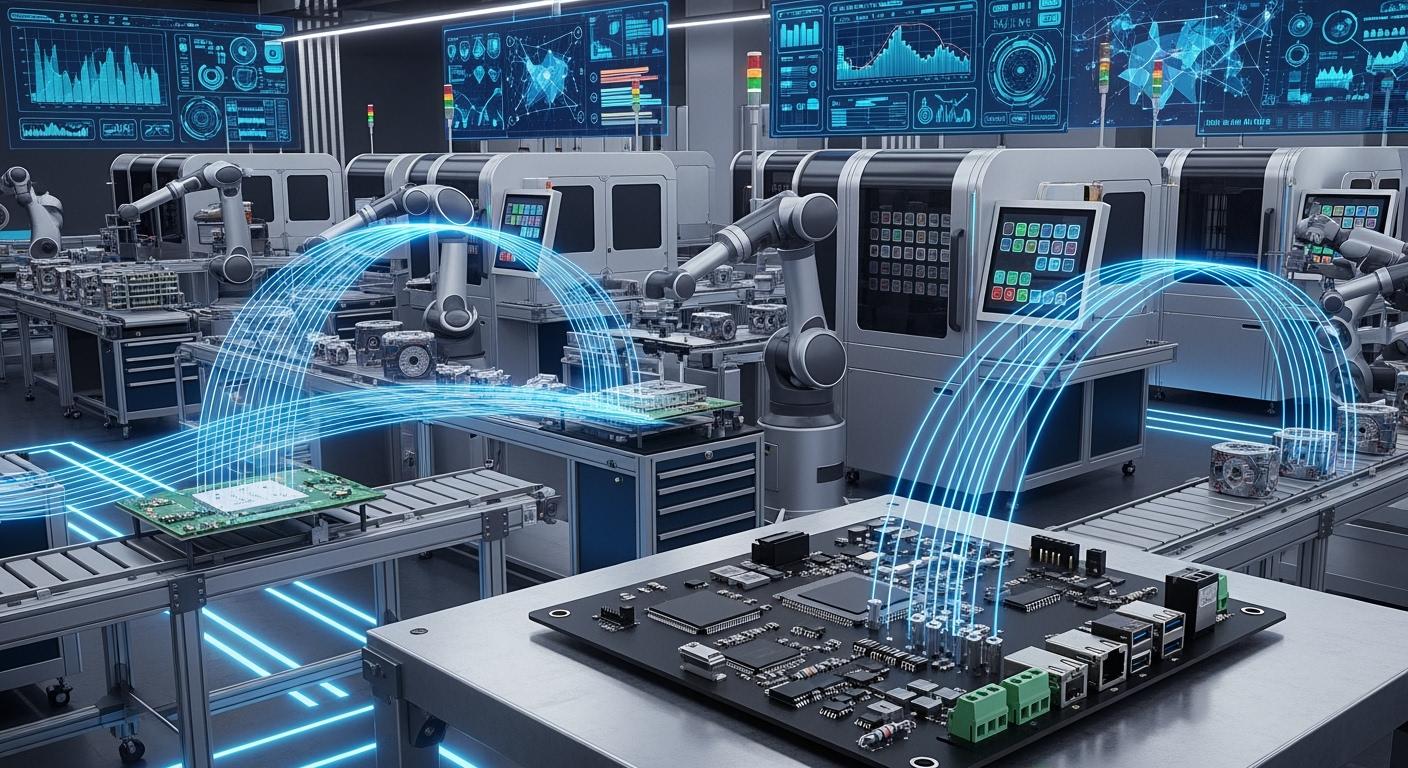
You make your factory’s data move faster and work better when you use an Industrial IoT Gateway PCBA. Sensors, actuators, and communication modules help watch machines in real time and change controls as needed. This setup lets machines talk to each other easily and helps fix problems before they get big. Safe connections need strong hardware, secret codes, and ways to check who is using the system. The money saved and less time fixing machines show big advantages:
Evidence Description | Impact |
|---|---|
Economic impact of IoT applications | $1.2 to $3.7 trillion per year by 2025 |
Reduction in equipment breakdowns | 70% |
Decrease in maintenance costs | 25% |
Reduction in energy costs | Almost 40% |
Key Takeaways
Use an Industrial IoT Gateway PCBA to link machines and sensors. This helps you watch and control things as they happen.
Set up strong security steps like good passwords and updates. This keeps your factory's data safe from harm.
Pick the best communication modules for your factory. This makes sure data moves fast and does not get lost.
Begin with small changes to connect old machines to digital systems. This lets you make slow and steady improvements.
Pay attention to quality checks and testing. This makes sure each PCBA works right from the beginning.
Industrial IoT Gateway Role in Data Flow
Bridging IT and OT Systems
Factories need a good link between OT and IT systems. The Industrial IoT Gateway acts as this bridge. It connects machines and sensors to business software and cloud platforms. This helps you collect, process, and share data fast and safely.
The Industrial IoT Gateway gives your factory many helpful functions:
Protocol translation lets devices talk, even with different languages.
Data management keeps information neat and ready to use.
Device management lets you control and update equipment from one place.
Computation processes data at the edge, so there is less delay.
Communication moves data where it needs to go.
Resource management helps you use equipment and energy well.
Security management keeps your data safe from threats.
Managing quality of service keeps your network working smoothly.
Tip: Bridging IT and OT helps you see real-time data and make faster decisions.
Connecting Field Devices
Factories use many devices like sensors, PLCs, RTUs, meters, and actuators. The Industrial IoT Gateway connects these devices to higher-level systems. This helps you monitor, control, and automate your operations.
Here is how the Industrial IoT Gateway helps your data flow:
Functionality | Description |
|---|---|
Bridge between OT and IT | Industrial IoT gateways let equipment talk to higher-level systems. |
Data acquisition | They collect data from devices like sensors and PLCs. |
Protocol conversion | Gateways change communication protocols so devices work together. |
Edge computing | They process data nearby to cut down on delays and save bandwidth. |
Remote monitoring | Gateways let you check devices from far away. |
Intelligent automation | They help automate processes by connecting with enterprise applications. |
Data transmission | Data goes to MES, ERP, and cloud platforms for analysis and visibility. |
You must keep your data safe as it moves between machines and business systems. Security steps are very important. You can use strong passwords to protect your gateway. Regular updates keep software safe from new threats. Network segmentation controls who can reach different parts of your network.
Security Measure | Description |
|---|---|
Strong Passwords | Needed to protect access to the gateway. |
Regular Updates | Keeps software safe from weaknesses. |
Network Segmentation | Lowers the risk of unwanted access by separating parts of the network. |
Using these security steps keeps your data safe and your factory running well.
PCBA Design for Reliability
RS485 and EMC Protection
Factories need strong protection for data signals. RS485 protection and EMC control help the PCBA handle electrical surges and interference. These features keep energy monitoring systems working all the time. Gas discharge tubes send big surges safely to the ground. Transient voltage suppressor diode arrays stop spikes from getting too high. Polymer resettable fuses limit fault currents when there is too much voltage. Galvanic isolation keeps the processor safe from voltage differences. These methods make the Industrial IoT Gateway stronger and keep data moving well.
Protection Strategy | Description |
|---|---|
Gas Discharge Tubes (GDTs) | Send big surges to the chassis earth at the main terminal. |
TVS Diode Arrays | Stop spikes from going past safe limits for the transceiver. |
PPTC Resettable Fuses | Limit fault currents when there is too much voltage for a long time. |
Galvanic Isolation | Keeps the main processor safe from voltage differences by separating the RS485 transceiver’s digital side. |
Note: Strong RS485 and EMC protection helps your PCBA handle voltage changes and electrical noise in tough places.
Rugged Surface-Mount Technology
Factories need PCBAs that last in tough places. Surface-mount technology (SMT) makes boards strong and durable. SMT parts resist shaking, hits, and wetness better than old parts. You can trust your PCBA to work in hot, cold, and wet areas. Special coatings like acrylic or polyurethane protect against rust and water. Coated boards can last over 60 months, while uncoated ones last only 18 months. Material choices, layout, and protection all help reliability.
Strong PCB design keeps data collection and signals working.
Mechanical strength comes from thick copper layers and good mounting points.
Reliable parts work in many temperatures.
Redundancy and fault tolerance keep the system running if one part breaks.
Every step, from picking materials to testing, helps reliability.
Tip: Use strong SMT and coatings to make your PCBA last longer and work better in factories.
Real-Time Monitoring and Control
Sensor and Actuator Integration
You can make your factory work better by using sensors and actuators. Sensors check things like temperature, pressure, vibration, and energy use. Actuators help machines move, open valves, and change settings. When you connect these devices to your Industrial IoT Gateway, you get quick data and fast actions. You can see problems right away and fix them before they get worse. You can make jobs automatic, cut down mistakes, and keep people safe.
Sensors give information about how machines and the environment are doing.
Actuators change what machines do when they get commands.
You can watch and control machines from one screen.
Automatic alerts help you act fast.
Tip: Use sensors and actuators together to find problems early and keep your factory working well.
Communication Module Connectivity
You need strong communication modules to send data quickly and safely. These modules link your gateway to devices, networks, and the cloud. Each module has special features for different jobs. Wi-Fi 6 lets you send lots of data fast. Zigbee connects many devices in a big network. Cellular IoT uses mobile networks like 2G, 3G, and 4G LTE. NB-IoT works well in places with thick walls. LTE Cat 1 gives good speed and coverage. 5G RedCap is fast and works well for devices that use batteries. LoRaWAN sends data far and works in noisy places. Sigfox can reach up to 40 kilometers with its special signals.
Communication Module | Key Features |
|---|---|
Wi-Fi 6 | Sends lots of data, up to 600 Mbps |
Zigbee | Connects many devices, up to 65,000 nodes |
Cellular IoT | Uses 2G, 3G, 4G LTE, and special IoT networks |
NB-IoT | Works inside buildings, up to 250 kbps |
LTE Cat 1 | Downlink speed is 10 Mbps, uplink is 5 Mbps |
5G RedCap | Saves money, is fast, good for battery devices |
LoRaWAN | Sends data up to 15km, works in noisy places |
Sigfox | Special signals, sends data up to 40km |
You pick the module that fits your factory best. Fast Wi-Fi is good for lots of data. LoRaWAN and Sigfox are good for faraway places. Zigbee is good for big networks with many devices. Good connections help you watch and control your factory in real time.
Note: Choose communication modules that fit your factory and data needs to get the best results.
Manufacturing and Assembly Considerations
Professional PCB Board Production
You need a good company to make your PCB board for the Industrial IoT Gateway PCBA. Professional companies do everything from design to putting the board together. This saves you time and money. Startups and OEMs can order only what they need. This means you do not waste money or hurt your reputation.
Advantage | Description |
|---|---|
Fast Turnaround Times | You get prototypes and finished boards quickly, so your project stays on track. |
End-to-End Development Services | Every step, from drawing plans to making the final board, is done for you. |
Manufacturing Advantages | Making boards in one place helps control quality and cost, so boards work better. |
Long-Term Value Programs | You get help and discounts for your product for a long time. |
Tip: Pick a company that lets you test a few boards first. This helps you find and fix problems before making lots of boards.
Quality Assurance and Testing
You want every PCBA to work right the first time. Good design keeps signals clear and stops noise. Companies pick parts that work well and fit together. They check boards by looking at them, using machines, and even X-rays to find problems early.
Making a few boards first lets you test if they work.
Checks make sure each board works before making more.
Good process control keeps boards the same every time.
Special tests check how the board works and gives power.
Watching boards during making helps catch problems fast.
Step | Description |
|---|---|
Transition to Pilot Run | Make sure the way you build boards works, not just the board itself. |
Identify Issues | Fix problems like too much solder or parts not fitting right. |
Establish Profiles | Set oven heat and machine checks to make boards right. |
Achieve Stable Yields | Make sure you get good boards every time before making a lot. |
Transition to Mass Prod. | Spread out costs and use machines to check boards for quality. |
Note: A strong quality system makes sure your Industrial IoT Gateway PCBA works well every time.
Integration with Factory Equipment
Legacy System Compatibility
It can be hard to connect new Industrial IoT Gateway PCBA to old machines. Many old systems use special or old ways to talk. Some machines do not send digital data at all. Sometimes, there is not much information about how the machines work. Safety rules can also make things tricky. These problems can slow down your upgrade.
Challenges | Solutions |
|---|---|
Proprietary or obsolete communication protocols | Use edge gateways for protocol translation. |
No digital output at all | Add sensors to legacy equipment to create digital interfaces. |
Safety and timing constraints | Ensure integration does not interfere with real-time control loops. |
Limited documentation | Employ a methodical approach to overcome documentation challenges. |
Neglecting cybersecurity | Implement proper network segmentation and use encrypted protocols. |
You can fix these problems with the right gateway. Industrial gateways can use many ways to talk to machines. This means you can connect almost any machine. You can put sensors on old machines to get digital signals. If you do not have much info, work step by step. Always keep your network safe with special protections.
Industrial gateways need to work in tough places. Dust, water, and chemicals can hurt electronics. A special coating on the PCBA keeps your gateway safe for a long time. You also need strong security, like a trusted platform module, to keep your data safe.
Works with many protocols
Handles hot and cold places
Has strong I/O isolation
Tip: Pick gateways with these features to make connecting old machines easy and safe.
Modern Automation Support
You want your factory to use the newest automation. Modern Industrial IoT Gateway PCBA helps you connect robots, smart sensors, and cloud systems. The gateway can change device languages so everything works together. This helps your data move smoothly.
Challenge | Description |
|---|---|
Protocol Fragmentation | Different devices on a production line often use various communication protocols, leading to integration difficulties. This lack of interoperability is a major technical challenge in IIoT data acquisition. |
Data Quality | Poor data quality can lead to ineffective decision-making, as the principle of 'Garbage In, Garbage Out' applies. Ensuring high-quality data is essential for successful integration and operation of smart factories. |
You need good data to make smart choices. The gateway helps you get clean, reliable data from all machines. You can use this data to watch machines, fix problems early, and save energy. Modern gateways let you see your factory data from anywhere.
Connects old and new machines
Makes automation better
Lets you watch and control from far away
Note: A strong gateway lets you upgrade your factory slowly, so you do not need to buy all new machines.
Future Trends and Recommendations
Evolving Standards
New standards are changing how you design Industrial IoT Gateway PCBA. These rules help you build safer and smarter systems. You must follow rules from groups like ISO, IEC, UL, ASME, MIL-PRF, MIL-STD, and IPC. ISA/IEC 62443 gives advice for keeping your factory safe from cyber threats. Standards make sure your gateway works well and stays protected.
You also see new ways to design PCBAs. The table below shows some big trends:
Design Strategy | Description |
|---|---|
High-Density Interconnect (HDI) | Lets you put more parts close together for better function in smaller boards. |
Flexible and Rigid-Flex Integration | Mixes bendable and stiff parts for creative layouts and longer life. |
Signal Integrity | Keeps signals clear and strong, which is important for 5G devices. |
Thermal Management | Uses new ways to handle heat in powerful IoT nodes. |
5G technology is changing how you design PCBs. You need tighter measurements and better materials to move data faster. These changes help you fit more devices and support edge computing in your factory.
Adoption Strategies
You can make your factory smarter by connecting old machines to digital systems. You add wireless sensors and communication modules to your equipment. You use cloud or local systems to manage your data. These steps help you see how machines are doing and predict when they need fixing.
You need gateways that work with many protocols and can use several radios at once. You use software tools to build and manage apps quickly. Features like gateway management, user management, and real-time logging help you control your system and keep it running well.
Connect machines to digital systems.
Add wireless sensors and communication modules.
Use cloud or local platforms for data management.
Get real-time visibility and predict maintenance needs.
Pick gateways with multi-protocol support and strong software tools.
Tip: Start with small upgrades and test them. You can grow bigger as you see results and feel confident.
You get lots of benefits when you use Industrial IoT Gateway PCBA in your smart factory. Good manufacturing and strong design make your machines last longer and work better. You can connect old machines and new machines easily.
You can make machine maintenance automatic
You can see where your equipment is at all times
You can lower risks
You can make workers safer
You can change from just fixing machines to knowing when they need fixing
You can make your factory better for the environment
You can keep track of your inventory better
Begin with small changes. Try out your systems. Make your factory better one step at a time.
FAQ
What is an Industrial IoT Gateway PCBA?
An Industrial IoT Gateway PCBA helps connect sensors, machines, and software in a factory. This board gathers data, works with it, and sends it out. It helps you watch and control machines right away.
How does the gateway improve factory security?
You get safer systems by using strong passwords and updating software often. Network segmentation also helps protect your data from hackers. These steps keep your factory safe.
Can you connect old machines to the gateway?
Yes, you can connect old machines. The gateway works with many protocols and lets you add sensors to older machines. This means you can watch almost any machine, even if it is old.
What communication options do you have?
You can pick Wi-Fi, Zigbee, Cellular IoT, NB-IoT, LTE Cat 1, 5G RedCap, LoRaWAN, or Sigfox. Each one is good for different speeds, distances, and how well it works.
See Also
Exploring The Role Of Industrial Serial Screen PCBAs Today
Maximizing Business Efficiency Through PCBA Contract Manufacturing
Essential Tips For Designing Industrial Controller Printed Circuit Boards
Improving PCB Manufacturing Efficiency With EMS Company Solutions
DIP PCBA Manufacturing: Process, Quality Assurance, And Applications
