Functional Testing vs In-Circuit Testing ICT Which Is Right for Your Product
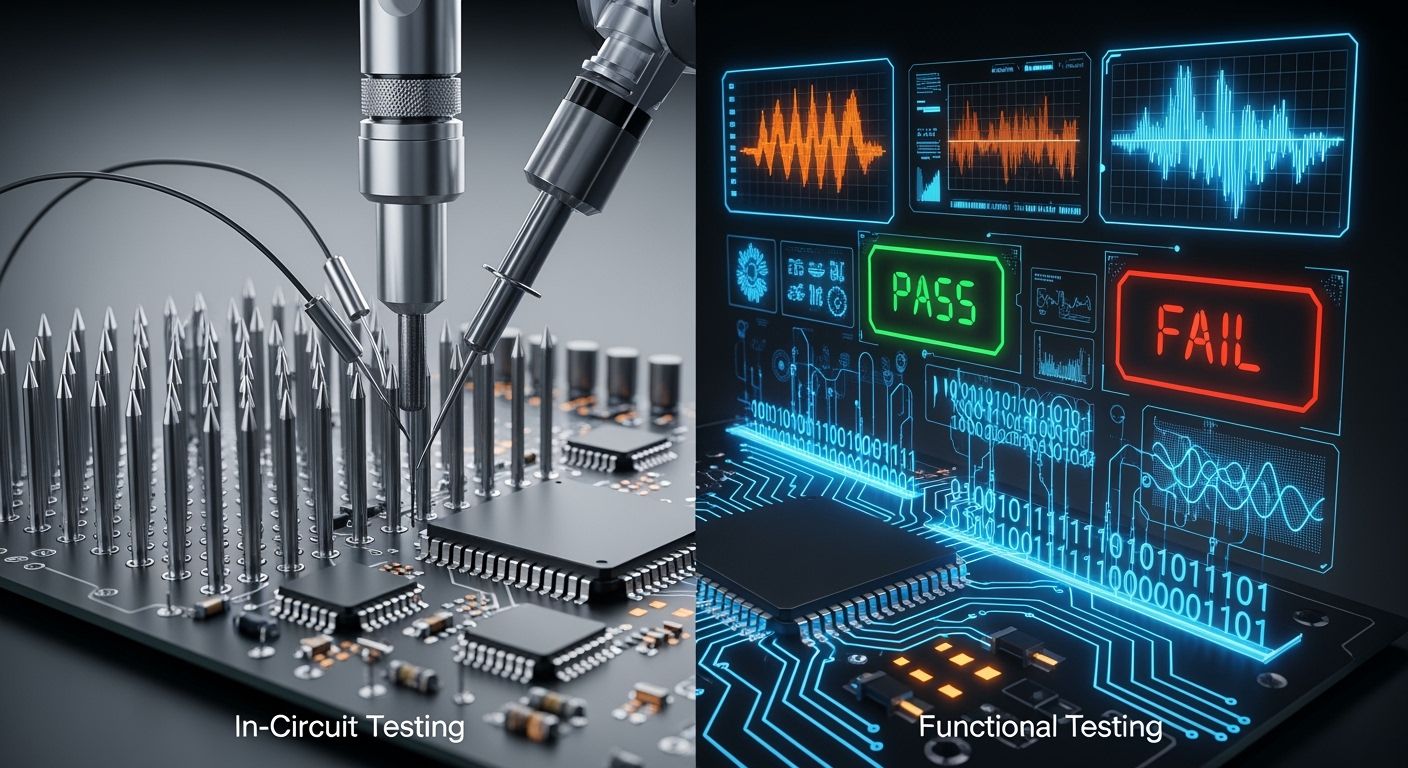
Picking the best test method for making electronics controls your final product quality. You need to balance fast speeds, total costs, and finding mistakes early. In-circuit testing finds broken parts right away on crowded circuit boards. Meanwhile, functional testing checks that the entire board works correctly under full power.
Parameter | ICT | FCT | Both |
|---|---|---|---|
Production Volume | High | Low-Medium | High |
Budget Constraints | High setup cost | Low setup cost | Highest investment |
Circuit Density | High density | Flexible | High complexity |
Risk Tolerance | Low assembly risk | Low operational risk | Zero defect goal |
Picking ict vs fct directly shapes your long-term business profits. Using a functional test along with ICT and FCT guarantees complete performance for your main product.
Key Takeaways
In-circuit testing finds broken parts quickly on high-volume production lines.
Functional testing checks how a whole product works using real electrical power.
Use both testing methods together to find every problem and improve overall product quality.
Pick functional testing for small projects to keep your starting costs low.
Use in-circuit testing on crowded circuit boards to stop short circuits from causing damage.
What Is In-Circuit Testing (ICT)
How In-Circuit Testing Works
In-circuit testing checks each part on a filled circuit board one at a time. First, you place the built board on a bed-of-nails fixture. This solid plate uses springy metal pins to touch exact test points across the board. The tool connects your board to measuring devices, signal tools, and switches in the main test head.
yield = good units / total units x 100
System software runs an automated test using tiny electric signals. The ict system isolates each part on the board with special guarding tricks. These switching paths keep other electric currents from messing up your numbers. You measure values for connections, resistance, capacitance, and inductance without removing any parts. Big factories rely on this setup for fast work. Fixture systems hold about 55% of the market because they test boards very quickly.
How ICT Detects Assembly Defects
An ict test finds build errors fast before you turn on main power to the board. Test probes look for physical connection errors from automatic soldering tools. You spot dangerous solder shorts and broken paths right away. The machine also checks if pick-and-place robots put down wrong parts or flipped them backward.
Early fault detection using an in-circuit test protects sensitive components from catastrophic damage caused by short circuits.
The testing machine checks target parts against normal limit numbers. The ict software flags problems fast when missing parts or backward diodes change the signal. This focused fixing power gives electronic makers a huge boost. Consumer gear uses 34% of all ict testing because big factory lines need low error rates. You see exact error spots down to a single pin or wire junction. This fast feedback helps your team fix bugs quickly and keep production moving fast.
What Is Functional Testing (FCT)
FCT and Operational Validation
You use functional testing to confirm total product operation before shipping. A functional circuit test powers up the built board. This fct evaluates complete system performance under real operational conditions. Specialized in-circuit tools verify individual components. Meanwhile, a functional test checks actual hardware responses and programmed firmware actions. An fct setup guarantees precise output values.
Functional testing catches critical hardware defects that static electrical checks miss entirely. You compare outputs against target specs during full operation.
Functional Failure Category | Example Missed by In-Circuit Testing (ICT) |
|---|---|
Logic Errors & Software Faults | Microcontroller failing to execute firmware. |
Timing Issues | Clock timing problem causing boot failure. |
Latent Defects under Stress | Calibration errors in dynamic operation. |
Functional Test Implementation
You execute a structured testing process to validate every board feature. Your engineering team builds a custom fct test bench to simulate real environmental conditions. You attach power sources, signal generators, and load fixtures directly to external connectors. This fct delivers precise electrical signals. Next, automated software records board outputs. A standalone test measures electric currents under full workload. An fct test verifies voltage stability across operating circuits.
Engineers establish a primary functional test routine to evaluate operational reliability.
Example of creating test scenarios for a payment module: the test scenarios may include multiple currencies, handling invalid or expired card numbers, and generating a notification on successful transaction completion.
Detailed testing verifies every user feature. You run functional testing across key workflows to prevent dynamic failures. Every functional test validates expected system responses. Executing a secondary functional test eliminates undetected operational errors. Moreover, regular functional testing catches firmware bugs, timing glitches, and signal crosstalk before shipping. An advanced fct test helps protect your main product line from expensive field failures. Broad functional testing delivers proven quality across production lines. Deploying a unified fct strategy ensures long-term operational success. This fct methodology gives your business complete quality control. A final functional test confirms complete readiness.
ICT vs FCT Comparison
Cost and Diagnostic Differences
Choosing between in-circuit testing and functional testing requires studying upfront costs carefully. An ict setup uses special bed-of-nails fixtures with precise code routines. Setting up a standard fct station runs from $5,000 to $15,000, and custom fct tools cost $2,000 to $10,000.
Testing Method | Fixture Development Cost | Programming Cost | Total Typical Setup Cost Range |
|---|---|---|---|
In-Circuit Testing (ICT) | $10,000 - $20,000 per unique PCB design | $1,000 - $3,000 | $11,000 - $23,000+ |
Diagnostic features display clear differences in how deeply they analyze boards. An in-circuit test separates individual parts to find precise building mistakes. This ict method identifies short circuits, bad resistors, or crooked pins right away. In contrast, a functional circuit test checks full board operation under power. A functional test evaluates output signals across entire circuits. Still, a normal fct test cannot tell you which specific component broke. Using both test options together provides complete defect detection across factory lines.
Volume and Speed Trade-Offs
How fast you test each unit shapes your total factory output. An ict test run finishes in roughly 1 minute per circuit board. Fast times let ict tools check hundreds or thousands of units every hour on multi-lane setups. Running an ict check finds missing parts very quickly. A standard fct test runs slower because its software executes full operational code. Each functional test checks overall performance right before you ship products.
Longer testing times compared to ICT.
Manufacturing volume guides your final choice when comparing ict versus fct options. Large manufacturing runs make high upfront ict costs worthwhile because per-unit testing expenses drop fast. Big factories depend on functional testing after completing basic component checks. Smaller manufacturing lines benefit from flexible functional testing equipment. Low-volume builders run functional test tools to keep starting expenses low. An fct test offers cheap entry costs for small manufacturing batches. Weighing ict vs fct options helps your team select ideal testing routines. Running a functional test checks true operation across advanced designs. Selecting an fct test protects your equipment investment. Reviewing ict vs fct details ensures strong quality for every product line.
Hybrid Strategy: Combining ICT and FCT
Sequential Quality Gates
You can use a hybrid testing method to boost product quality on your lines. Running an ict test first lets you check physical build errors without powering up the board. This initial test finds basic hardware problems right away. You spot open paths and solder shorts early.
yield = good units / total units x 100
This unpowered ict step shields delicate parts from major damage. Sending full power to a shorted board instantly burns out costly chips. Running an fct test after ict keeps power applications safe. The secondary fct test then applies normal working voltages to check true board performance.
Test Stage | Primary Focus | Defects Caught | Role in Reducing Field Failures |
|---|---|---|---|
ICT (In-Circuit Test) | Structural integrity of components and solder joints. | Shorts, opens, wrong/missing components. | Acts as an early filter, removing gross manufacturing defects before functional validation. |
FCT (Functional Testing) | Actual board performance under real-world operating conditions. | Incorrect component values, firmware errors, logic/communication faults, intermittent failures. | Catches complex, system-level issues missed by ICT, preventing defective units from being shipped. |
Sequential Use (ICT then FCT) | Comprehensive validation from structure to function. | The full spectrum: from basic soldering faults to operational failures. | ICT provides a quality baseline; FCT validates final performance. This layered approach drastically lowers the chance of latent defects reaching the customer. |
Maximizing First-Pass Yield
Combining both methods increases your total first-pass yield across factory runs. Your initial ict pass catches big physical faults fast. Then, your functional test checks complete software code, signal timing, and wireless features under live conditions.
By identifying defects that impact real-world performance, FCT greatly reduces the chance of shipping a defective product. [...] FCT catches issues other tests miss, such as incorrect component values, firmware errors, and intermittent faults, making it an indispensable complement to structural tests like ICT.
This double-check plan offers vital error detection for high-reliability gear. Review these practical cases:
Automotive Safety Systems: Sequential testing (ICT followed by FCT) for airbag controllers led to a 32% reduction in field returns. FCT caught intermittent faults related to signal response and communication that ICT alone missed.
Medical Devices: For handheld diagnostic tools, FCT applied after ICT identified 2% of units that passed structural checks but failed under real-use conditions (e.g., analog front-end or Bluetooth communication), preventing their shipment.
Using functional testing with ict shields your brand reputation. A extra functional test catches hidden logic bugs that pass simple build checks. This combined strategy improves your first-pass yield and stops expensive field returns.
Choosing the Right Test Strategy
Product Lifecycle Selection
Your product stage dictates the best testing setup during hardware development. Early prototypes require quick flexibility because design changes happen often. Custom fixture development takes extra effort and creates long turnaround times. Therefore, functional testing works best during small initial production runs. You validate total board operations without spending money on expensive custom fixtures.
As your electronic product scales into mass production, quality risks grow rapidly. High-volume manufacturing demands automated speed and instant structural defect checks. In-circuit testing screens early physical assembly errors like short circuits before power application. Adding this structural check guarantees high-quality products across every single production run. You protect your brand quality while lowering long-term repair costs.
Engineering Decision Framework
Selecting an effective manufacturing test strategy requires evaluating key technical constraints. You must align your production volume with your financial resources. Every engineering team must evaluate three core technical factors:
Budget: The total cost of the testing method includes upfront setup and maintenance expenses. Custom hardware fixtures raise initial investments, but they lower individual unit inspection costs over long production runs.
Circuit Density: High-density board designs often lack physical access points for physical probes. Compact layouts may require specialized software routines or boundary scan tools to check connections.
Time-to-Market: Production deadlines drive testing decisions. Long setup times for custom in-circuit testing fixtures delay product launches. Flying probe setups or flexible functional test stations offer much faster initial setup times for fast-paced projects.
Your final test choice directly balances structural fault isolation against total validation speed. A dedicated ict test isolates component-level faults quickly. Meanwhile, an fct check verifies complete system performance under full operational power. Comparing ict vs fct capabilities helps you design an optimal quality plan. Combining in-circuit testing with functional test gates delivers comprehensive coverage. You keep total expenses low while shipping reliable hardware.
Picking the right testing approach requires looking at your production volume, board complexity, and total budget. You use ict to check physical build quality early without turning on main power. This initial test step isolates specific component defects quickly. Conversely, fct acts as your final performance check. This method checks true operational behavior under full power before shipping products.
Engineering leads must review tool costs before growing manufacturing. High-volume runs justify custom ict tool expenses through quick unit inspection times. Low-volume or changing designs benefit from lower upfront fct setup costs. Choosing the best strategy protects your product quality and improves overall manufacturing expenses.
FAQ
Which test method should you choose for low-volume production?
Pick functional testing for small manufacturing runs. This equipment demands smaller starting fees than in-circuit testing setups. Making this pick keeps early costs down while checking total product performance before shipping items.
How fast does in-circuit testing check a single board?
An in-circuit test completes in about 1 minute for each board. Quick cycle times allow you to inspect hundreds of pieces every hour. That rapid pace renders in-circuit testing perfect for big factory lines.
Can functional testing pinpoint broken components?
No, a typical functional test checks output signals across entire circuit paths. It validates overall system behavior while running on power. Yet, it fails to name the exact part that broke on your board.
How much does setting up functional testing cost?
Building a basic functional test bench costs between $5,000 and $15,000. Custom gear expenses range from $2,000 to $10,000. These lower upfront investments assist tech teams with small budgets to release new products smoothly.
See Also
The Essential Reasons PCBA Products Require Comprehensive Aging Tests
How End To End PCBA Services Streamline Electronics Production
Why Automated Optical Inspection Is Vital For Superior Circuit Quality
Five Advanced Testing Methods Used In Professional Hole Assembly Services
How Modern X Ray Inspection Improves Circuit Board Quality Control
